Some 6,000 years ago, a Mesolithic man fished and foraged among the dry hills and thick forests of Sejero, a small island off the coast of Denmark. The island hosted few land animals, but the surrounding sea teemed with diverse and nutritious marine life that made up the bulk of his early diet.
Then the Neolithic farmers arrived.
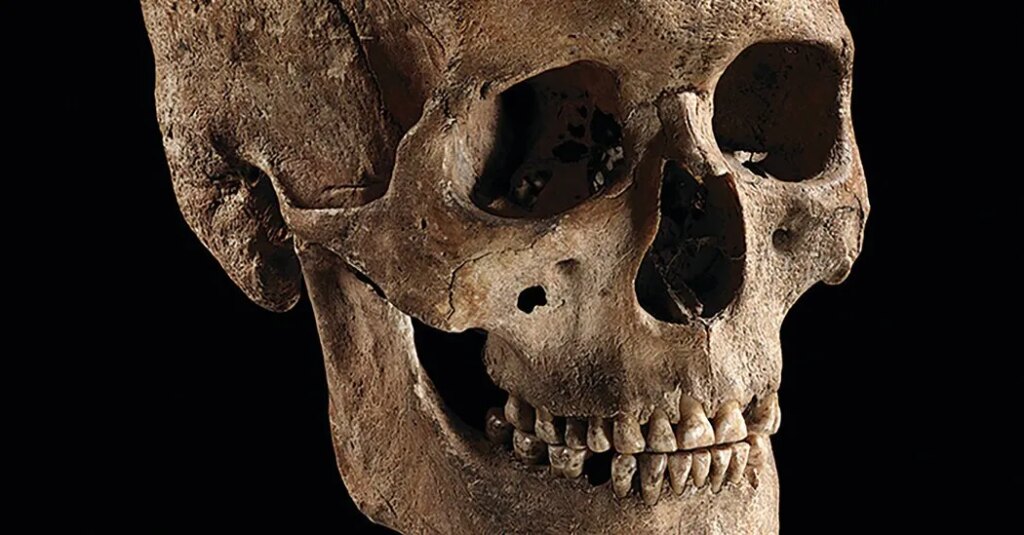
The skeleton of the ancient islander, nicknamed “Rodhals Man,” bears telltale chemical clues that his diet changed as he aged; he ate mostly local marine life as a youth but started dining on significant amounts of land-based plants and animals as an adolescent.
Based on this change and the time period in which he lived, scientists who studied the body concluded that Rodhals Man was an eyewitness to one of the biggest shifts in human history: the Neolithic revolution, when people made the widespread transition from foraging to farming. The paper was published in the journal Antiquity on Nov. 16.
“Where did the earliest farmers of Europe come from?” said Anders Fischer, an archaeologist at the University of Gothenburg in Sweden who led the study. “How did people experience these dramatic changes? We’re starting to tell a new story.”
Originally found by modern residents of the island, Rodhals Man had been buried in a shell midden, a deposit of discarded mollusk shells and other archaeological waste. Ole Klindt-Jensen, an archaeologist sent by the Danish National Museum, excavated the body in 1956, recording and salvaging the remains despite pouring rain. The nearly complete skeleton has since been housed in the museum’s collection.
For the new study, Fischer and his team examined data from various methods, including genetic analysis and radiocarbon dating, to flesh out the man’s life story.
The Neolithic Revolution began roughly 12,000 years ago in the Middle East’s Fertile Crescent, a region where wild wheat and barley started to grow as Earth entered a warmer period. Some groups of humans gave up their nomadic lifestyles of hunting and gathering and began cultivating plants and domesticating animals. This practice would soon spread across the world, landing in Europe a few thousand years later.
Fischer’s team showed that Rodhals Man not only belonged to this period of transition but was one of the few individuals known to have experienced the dietary shift in real time. An individual found in a Danish bog and nicknamed “Vittrup Man” also lived during this time, but he left his coastal community and traveled across Denmark to live among inland farmers.
Rodhals Man was between 30 and 40 years old when he died. His bones indicate he was in relatively good health and had a nutritious diet growing up.
Radiocarbon dating showed that Rodhals Man lived long after the first farmers arrived in the region. But DNA analysis showed that his ancestry is entirely Western hunter-gatherer, with no traces of genes from Neolithic farmers.
The researchers also analyzed the skeleton’s teeth by looking at thin slices of dentin, or the calcified yellow-brown tissue that forms the main bulk of a tooth.
In archaeological research, teeth are especially useful as time capsules because the enamel that covers dentin does not change chemically once it forms during childhood, locking away a permanent record of what an individual ate during their early life. Scientists can also look at the chemistry of collagen in teeth and bones to figure out what a person ate as an adult.
In this way, the body “fossilizes behavior,” said John Meadows, an archaeologist at the Leibniz Center for Archaeology in Germany who is a co-author of the study.
The dentin samples from Rodhals Man showed that his diet consisted of fish when he was a young man but shifted to include terrestrial plants and animals, most likely cultivated grains and domesticated livestock, later in life.
He took a jump from “one world to another,” Dr. Fischer said.
Even in death, Rodhals Man may have been influenced by farmers. The skeleton was found on its back with arms stretched along the body, legs extended and skull facing to the west. Two large stones framed his body in an “obvious grave,” the authors said in the paper. This burial style shares more similarities to those of early Neolithic farmers than the funerary practices of late Mesolithic hunter-gatherers, the scientists said.
The discoveries can help archaeologists answer unsettled debates about the agricultural transition. For example, were hunter-gatherers forced to adopt farming because nomadic lifestyles were no longer sustainable, or did farming spread because certain environments were good for growing crops, which made nutrition more readily available?
Understanding this dynamic is crucial to unlocking the secrets of human history, said Rowan McLaughlin, an archaeologist and data scientist at the University of York in England who was not involved in the study. “There’s a remarkable insight that ancient genomics have been able to give us,” he said.
“We want to bring out what it was like, at an individual or societal level, to go through a transition like this,” Dr. Meadows said. “We can’t do that with one person, of course. But we’re trying to add a lot more nuance to these big-picture stories.”
The post This Danish Man Was a Rare Witness to the Agricultural Revolution appeared first on New York Times.