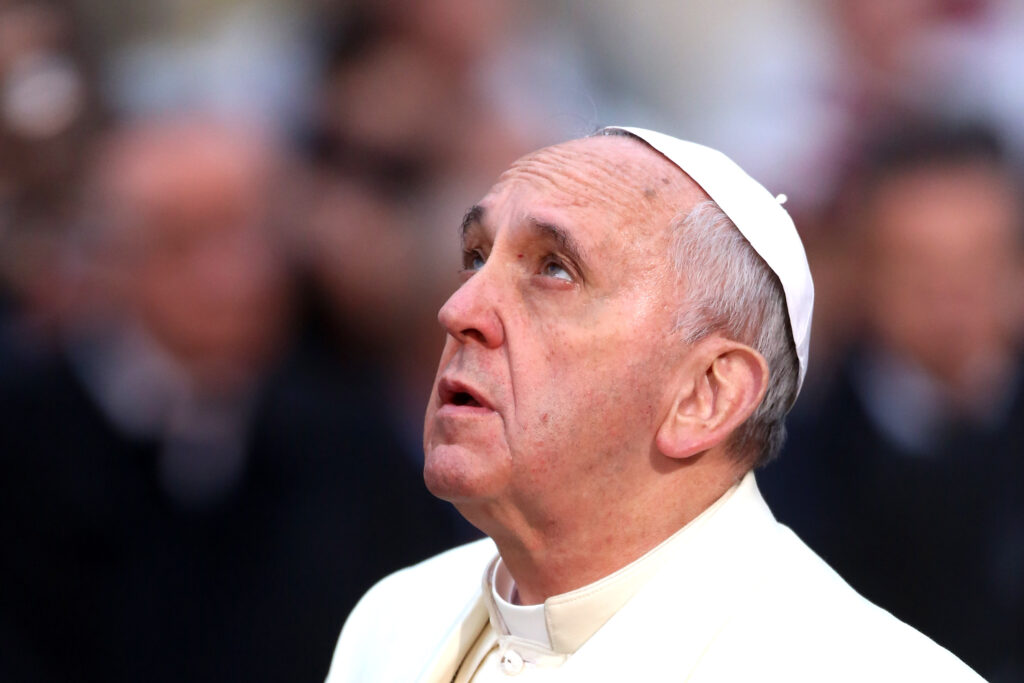
VATICAN CITY — To the world, he was the unconventional pope, a charismatic leader with a dry wit who challenged tradition and preached inclusion. But in the dark bower of his mind, hidden from public view, Pope Francis was tormented — by death, the Devil and his own power.
The release on Tuesday of a new book containing passages from the pope’s personal diary paints a portrait of a devout man plagued by remarkable inner turmoil, including an existential crisis in which Francis believed it might be better for God to take his life “so I don’t continue causing harm.”
The first Latin American pope had vivid visions of encounters with the Devil at least three times, so visceral that the Devil revealed himself by his “seductive eyes” and “eyes of fire.” Later in Francis’s papacy, as his health failed, he entered a two-year period of bleak emotional darkness, consumed by “withdrawal and worldliness” and what he described as “assaults” by “the forces of evil.”
“Last night I saw the entrance to hell,” Francis wrote in 2018, according to the new book, in which the diary entries are curated and contextualized by Cardinal Víctor Manuel Fernández, a senior Vatican official and longtime Francis confidant.
“Pagan seduction in full force,” Francis wrote. “I peeked in to look a little, and it terrified me. It was before going to sleep. I grabbed the Rosary as a weapon. … This isn’t the first time in my life I’ve had this experience, but this time the intensity was voracious.”
In a final entry in 2024, he recounted his tiring battles with the Devil, begging “the Virgin to protect and help me.”
Francis’s struggle with demons both inner and supernatural is the biggest revelation in “The Private Diary of Pope Francis,” which draws on a journal the pope kept from 1992 to 2024, the year before his death.
The book, being published in five languages and 94 countries, presents a pope who was afflicted with more turmoil than those around him ever fully understood.
“He had shared many private thoughts with me regarding his pastoral, political or theological views — hiding nothing — but regarding his spirituality and his inner life, he had said nothing,” said Fernández, head of the Vatican’s powerful Dicastery for the Doctrine of the Faith, in an exclusive interview. He described Francis’s diary as containing “surprising experiences, concerns he never expressed, fears, moments of exhaustion — things he never spoke about.”
A secret diary
The “diary” the book is based on is a black-bound planner from 1992, the year Francis began entries. Measuring 8.7 by 5.9 inches, the journal was among the highly personal items Francis requested be sent to Vatican City from Buenos Aires after his ascension to the Throne of St. Peter in March 2013; not expecting to assume the role, he had not traveled prepared. It contains 86 pages of notes from before his papacy, as well as 55 pages of entries during his time as pope.
Several people who worked closely with Francis were aware he kept the notebook, Fernández said. But they assumed it contained only “practical matters.”
That would begin to change when Fernández went to Casa Santa Marta — the boardinghouse behind a gas station in Vatican City where Francis, an austere Jesuit, chose to live — while the pope was ailing in 2025. He was there to discuss a protocol should Francis “irreversibly lose consciousness.”
“At one point, he decided he didn’t want to talk about that anymore and instead showed me his diary and other books he cherished,” Fernández told The Washington Post. “He mentioned that some of it might be published in the future, provided it could do some good for people — ‘to edify’ was the exact word he used.”
After Francis’s death, Fernández informed the new pope — Leo XIV — of the journal’s existence and Francis’s wishes.
Leo “took an interest, had a search conducted and sent everything to me in a cardboard box,” Fernández said. “He sent it so that I could undertake the editorial work and provide commentary to help clarify the context of the writings — since there are certain things that, without specific background information, would undoubtedly be impossible to interpret.”
A rare kind of papal diary
Papal diaries often contain intimate spiritual reflections. John Paul II instructed that his journal be burned, but the notebook with writings on his interior faith and self-analysis was nevertheless preserved and published due to its historic value. John XXIII’s diary famously contained his controversial assessment that while the fascist dictator Benito Mussolini had “committed errors,” he had also brought “great benefits” to Italy.
Yet the diary of Francis — published in partnership with Libreria Editrice Vaticana, the Holy See’s publishing house — at times appears to veer into a study of a pope who clung to faith like a life raft and may lead some observers to reevaluate what they thought they knew of Francis. Fernández said it is being published under the belief that the faithful can and should have a fuller understanding of a pontiff who, during his tenure, was embraced by liberals but derided by some archconservatives as a heretic.
“While [some verses] may come as a surprise or even be unsettling, I believe it is worse for certain groups to continue claiming that he was an unscrupulous or superficial man, or a cold, clinical figure devoid of faith,” Fernández said, adding that even he had to overcome some “hesitation” before pressing for its publication.
Secret codes
Francis wrote portions of his diary using a kind of code, making some parts hard or impossible to decipher. Fernández said he opted to exclude “a few paragraphs” that dealt with “living individuals,” saying he believed it would lead readers to “pass judgment on those people.”
“That said, I must clarify that he never complains about famous figures with whom he may have had disagreements — such as Trump, other politicians or public figures,” Fernández said. “Rather, everything relates to matters that, in some way, touched him deeply and on a very personal, internal level.”
Some hot button issues are not addressed in the book, including why Francis never returned to his native Argentina after his selection as pontiff, or reflections on the uproar that confronted the pope in conservative sectors of the Catholic Church after his approval of short blessings for some same-sex couples in 2023.
Fernández said that the diary contained no specific thoughts on the same-sex couples ruling, but he notes in the book that Francis “suffered deeply at the pain of those whom society ostracizes — migrants, public sinners, poor women, homosexuals (particularly those who live in homophobic regions), the unemployed (in those places where efficiency is worshipped), people who have made mistakes — or simply those on the margins who are devalued or deprived of their rights.”
Existential crisis
In the late 1990s, just months after his appointment as archbishop of Buenos Aires, the cleric born Jorge Bergoglio reflected on his own “shortcomings and failures,” offering his own “life to the Lord” and believing it might be “better so I don’t continue causing harm.”
A year later, he again wrote that God should “take me away so as to stop causing harm.” In 2009, four years before becoming pope, dark thoughts still haunted the soon-to-be pontiff. He mused again about how he had “offered” his own life if God desired to take it.
The triggers for these dark feelings were varied — the first Mass of a newly ordained priest, conversations with people who appeared to adore the late pope and in whom they had expressed “hope,” causing Francis to feel somehow unworthy.
In the decades preceding his death, Francis was frequently dogged by right-wing critics. In 2011, he appeared to despair over his age, ill-health and an increasing barrage of online attacks “from the far right.”
“I, with this silence that surrounds me and is penetrating me, continue asking the Lord to have mercy on me and on the diocese. That before being a scandal, he send me death. And that he send a good successor,” Francis wrote.
The backing of those around him appeared to overcome Francis, who often seemed to believe himself inadequate of ministry or susceptible to the sin of pride.
The extent of Francis’s self-admonishment, as set out in the text, dissipated after he became pope, but he still found himself struggling to come to grips with his own power — with Fernández describing 2021 and 2022 as “perhaps his worst period of temptation.”
In 2022, Francis wrote disparagingly of himself as “the proud, self-sufficient, cynical, self-deceptive Jorge.”
“This didn’t happen just once as a specific crisis. Rather, it occurred frequently,” said Fernández, who, like Francis, is Argentine-born and had a friendship with the pope that dated back decades. “It was a feeling that at times tormented him. That he was not up to the task of his mission.”
Fernández referenced conversations he had with the pope, in which the cardinal questioned Francis about his decision to keep on an unnamed official in the powerful bureaucracy of Vatican City who was working against Francis. The pope would respond that God did not want him to become a “puppeteer.”
Francis and the devil
Few details are more dramatic than those in Francis’s descriptions of his encounters with the Devil. He claimed to have seen his “menacing and, at the same time, seductive eyes” at least “three times,” including once “outside a car window.” He would write again of visualizing Satan’s “eyes of fire” during a celebration in a chapel, compelling the pope into a personal tug of war between his curiosity of the unholy and God’s righteousness, winning his battle only after he grasped a rosary and prayed to the Virgin Mary.
His visions were sometimes precipitated by jarring events, including Francis’s 2018 trip to Chile, when he was questioned by journalists aboard a papal flight for defending a bishop accused of covering up sexual abuse, despite a preponderance of evidence. Francis would later realize he had been misled and apologize— but in his diary, he also seemed to see Satan’s hand.
“A few days after returning to Rome, I was in a meeting. I saw [the Devil] and heard his voice, triumphant, possessing everything: ‘Now I’ve gotten everything I wanted.’ Just as I can’t forget his eyes from the previous two, in this case, I can’t forget the powerful raspiness of his voice,” Francis wrote.
Francis was known to describe the Devil in literal terms, dwelling more on Satan in sermons than some of his predecessors and once laying hands on a man in a wheelchair who claimed to be possessed by demons in what many saw as an impromptu act of cleansing.
Yet Francis’s writings that he had direct interaction with the Devil is likely to surprise some observers — particularly as Francis appeared to feel Satan’s pull in his illnesses and internal struggles.
His final entry suggests a certain exhaustion following his battles.
“The last thing he wrote in the diary concerns the times he saw the Devil — as if expressing a fear that it might happen again — which is why he concludes by asking the Virgin Mary to watch over him,” Fernández said.
“At the same time, however, he presents these lines as a reflection on his entire life. I interpret this to mean that he had made a conscious decision to stop writing — to bring the diary to an end,” he added. “For decades, he had often felt that his life was coming to a close and that he would die soon. I believe that on the day he finished the diary, he was certain that, this time, it would actually come to pass.”
The post The temptation of Pope Francis: Private diary reveals torment, visions of Devil appeared first on Washington Post.