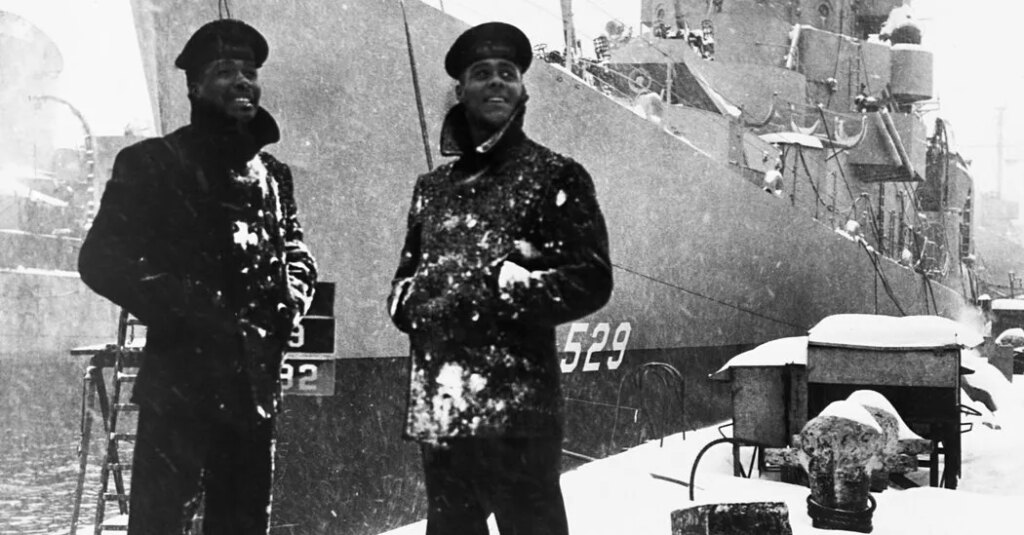
The United States Navy is about to throw its most signature garment overboard.
A naval administrative message issued earlier this month announced that after more than a century, the double-breasted, hip-length wool peacoat that is synonymous with the romance of the sea, would be replaced by the “synthetic black cold weather parka” (among other pieces of outerwear).
In a statement, Adm. Daryl Caudle, the chief of naval operations, said the Navy’s Uniform Board’s decision reflected “our commitment to eliminating unnecessary costs while ensuring sailors have the cold-weather protection they need to accomplish their missions.”
According to a report in the U.S. Naval Institute News, the parka was deemed more desirable because of its “modern appearance,” as well as “its versatility in being able to be worn with service and dress uniforms and civilian clothing.”
Yet of all the garments that have made the leap from military to civilian life, the peacoat may be the most universally beloved. As Valerie Steele, the director of the Museum at the Fashion Institute of Technology, pointed out, the peacoat doesn’t have the associations with violence and warfare often attached to camouflage and Army greatcoats. Rather, the peacoat more often represents bravery against the elements and the romance of voyages to places unknown.
It is what the French sociologist Pierre Bourdieu called “a symbolic good”: an object that derives its value not just from its function, but also from what it represents. And not just for veterans, but in fashion and pop culture, which have embraced its semiology for decades.
There’s a reason that the entry to the United States Navy Memorial in Washington features a bronze statue of “The Lone Sailor” gazing out under his formal cap, his hands shoved deep in the pockets of a peacoat. Created by Stanley Bleifeld and dedicated in 1987, the statue has been reproduced for 19 other naval sites, becoming a mythic mariner of the mind.
First designed for Dutch sailors in the 18th century, the pijakker was particularly well-suited for life at sea: roomy enough to accommodate warm inner layers but streamlined enough not to get caught in a ship’s rigging. Its collar could be turned up to shield the face against wind, and side pockets kept the coat closer to the body in cold weather.
Adopted by the Royal Navy in 1857, the peacoat made the leap to the U.S. Navy shortly thereafter, becoming standard issue in 1886. And though small details may have been tweaked, the general style has remained the same. And not just for service men and women.
The first designer to see the fashion possibilities of the peacoat was Yves Saint Laurent, who opened his first Rive Gauche show in 1962 with his version of a peacoat — one that was slightly more relaxed than the naval version but that laid claim to ideas of gender-bending strength and agency that became his signature.
Since then, myriad designers have tried their hand at a peacoat, including Ralph Lauren, Junya Watanabe and Tom Ford. “I design a new peacoat almost every season, and they always sell out for us,” Joseph Altuzarra said.
Peacoats played a starring role on Robert Redford in “Three Days of the Condor,” on Ali MacGraw in “Love Story” and on Robert Pattinson in “Twilight.” The peacoat is name-checked in tracks by Future, Estelle and DaBaby.
But in 2017 the Navy began thinking about a change. At that time, the House Armed Services Committee raised objections to a proposal to abandon the coat over concerns that it would adversely affect local manufacturers that had contracts to produce the peacoats, so it became an “optional” garment. Soon, however, even that will no longer be the case.
Now a petition has begun on Change.org to “Save the Navy Peacoat: preserve our naval tradition and heritage.” As of Monday evening, it had over 1,400 signatures.
“This is about far more than just a coat,” Adam Taylor, the man who started the petition, wrote in an email. “I take an immense amount of pride in wearing the uniform of the United States Navy. Not just because of what it means today, but because of the generations who wore it before me. It’s a reminder that we’re part of something much bigger than ourselves.”
Adm. Caudle had a different perspective. “We can honor our traditions without being bound by them,” he wrote in the statement. “Putting sailors first means being willing to make common-sense changes that improve their quality of service.”
Samantha Mendiguren, the chief of naval personnel public affairs, added that “sailors cited dissatisfaction with the outdated appearance, weight and wear discomfort of the peacoat when wet.” She said that only 15 peacoats were purchased by sailors in 2026. That made it difficult to “continue production,” she said.
Existing peacoats can continue to be worn until October 2027, but it is doubtful that the replacement garment, which looks like a generic performance raincoat, will have the same impact — either on the water or in the wardrobe. It most likely will be left to fashion designers to keep the peacoat’s presence afloat.
The post The Navy Waves Goodbye to the Peacoat appeared first on New York Times.