Sponsored by:

In the space of just three decades, mobile communications has evolved in ways not thought possible before: delivering seamless service on high-speed trains traveling over 200 miles per hour, to the world’s highest peak, Mount Everest, and in football stadiums hosting 60,000 spectators.
The evolution of wireless networks has required engineers to rethink how base stations are designed, how spectrum is used and how increasingly complex networks can run more efficiently.
That evolution has been fueled by a decades-long commitment to investing in R&D.
A four-part documentary, Signals of Change, explores this evolution through key milestones in wireless technology over the past 30 years. Combining historical accounts, engineering insights and perspectives from industry veterans, the series examines how technological breakthroughs have helped reshape mobile communications and create the foundations for today’s hyper-connected world.
Rethinking the mobile architecture
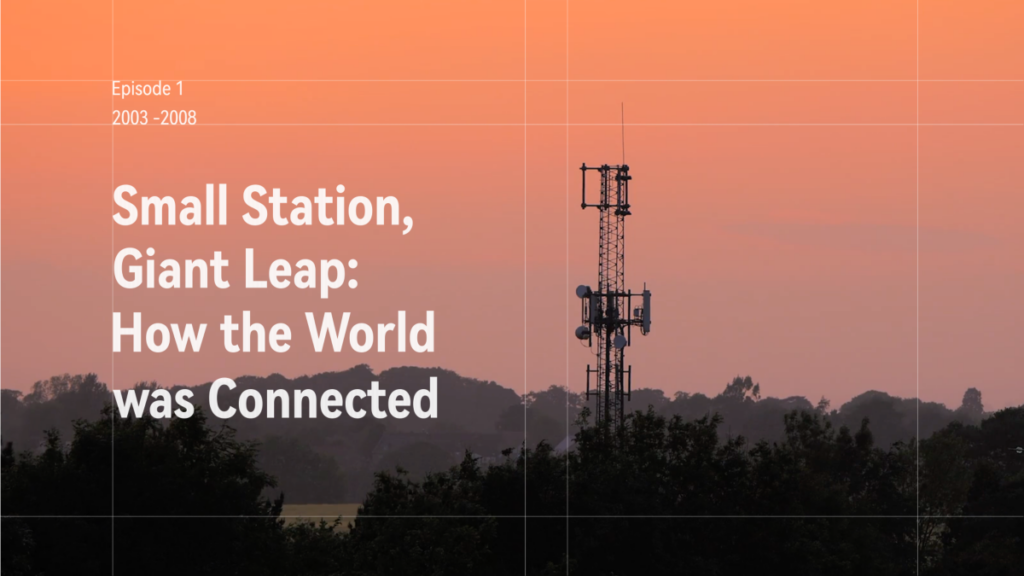
One of the earliest breakthroughs highlighted in the documentary was the expansion of 3G networks in the early 2000s, when operators faced significant challenges in extending coverage while controlling infrastructure costs.
Traditional base stations relied on large equipment cabinets containing radio frequency (RF) components, which made securing sites, and maintaining this infrastructure expensive, particularly in markets where site rental costs were high.
Huawei’s innovative solution to this problem was developing a distributed base station architecture that separated the radio frequency unit from the baseband processing equipment and placed the radio unit closer to the antenna, significantly reducing the size and complexity of equipment required at individual sites.
“The effect of that was to reduce costs significantly for the operator. And in consequence, we could provide more and more service for our customers,” recalled Fergal Kelly, former CTO at Vodafone UK and Vodafone Ireland, in the first episode.
Richard Yu, Executive Director of Huawei, highlighted that Huawei’s “architectural innovation shap[ed] the direction of the entire wireless network industry.”
This advancement was vital in Huawei’s success in the European 3G market and driving the transformation of mobile network deployment methods, insisted Yu, who previously served as president of Huawei Wireless Product Line and president of the European Region.
From adaptation to innovation
During the mid-to-late 2000s, distributed base stations became a significant force in driving the rapid expansion of mobile networks, noted Shaun Collins, FDM CCS Insight President in episode 2.
Former Telus CTO Ibrahim Gedeon agreed, noting “In a year, it became the new mode of deployment. After that, any equipment not conforming to this model was no longer suitable.”
As mobile networks continued to evolve from 2G to 3G, the next challenge was managing the growing complexity of mobile networks as new generations of technology emerged.
Traditionally, operators built separate network infrastructure for different communication standards, requiring additional equipment, increased energy consumption and more complicated network management when a new generation of mobile technology was introduced.
Huawei’s SingleRAN (single radio access network) architecture sought to address this problem by integrating multiple generations of mobile technology on a unified hardware platform, supported by software-defined radio.
By unifying the base station architecture and employing software-defined radio technology, Huawei shifted away from the traditional model of independent construction for different communication standards.
Yu emphasized that Huawei’s SingleRAN used the same equipment setup to provide both 2G and 3G. “It was a disruptive change across technology generations… Several large cabinets could be removed and replaced by one, enabled by software-defined radio.”
“SingleRAN not just allowed us to collapse together some of the technologies, it also allowed us then to evolve the network as we wanted it,” Kelly added.
As mobile data traffic accelerated, the industry faced another fundamental limitation: how to accommodate more users and higher data demand without access to unlimited spectrum.
To address this limitation, in 2011 Huawei rapidly developed what is known as the Massive multiple input multiple output (MIMO), which uses a large number of antennas to improve spectrum efficiency and network capacity. Many industry insiders credit this technology with setting Huawei far ahead of the competition in the early days of 5G.
Innovation driven by customer needs
Technological breakthroughs do not emerge in isolation. They depend on sustained investment in research, engineering talent and the ability to pursue long-term technical challenges.
Founded in 1987, Huawei has spent decades building its R&D capabilities. In 2025, its R&D expenditure reached CNY192.3 billion ($28.8 billion), equivalent to nearly 22% of annual revenue of CNY881 billion. Over the last decade, it allocated some CNY1.4 trillion to R&D, with its research team growing by 43% to about 114,000 at the end of 2025 and making up 53.7% of its total workforce.
In its 2025 earnings report it claimed holding 165,000 active granted patents and signed more than 260 licence agreements. The company’s exploration in wireless communications technologies has spurred its expansion from the China market to global markets.
For the wireless business, the underlying objective remains consistent: developing technologies that address the next set of challenges facing operators and the wider digital economy.
From transforming base station architectures and enabling multi-standard network integration, contributing to global standards and developing more energy-efficient technologies, Huawei’s wireless innovation journey has been guided by a consistent commitment: addressing customer needs while pursuing scientific advancement and pushing technological boundaries.
The many examples documented in the series not only show how the company gradually created its own innovative capabilities but also highlights its journey in leading the development of the global mobile communications industry and the evolution of its technology.
Signals of what comes next
The history presented in Signals of Change is more than a retrospective of technological achievements. It illustrates how the ability to challenge established approaches, solve real-world problems and sustain investment in research can reshape an entire industry.
Collins gave credit to the engineers behind the continuous network innovation. “The engineers don’t get enough credit in this industry. Because they’re able to deliver experiences that we didn’t even know we wanted and now can’t live without.”
Looking back at Huawei’s wireless innovation over the past 30 years, Yu insisted: “The lesson was to think boldly and to make breakthroughs using new technology to challenge existing approaches.”
From making base stations smaller to running smarter and more energy-efficient networks, the evolution of wireless communications has continually expanded the possibilities created by connectivity. And as the digital world becomes more interconnected, the signals of change are far from over.
Follow these stories to learn more about Huawei’s investment in R&D and determination to innovate.
The post Signals of Change: The wireless innovations shaping a connected world appeared first on New York Post.