Imagine it’s the Cold War. The head of a U.S. defense contractor has an affair with someone who the government determines is a Soviet asset. The affair is revealed, the chief executive resigns — then two weeks later the president himself pressures the company to rehire him.
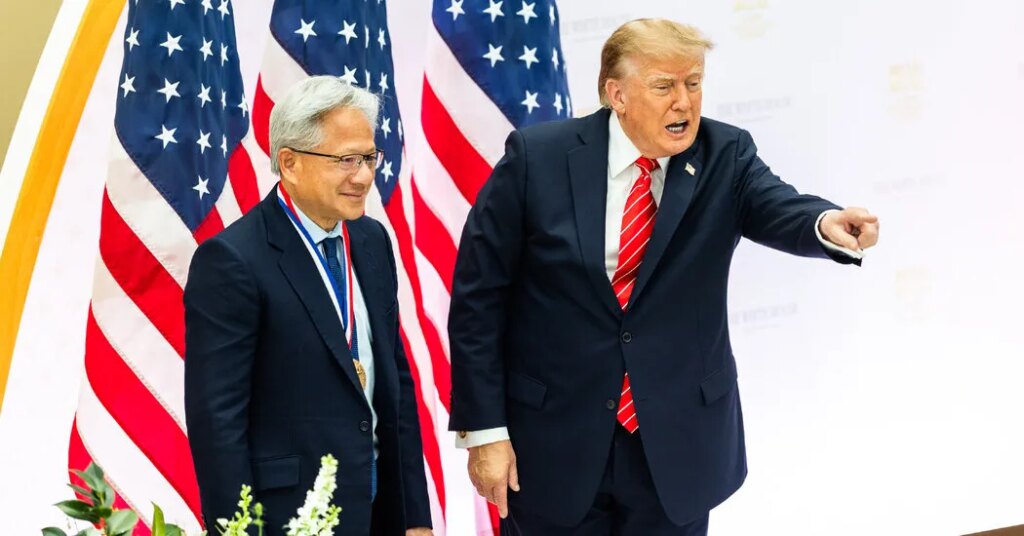
Unthinkable? That’s kind of what just happened with Jensen Huang, the chief executive of the chip maker Nvidia, who recently resigned after admitting to an affair with a woman the U.S. government believes was a Chinese intelligence asset. President Trump not only pressured the company’s board into rehiring Huang. He also signaled that his Justice Department would not pursue any charges against him even as an investigation into chip smuggling to China is ongoing.
It’s an extraordinary degree of interference in a private company. Today my colleague Patti Cohen, our international economics correspondent, writes about how, under the Trump administration, national security seems to have taken a backseat to the stock market.
Nvidia and the Great Game
By Patricia Cohen
The increasing importance of technology, trade and finance to great-power politics means that in recent years, private businesses have, often unwillingly, been thrust to the front lines of foreign policy. Tools like tariffs and export restrictions mean global titans and mom-and-pop shops alike have had to sacrifice their bottom lines in the interests of national security.
Then there’s what happened this week.
President Trump’s decision to personally lobby Nvidia to rehire Jensen Huang as chief executive despite his involvement in a China-related spying scandal effectively reversed those priorities. (Yesterday, Huang told Nvidia employees that the notion that he is back because of Trump’s pressure on the company was “completely untrue.”)
Nvidia is a Silicon Valley giant worth some $4 trillion, and Huang is considered a singular figure in artificial intelligence. His resignation dragged down stock indexes, and prompted worries about the future of an industry that has been responsible for much of the stock market’s gains and the American economy’s growth.
Nvidia is also at the center of an intense global competition with China for an edge in A.I. Huang resigned after revelations of a relationship with a woman who U.S. intelligence officials believe was a Chinese asset, and whose company they believe was involved in helping China gain access to restricted A.I. chips.
And so Trump’s personal lobbying caused shock waves not only because of the level of presidential intervention in a private company’s affairs, but also the reasons he exercised such power.
“It’s the stock market first,” Julian E. Zelizer, a presidential historian at Princeton University, said. “National security seems secondary.”
An age of economic warfare
The Jensen Huang affair has come about at a moment when economic warfare is growing in importance. Increasingly, the world’s most powerful nations are relying on their economic arsenals in addition to their military ones. The long list of weapons includes tariffs, sanctions, export controls and more. And private companies have had to adapt.
Government restrictions on international business dealings have soared in recent years, according to a new study. One analyst told me that Washington policy is affecting the bottom lines of companies more now than it has in the previous three decades.
And few companies have been as central to the current superpower rivalry as Nvidia. In 2022, the Biden administration imposed sweeping limitations on China’s access to semiconductors and other computing technology. One product on the restricted list: the high-end models of Nvidia chips, considered the most advanced in the world. They have given the U.S. a crucial advantage in the fierce race between the U.S. and China to develop the most powerful A.I.
China, for its part, has fought back, designating companies, including defense giants like Raytheon, Boeing and Lockheed Martin as “unreliable entities” and putting them on its own export control list.
This spring, Beijing blocked Meta’s acquisition of an A.I. start-up founded by Chinese entrepreneurs, citing rules about foreign investment and technology exports. And of course, it has used its control over critical rare-earth elements to punish and pressure trading partners.
It’s in this environment that Trump has opted to sweep aside national security concerns in the service of a single corporation — and a single executive — whose fortunes he views as critical to the American economy and stock market.
When presidents lean on companies
Presidents have inserted themselves into the affairs of industry and even individual companies before. But what Trump did this week was “very different,” Zelizer said.
Harry Truman temporarily seized control of steel mills to prevent a strike during the Korean War. (After the steel companies sued, the U.S. Supreme Court struck down the president’s order as unconstitutional.)
A decade later, John F. Kennedy pressured steel companies to roll back a planned price increase. And in 2009, amid a spiraling global financial crisis, Barack Obama pushed out the chairman of General Motors as part of a multibillion-dollar bailout of the auto industry.
What’s made Trump’s interference so singular is that it took place even when there is no war or national emergency.
Trump has frequently pressured industry and company leaders. In his first term, he leaned on companies to not move production to Mexico. In his second, he went a step further and committed more than $10 billion of taxpayer money to buy up ownership shares of companies the administration considers essential to national security, including Intel, Westinghouse and U.S. Steel.
That unusual government intervention into the private market aroused concerns about conflicts of interest, market distortions and taxpayer losses. Now, Trump’s lobbying of Nvidia has set off new alarms.
“In free, democratic and rules-based countries, political power should refrain from interfering in the economic engagement of companies,” Germany’s foreign minister, Johann Wadephul, said yesterday.
In an age of economic warfare, political leaders across the West have often made exceptions in the name of national security. What few have done, before this episode, is brush aside national security concerns to boost the prospects of a single C.E.O. and a stock market whose fortunes are so closely tied to his fate.
The latest:
-
Jensen Huang apologized to Nvidia employees and said he was in therapy.
-
Alice Huang, the woman at the center of the Nvidia spying scandal, grew up in a small factory town in China. Her jump to the tech world paralleled China’s own.
-
Ben Casselman, our chief economics correspondent, explains in the video below how the future of the U.S. economy is tied to A.I.
MORE TOP NEWS
-
The Communist Party leader of Shanghai was placed under investigation as China’s leader, Xi Jinping, expanded his purge of party ranks.
-
A strike by Yemen’s Houthi militia on a skyscraper in Riyadh, the capital of Saudi Arabia, injured 11 people.
-
A French appeals court ruled that a police officer accused of fatally shooting a teenage driver will stand trial for murder.
-
The International Criminal Court got a boost from Japan, which welcomed the court’s president to Tokyo and pledged financial support.
-
Twenty-eight people remain unaccounted for after a fire at a candy factory in Indonesia that killed 26 people.
-
An Iranian woman received 74 lashes for singing publicly in 2024 without a hijab.
-
Iraq’s prime minister ordered federal forces to take over border crossings and oil fields in the Kurdistan region.
WHAT ELSE IS HAPPENING
-
A new book of excerpts from Pope Francis’ diary highlights his fears and doubts.
-
Phumzile Mlambo-Ngcuka, South Africa’s first female deputy president, died at 71.
-
As a new Miss Universe is set to be crowned, the organization has split into rival camps, and it’s hard to figure out who is actually in control.
TOP OF THE WORLD
The most clicked link in your newsletter yesterday was about travel with older adults.
SPORTS
Football: Senegal was reinstated as the winner of the 2025 Africa Cup of Nations after a successful court appeal.
GREAT READS OF THE DAY
100 notable books
Every fall, my Book Review colleagues put together a list of their favorite 100 fiction and nonfiction titles of the year. And every fall, I briefly feel very — inadequate!
This year’s list includes some of my own favorites (“London Falling” by Patrick Radden Keefe is the best thing I’ve read this year) and many more that I’ve never heard of. What I love most about the list is that you can use it to build a reading list based on other books you liked. I just finished “Tom Lake” by Ann Patchett and loved it. Apparently, that means I will probably like Barbara Kingsolver’s “Partita.” Sold. I shall report back!
MORNING READ
Six years after they left Britain and their royal duties, Prince Harry and Meghan, Duchess of Sussex, are back and settling into life as “private citizens.” They have a carefully managed program of public appearances that look distinctly royal at times, including bows and curtsies.
Buckingham Palace may have stripped away Harry and Meghan’s official status, but it has not stripped away their star power. Read more about their life as “nonroyal royals.”
AROUND THE WORLD
Tiles and tribulations
American mahjong, the homegrown spinoff of the traditional Chinese game, has seemingly taken over the United States and ballooned into a multimillion-dollar industry. It comes with its own rules and modified tiles that render it nearly unrecognizable to devotees of the original game.
Critics have accused a few entrepreneurs of profiting from American mahjong while disrespecting the game’s cultural heritage. Read more about the mahjong turf war.
RECOMMENDATIONS
Discover: Agatha Christie’s West End thriller “The Mousetrap” begins its 75th year with a slick new staging.
Ask: A reader’s partner uses A.I. to write her love letters. Is she wrong to be upset?
Listen: Lana Del Rey and Dua Lipa added tracks to the Grand Theft Auto VI video game.
Laugh: Defuse awkward moments with humor. Here’s how.
RECIPE
A Spanish potato tortilla is an egg dish unlike any other. It doesn’t resemble the French omelet, which is loose and wobbly, or the Italian frittata, which is puffy and custardy. Instead, a tortilla is a solid cake, often enjoyed as a tapa.
WHERE IS THIS?
Which river is this?
TIME TO PLAY
Here are today’s Spelling Bee, Mini Crossword, Wordle and Sudoku. Find all our games here.
That’s it for today. See you tomorrow! — Katrin
Patricia Cohen was our guest writer today.
We welcome your feedback. Send us your suggestions at [email protected].
The post National Security vs. the Stock Market appeared first on New York Times.