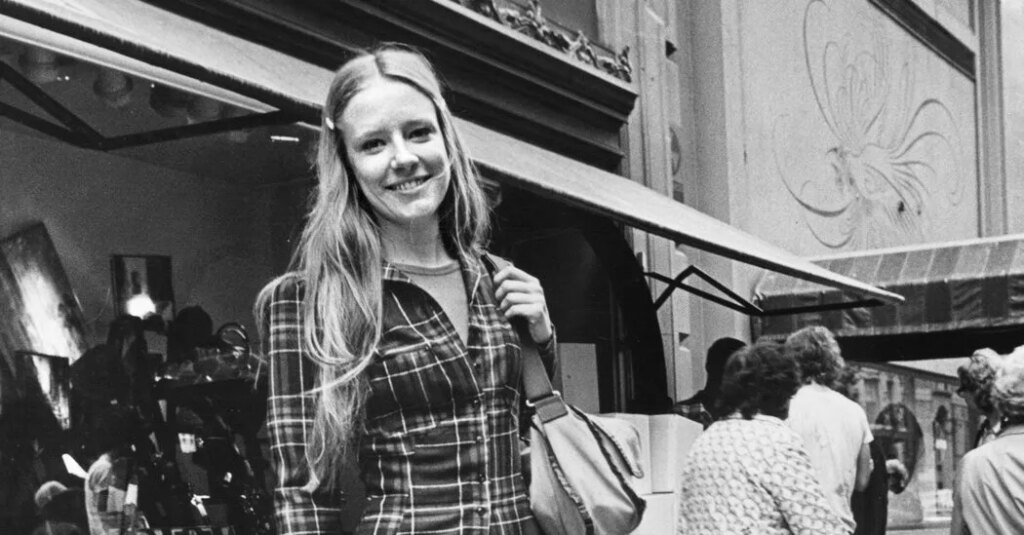
Mary Peacock, a founding editor of Ms. magazine who, as a maverick fashion editor behind Rags magazine in the early 1970s, and later, the sartorial savant of The Village Voice, fought to liberate fashion from Paris couture houses and Fifth Avenue ateliers with a guerrilla approach to style, died on Nov. 6 in Colchester, Vt. She was 84.
She died of a brain hemorrhage in a hospice retreat after a fall, her husband, Jonathan Larsen, a former editor of The Voice, said.
Ms. Peacock helped spark a revolution in miniature in the fashion world as a founding editor of Rags, a bicoastal monthly fashion magazine based in San Francisco.
She started the grass roots publication in 1970 with Baron Wolman, the original chief photographer for Rolling Stone, as president and publisher and Daphne Davis, another veteran of the fashion magazine establishment. Barbara Kruger, the future conceptual artist, served as an art director.
Rags made far more impact than money, lasting only about a year. Even so, it was “one of the most influential magazines most people have never heard of,” Vanessa Friedman, the fashion director of The New York Times, wrote in a 2021 retrospective. It was, she added, “the first publication to identify street style as a discrete fashion sector and call out the establishment for trying to manufacture trends.”
Channeling the counterculture spirit of the time, the iconoclastic magazine — printed in black-and-white, on ordinary newsprint — was conceived as the Rolling Stone of fashion, when that rock bible, then based in San Francisco, still had the feel of an underground newspaper.
With Ms. Peacock, who was based in New York, as a guiding force, Rags sought to overturn “fashion fascism” — as one cover story put it — as embodied by the lordly glossies and the august fashion houses of Paris, New York and Milan.
Traditional fashion magazines celebrated the “rich and rangy,” Time magazine noted in 1970, while in Rags, a reader could find “people with bulges like her own, wearing clothes that she can afford, against backdrops as familiar as a brick wall.”
As Ms. Peacock, then 27, told Time: “Fashion is not fashionable any more. The slick magazines are always telling you how you should look. We do it the other way around. We report what people are wearing without trying to change them.”
In spirit, Rags was the anti-Vogue. Articles included an interview with the communications theorist Marshall McLuhan about “mini skirt tribalism,” a look at clothing made from garbage, tips on where to find surplus Navy nurses’ uniforms and a profile of the guy who made Jimi Hendrix’s fringe jacket. “Rock ‘n’ roll stars were our designers,” the irreverent fashion writer Blair Sabol, an editor there, said in an interview.
One article, titled “True Underground Fashion,” detailed a company in Memphis that designed clothes for corpses.
For Rags, the most daring new looks were displayed on city sidewalks, not in Seventh Avenue showrooms. Rags started a pioneering street-style column, “On the Street” long before Bill Cunningham, the bike-riding fashion-world institution, started his column of the same name at The Times in 1989, and decades before The Sartorialist and other shutterbug sensations emerged.
“Our beat was anything that was public,” Ms. Sabol recalled — and that included snapping unwitting fashion avatars at protest marches, communes, concerts in Golden Gate Park, even McDonald’s.
Rags reflected a period “when vintage clothing was really discovered,” Ms. Peacock recalled in a 1987 interview with NPR’s “Fresh Air” with Terry Gross. “Kids who didn’t have a lot of money, but wanted something interesting, started going to thrift stores, and that’s what we trying to get across,” to say “‘ ‘fashion is your fashion.’”
Mary Willa Peacock was born on Oct. 23, 1942, in Evanston, Ill., the eldest of three children of William G. Peacock Jr. and Mary (Young) Peacock. Her father, an entrepreneur, had with his father, William Gilbert Peacock, created V8 juice during the Great Depression.
Mary spent the bulk of her youth living with her family in Fort Lauderdale, Fla. before enrolling at Vassar College.
After graduating in 1964 with a bachelor’s degree in English, she took a job at Harper’s Bazaar as an assistant editor, and briefly served as an editor at Innovations, a business-oriented design and culture magazine, before she and her colleagues embarked on Rags.
After the magazine proved financially unsustainable, Ms. Peacock in 1971 joined Gloria Steinem and seven other editors in founding Ms. magazine, where she worked on a wide variety of articles on topics like women’s history and politics.
In an era when women often were unable to attain credit cards without a man’s signature, it was a challenge to establish a trailblazing feminist magazine named after a honorific of liberation that was only then starting to carve out space next to Mrs. and Miss.
“When Ms. started,” Ms. Peacock told New York Magazine in 2011, “you couldn’t pick up the phone and say, ‘Ms. Magazine,’ because what people heard was “Mmzzz” and they’d ask, ‘What are you saying?’ This would happen 25 times a day.”
While committed to the magazine’s goals, to promote female empowerment at home, at work and in society at large, Ms. Peacock also aimed to inject a commercial sizzle, as well.
“Those of us who wanted better cover images and better cover lines got resistance from people for whom ideology ruled everything,” she told New York Magazine. “They didn’t seem to understand what the medium was. The idea was to entice people to read the magazine.”
In the 1980s Ms. Peacock served as the fashion editor of The Voice, an issues-driven, left-leaning alternative weekly not known for tips on accessorizing, where she again focused on “fashion generally costing in the hundreds,” as she once put it, “not the thousands.”
Overseeing the alternative weekly’s style section, V, as well as a splashy, if short-lived color fashion insert called Vue in the mid-1980s, she infused the alternative weekly’s fashion coverage pages with her wry, subversive sensibility, including in her own writing.
In a column on jumpsuits, she invoked the front-zipping uniforms in George Orwell’s “1984,” while observing that when “it comes to sex, there’s nothing you can get out of faster than an outfit held together by only one zipper.”
In her NPR interview, Ms. Peacock said that she had always been “desperate to inject a little humor” into her fashion coverage, “because, after all, getting dressed is supposed to be fun.”
She went on to serve as the editor of Model, a style magazine, and later came to terms with the style establishment working for Mirabella, the fashion and lifestyle magazine, and InStyle.
In addition to her husband, she is survived by a stepson, Edward Larsen.
In her NPR interview, Ms. Peacock discussed her 1987 book, “The Village Voice Guide to Manhattan’s Hottest Shopping Neighborhoods,” and demonstrated that her personal views on the topic reflected her editorial vision.
“I’m not a window shopper,” she said. “To me, it just torment to look at things I can’t possibly have.”
“Frankly,” she added, “I don’t think it’s a museum, I think it’s a store, and if I can’t buy it, I don’t want to look at it.”
The post Mary Peacock Has Died. She Found Style on the Streets. (Not Fifth Avenue.) appeared first on New York Times.