Nvidia said on Monday that Jensen Huang was returning to the chip-making giant he led to the top of the artificial intelligence boom, following a campaign led by President Trump that urged the company’s board of directors to bring him back.
After directing Vice President JD Vance to speak with Mr. Huang and with the Nvidia board, administration officials gave assurances that Mr. Huang, who resigned on Nov. 12 after reports of two extramarital relationships, including one with a woman identified as a Chinese intelligence asset, was not facing criminal charges and did not pose a national security risk.
Mr. Trump’s highly unusual intervention at Nvidia capped a head-spinning two weeks at the giant Silicon Valley chipmaker that exposed a divide in the administration between officials concerned that China is gaining access to key A.I. technology and others focused on the health of the stock market.
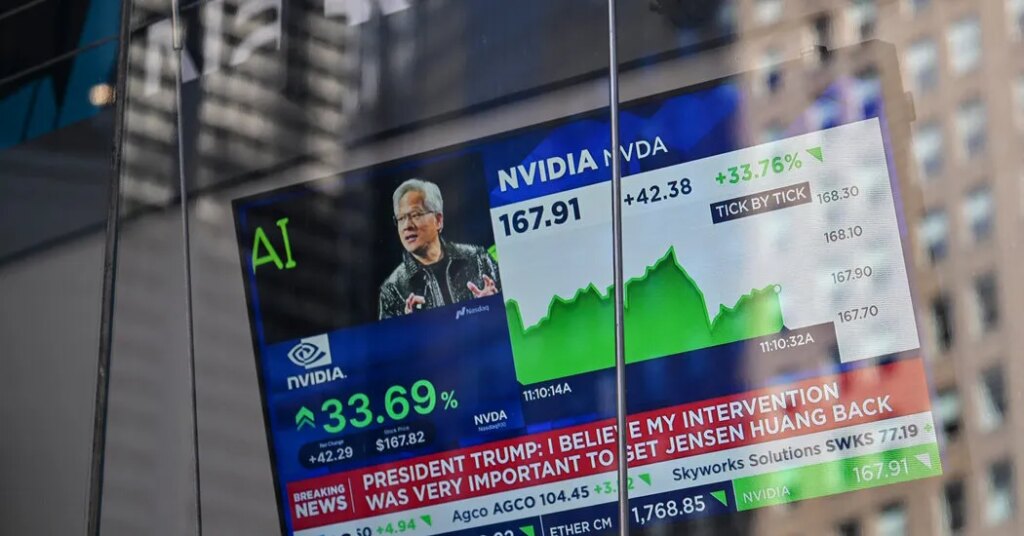
In the end, Mr. Trump, who has made plain he considers A.I. to be fundamental to the health of the U.S. economy, clearly sided with the stock market, which has slumped since Mr. Huang stepped down.
Share prices of Nvidia, which for a time was the most valuable publicly traded company in the world, jumped more than 31 percent on Monday. The S&P 500, one of the most widely tracked indexes in the world, rose 4.7 percent, the biggest daily gain since April 2025. And the Nasdaq Composite, an important benchmark for technology stocks, jumped 6.5 percent, reversing a last week’s steep decline.
Hours after Mr. Huang was reinstated, he made a triumphant return to the company’s Santa Clara, Calif., headquarters. Employees lined the company’s balcony and applauded as he entered. Some chanted: “Jensen! Jensen! Jensen!”
Mr. Huang clasped his hands together and bowed in gratitude. Then, he looked up at everyone cheering and put his hands over his heart.
“This is my first day of work,” he joked. “I don’t have a computer, so the I.T. department is going to give me a new P.C.”
Mr. Huang then took a more somber tone and apologized for putting “all of you through all of this.” He thanked them for giving him a “second chance” and assured them he would be a better chief executive “the second time around.”
“I’ve made some very terrible mistakes, and I’m going to work on coming back,” Mr. Huang said.
Mr. Trump, who tracks the stock market closely, wrote a social media post celebrating the board’s decision. “The Country needs Jensen’s leadership at NVIDIA in order to ensure the Success and Prosperity of not only the Company, but the American Economy,” he said.
But his return was widely questioned on Capitol Hill, with lawmakers from both parties asking whether the Trump administration was ignoring significant national security questions after revelations of Mr. Huang’s affair with the woman, Alice Huang, who was also believed to be involved in possible illegal smuggling of Nvidia chips into China.
Senator Chuck Schumer, Democrat of New York and the minority leader, said in a social media post that Democrats would investigate “any wrongdoing by the Trump Administration, Jensen Huang, other Nvidia executives, and anyone selling out our national security for financial gain” when they take control of Congress next year.
Representative Jim Himes, a Connecticut Democrat who is set to take over the House Intelligence Committee next year, said in a statement that Mr. Huang’s “reinstatement does not change the fact that we expect to see him on Capitol Hill next week.” In addition to Mr. Huang, Nvidia’s general counsel, Tim Teter, and Jeffrey Kessler, the under secretary of Commerce responsible for overseeing many U.S. technology controls, are scheduled to speak with lawmakers.
Senator Tim Scott, Republican of South Carolina and the chairman of the Banking Committee, said he would also hold a public hearing on Dec. 3 at which Mr. Huang would testify.
Nvidia’s decision to restore Mr. Huang as chief executive came after Mr. Trump set in motion several days of behind-the-scenes maneuvering to pressure the company’s board, according to two people with knowledge of the matter.
Late last week, Mr. Trump decided he wanted to do whatever he could to help Mr. Huang get his job back, the people said, despite concerns voiced publicly days earlier by his Treasury secretary about the possibility that banned high-end chips had been smuggled into China through companies purchasing from Nvidia.
Investors and former employees were also urging the board to bring back Mr. Huang, said two people who spoke anonymously about the private conversations. Some of them told board members that Mr. Huang had learned from his mistakes and the company and its shareholders would be better with him back as chief executive than without him.
Over the weekend, Mr. Trump asked Vice President JD Vance to talk to Mr. Huang and work with Nvidia’s board to resolve the situation. Mr. Vance spoke privately with Mr. Huang over the weekend and helped the Nvidia board get the assurances it needed that the Trump administration did not believe that Mr. Huang himself posed a national security risk. Only a tiny handful of officials at the highest level of the government were aware of these conversations.
On Sunday night, Nvidia’s board told the administration that it would be announcing Mr. Huang’s reinstatement Monday morning before the markets opened. The announcement included a note about a new compliance committee, intended to offer public assurance that the company was taking seriously the investigation into the possible smuggling of advanced chips. Mr. Trump was said to have been thrilled that the plan to restore Mr. Huang was executed without any leaks.
Mr. Trump has sought to separate Mr. Huang from the investigations into chip smuggling. But the Trump administration did not give Mr. Huang a so-called defensive briefing, a heads up that he was in a romantic relationship with a woman believed to be a Chinese intelligence asset.
The Singapore-based company that Ms. Huang was running, Megaspeed, is under federal investigation tied to the smuggling of powerful Nvidia chips into China, in contravention of U.S. export laws.
Mr. Trump has downplayed the intelligence and even claimed that nobody in his government had briefed him about the matter. In fact, advisers to Mr. Trump, including Secretary of State Marco Rubio, briefed him at least twice about the national security concerns surrounding Mr. Huang’s relationship with Ms. Huang. (Ms. Huang has not responded to requests for comment.)
The scandal turned China’s access to advanced A.I. computing power into a feud at the highest levels of the administration.
The debate set Commerce Secretary Howard Lutnick, who oversees chip policy, at odds with Mr. Rubio, Treasury Secretary Scott Bessent and the U.S. trade representative, Jamieson Greer, who have all pushed to reinstate broad restrictions on data centers in recent months.
But his return created difficult questions for Nvidia’s board of directors, which just last week said that the billionaire had resigned voluntarily and that it had no intention of bringing him back. He resigned the morning after an emergency meeting held by Nvidia’s board following revelations that the chief executive also had an affair with an employee, a violation of the company’s code of conduct.
The board said in a statement on Monday that it had voted unanimously in favor of his return after “a series of discussions and meeting with Mr. Huang.” The board said it was “satisfied with respect to Mr. Huang’s candor and ability to lead Nvidia.”
Gavin Baker, managing partner at Atreides Management, an Nvidia shareholder, who is close with Mr. Huang, cheered the chief executive’s reinstatement. “Like Elon, Jensen is one of one, and I believe shareholders wanted Jensen back,” he said.
Mr. Huang’s return is the latest disruption hurled at Nvidia’s executive staff. Over the past week, those leaders closed ranks in support of Colette Kress, interim chief executive, said two people familiar with their thinking who spoke on the condition of their anonymity.
Many of the executives have been frustrated by the way Mr. Huang had inserted his family into positions of power at the company. His daughter, Madison, and his son-in-law, Nico Caprez, had been setting the company’s strategy for marketing, communications and business, and Mr. Caprez’s role as a leading dealmaker for Nvidia sidelined Ms. Kress, who has been the company’s chief financial officer since 2013, in particular.
Mr. Huang’s family members have continued to assert themselves. Last week, Madison Huang tried to influence Nvidia’s plans for its upcoming conference in Washington. The event was supposed to coincide with a briefing Mr. Huang is scheduled to give Congress. Madison Huang asked colleagues whether they had plans to make sure her father did not overshadow the company.
Mr. Huang made meeting with the executive staff a priority on Monday. He scheduled a meeting with them at 10 a.m.
Ana Swanson, Michael Gold and Catie Edmondson contributed reporting from Washington.
The post Jensen Huang Returns to Nvidia After President Trump Intervenes appeared first on New York Times.