The tiny farming town of Middletown, Iowa, felt like it was bracing for a cyclone on Tuesday, a day before the Army plans to detonate nearly five tons of dangerously degraded explosives.
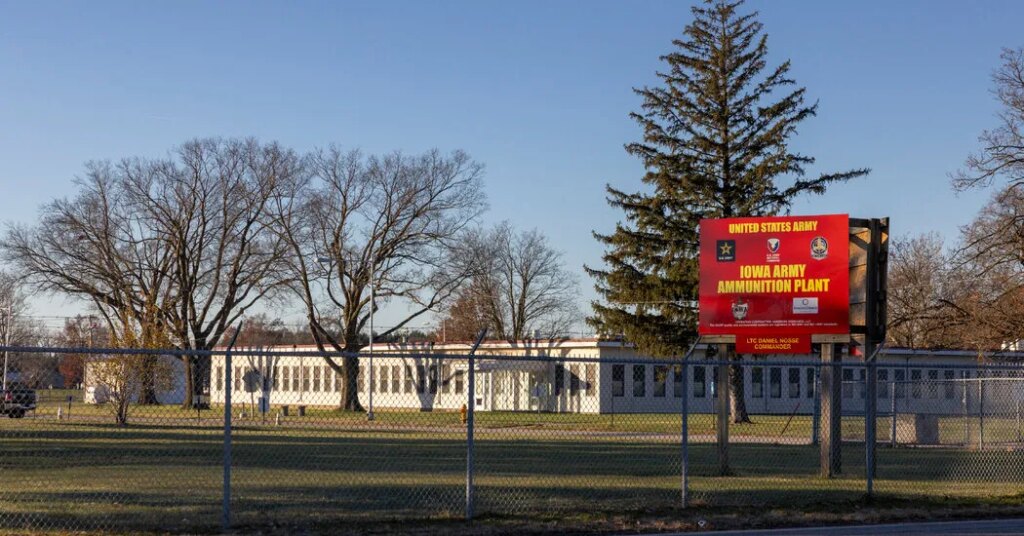
People who live closest to the blast site at the 19,000-acre Iowa Army Ammunition Plant were covering their windows with blue tape to keep them from shattering when the big bang happens at 9 a.m. Wednesday.
Others were checking weather forecasts to see whether the wind would carry a toxic plume of lead dust toward their homes and farms. Pregnant women and parents of young children — who are particularly vulnerable to lead exposure — agonized over whether they should ride it out, shutting themselves inside, or escape southeastern Iowa altogether a day before Thanksgiving.
Schools and businesses miles away closed as a precaution and were stocking up on cleaning supplies to wipe away any dust that the explosion wafts over miles of rural America.
After days of swirling uncertainty and confusion over the government’s shifting plans, most people in Middletown, population 360, and surrounding farm towns along the borders of Iowa, Illinois and Missouri were resigned. They were counting down the hours before the government blows up 68 barrels of lead azide.
“What can I do?” asked Shannon McGregor, a day care operator who changed her furnace filter and was planning to keep her children inside on Wednesday. “Really nothing — other than just hold on to your hats.”
Lead azide, an explosive substance, has been stockpiled at the Iowa facility since 2009. The Army said it had become dangerously degraded and could not be moved, and it was at risk of exploding as temperatures fell, threatening uncontrolled releases of lead.
That neurotoxin can interfere with fetal development, increase the risk of premature birth and miscarriage, and cause permanent developmental harm in children. There are no safe levels for exposure.
People’s concern about the environmental and health effects of the fallout has prompted them to take soil samples of their backyards and corn and soybean fields ahead of the blast. One mother even tested her daughter’s blood for lead so she could have a “before” level if the plume drifted toward her.
On Tuesday afternoon, dozens of state and federal officials and scientists surged into Middletown to finish preparing for the detonation of the barrels of lead azide, to hand out masking tape for insulation and to help people make evacuation plans.
Middletown directly adjoins the northern boundary of the ammunition plant, which is a major employer in town.
Outside its City Hall, which was locked and dark on Tuesday, were more than a dozen boxes of donated blue painter’s tape, with a sign telling residents to take what they needed. A man in a Federal Emergency Management Agency jacket was buying refreshments at the town’s only gas station while one resident groused to the cashier about the dozens of reporters and camera crews swarming the town.
In a neighborhood of neatly kept houses about a mile from the ammunition plant’s heavily guarded gates, neighbors breezily chatted in driveways and did yard work.
“It is what it is,” said Deb Schnicker, 72, who moved to Middletown in October after spending years living near a quarry where blasts would shake her windows.
Ms. Schnicker’s husband had taped their windows, and she said she was planning to leave home early on Wednesday morning with her anxious 5-year-old terrier mix, Skyler, and head to a sale at a big-box store one town over.
The Army’s earlier projections of the plume showed it spreading north from Middletown, but maps released on Tuesday showed it spreading southwest and as far as 100 miles across the Mississippi River watershed.
The maps showed the plume arcing right over Brent Koller’s farm in Donnellson, Iowa.
“It’s right in the bull’s-eye,” he said.
The U.S. Department of Agriculture said on Tuesday that 350 farms could be affected by the blast, but Mr. Koller, a former president of the Lee County Farm Bureau, said he was not too worried.
He and other farmers have already harvested and stored their corn and soybean crops for the winter, and he said they regularly test their soil. He said he felt reassured after a news conference on Tuesday morning during which federal officials laid out measures they had taken to mitigate the spread of any airborne lead dust.
“Everybody’s thinking it’s going to be a mushroom cloud of lead coming toward them,” he said. “Hopefully, it won’t be much.”
Still, Mr. Koller has three children, ages 14, 11 and 7, and he said he planned to keep them indoors on Wednesday, or leave town early for Thanksgiving to his in-laws’ near Des Moines.
Sunny Robbins, director of the public library in Donnellson, said she planned to close the library on Wednesday and then do a deep cleaning 24 to 48 hours after the blast, once residents get the all-clear to head outdoors again.
“We’ll be open Saturday, and we’ll be fine,” she said. “We’re not as panicked as the news is making it out.”
Kiki Hope, who runs a day care in the plume’s projected path, said she had covered up the sandbox, hauled all of the outdoor toys into the basement and planned to pressure-wash the concrete basketball court once the dust settles. She said the day care would be open on Wednesday because she watches several children of essential workers who cannot stay home.
“We’ll just be stuck inside till it clears,” she said. “There’s nothing else we can do.”
In West Burlington, a few miles east of Middletown, Layne Barnes, 69, made the rare decision to close down his motorsports dealership for the day. He usually keeps his store open even on holidays, but his windows sometimes rattle when machine guns are fired at the plant, so he did not want to take a chance with the detonation.
When he drove by Middletown on Monday night, he saw flatbed semis arriving and people preparing for the blast — all of which reassured him. Many residents said they supported the government’s decision to detonate the barrels of lead azide in a planned explosion, rather than take the risk of a spontaneous explosion.
“The proper steps are being taken, have been taken,” Mr. Barnes said.
Blake Gerst, 29, a sales manager at Mr. Barnes’s business, was thinking of her 7-year-old son, Oliver, who has been wondering when the “big boom” will happen. Ms. Gerst worries about how the explosion will affect the grass, the water and the crops, and has been frustrated by the government’s shifting plans.
The detonation was supposed to take place on Friday but was postponed, and then further thrown into question by legal challenges. A a federal judge cleared the way on Monday for the detonation to go ahead.
Ms. Gerst plans to keep Oliver inside with a video game and avoid the park where they like to play, worried it will be coated in “a noxious cloud of lead.”
The post Iowans Brace for a Toxic Plume on the Eve of a Planned Explosion appeared first on New York Times.