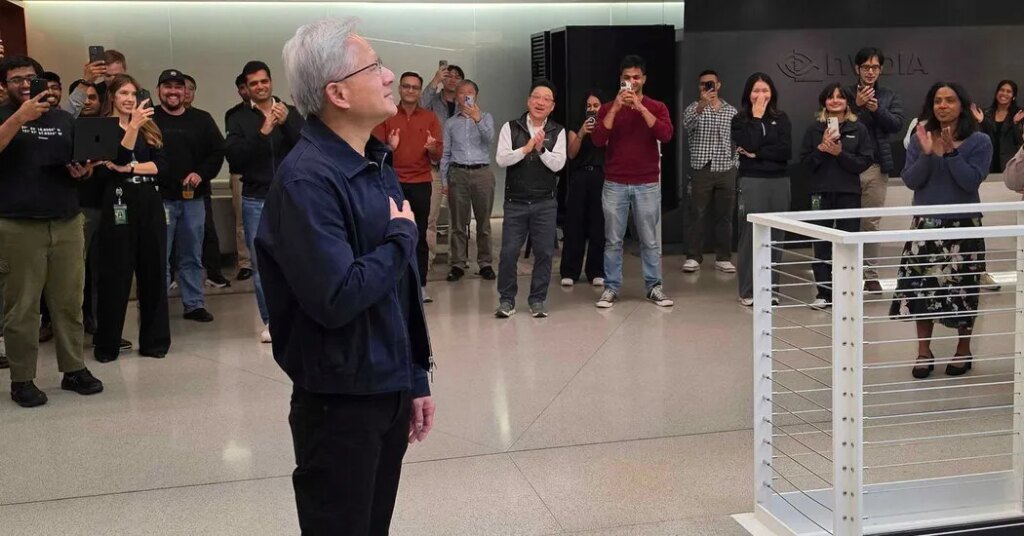
The reappointment of Jensen Huang as Nvidia’s chief executive appears to be good news for Beijing: The most influential advocate in the United States for selling advanced chips to China is back in charge after an extraordinary intervention by President Trump.
But the view in Beijing is likely to be murkier. While several Chinese tech executives welcomed Mr. Huang’s return, they also recognized that his hands may now be tied. Lawmakers in Washington are lining up to question him and tighten the rules on chip sales to China.
Either way, the whiplash will give Beijing further impetus in its efforts to wean Chinese companies off U.S. technology and develop their own. And the latest twist in the saga of the world’s most consequential chip company and the man who built it from the ground up ensures that Nvidia will remain at the center of U.S.-China relations.
No company can compete with Nvidia when it comes to designing advanced chips for artificial intelligence, a huge advantage for Washington as it presses to keep ahead of Beijing in the transformative technology.
In the broader competition with the United States, China has exceptional engineering talent, world-class A.I. models, and access to cheap power and vast land for its data centers. It has also repeatedly demonstrated an ability to do more with less.
But China is demonstrably weaker in chips and is still struggling to make enough of them to satisfy domestic demand. Epoch AI, a nonprofit research organization, estimates that smuggled chips account for roughly a third of China’s A.I. computing power, though it says the true share could be considerably smaller or larger.
For China’s A.I. industry and A.I. models, “Huang’s return is good news given its dependence on Nvidia and the importance of American technology,” Lizzi C. Lee, a fellow focusing on the Chinese economy at the Asia Society Policy Institute, said in an email. Beijing, she added, may also see it as “reassurance that practical and commercial interests still carry the day in Washington.”
But Ms. Lee said Chinese policymakers were unlikely to stake everything on Mr. Trump’s good will, given the results of the midterm elections and his lame-duck status. “If anything,” she said, “expect the push for domestic substitution to accelerate after this episode, which already exposed the vulnerability of China’s A.I. ambition.”
Much will depend on Washington, where a debate has been raging about how to approach Chinese access to advanced A.I. chips. That debate intensified in recent weeks after The New York Times reported that U.S. intelligence officials believed that Alice Huang, a Chinese businesswoman who allegedly had an extramarital affair with Mr. Huang, was an asset working for China’s spy agency.
China hawks and national security officials have argued that the best way to stay ahead on A.I. is to curtail exports of American technology. Mr. Huang and his supporters say it is better to lift restrictions and make China dependent on U.S. chips.
Two key issues for Beijing are whether it will continue to receive Nvidia chips, and whether new rules blocking Chinese companies from remotely accessing chips will persist.
The Trump administration reversed a ban on sales of Nvidia’s H20 chip to China in 2025 and then approved the more powerful H200. Lawmakers disclosed last week that the Commerce Department had approved the sale of more than 800,000 advanced A.I. chips to Chinese companies, including some with ties to China’s military.
Chinese companies had also exploited a loophole until recently. Unable to import Nvidia’s most advanced chips, they rented access to them through data centers in Southeast Asia and elsewhere. That was legal until last week, when the Commerce Department issued a rule clamping down on the ability of Chinese companies to access advanced Nvidia chips through data centers in third countries, and requiring licenses for chip exports to companies in Malaysia, Singapore, Thailand, Indonesia and Brazil.
A week after his administration unveiled those rules, though, Mr. Trump has helped restore to power their most prominent opponent.
Mr. Trump has framed Mr. Huang’s return partly as a way of keeping him away from Beijing. “Jensen could take the next plane to China, and I guarantee you, they would give him whatever he wanted,” Mr. Trump told CNBC on Monday.
In China, where Mr. Huang’s plight has generated widespread sympathy, some voices have greeted his return as vindication. Chinese officials have dismissed as “smears and slanders” the allegations of espionage.
Ms. Huang, who has not responded to The Times’ requests for comment, was previously at the head of Megaspeed, a Singapore-based data center company that bought large quantities of Nvidia chips and is now under federal investigation over accusations that it smuggled those chips to China.
On Tuesday, Asian shares, led by tech stocks, surged on news of Mr. Huang’s return.
China’s Ministry of Foreign Affairs declined to comment on Mr. Huang. However, the Global Times, a Communist Party tabloid, suggested that his reinstatement was proof that the spy affair was a “farce” instigated by U.S. media.
On Monday, the same day Mr. Huang returned, the Commerce Department added Megaspeed to a trade blacklist. Mr. Huang is also scheduled to face questions from House investigators and to testify before the Senate next week.
“Jensen is returning to a new political reality for U.S. export controls, which is that there is significantly more skepticism now about having a laissez-faire approach to chip sales all over the world,” said Vivek Chilukuri, director of the Technology and National Security Program at the Center for a New American Security.
Experts widely believe that China is six to nine months behind the United States in A.I. development. Mr. Chilukuri said that if Washington “actually closed the loopholes in export control policy and enforced the rules that are already on the books, that lead could double.”
Tighter controls will only deepen mistrust of Washington in Beijing, where the controversy has been read as further proof that the United States “is not a reliable partner,” said Wu Xinbo, an American studies scholar at Fudan University in Shanghai who advises China’s Foreign Ministry. Washington, he said, could cut off China’s supply chains at any time and on any pretext.
To Mr. Wu, China has been less a protagonist in the Nvidia case and more of a prop in U.S. political drama.
“The Jensen Huang episode reflects the intense political infighting within the United States and China is just the background music,” he said.
Other Chinese analysts warn Washington should not underestimate Beijing’s leverage. China dominates the supply of rare earths and magnets that American factories and weapons makers rely on. Under a trade truce reached last year, Beijing suspended sweeping controls on rare earth exports. But that truce expires on Jan. 10, and its extension could become entangled with the debate over U.S. chip exports.
Chinese analysts also say China is too big a market for American chipmakers to give up. And new restrictions, they add, would only speed up China’s efforts to power its A.I. boom with domestic chips and software. DeepSeek, one of China’s leading A.I. companies, is developing software for chips made by Huawei Technologies, partly as a way to circumvent Nvidia’s own software.
But China’s government and its A.I. companies do not always have the same incentives, said Olivia Shen, director of the strategic technologies program with the United States Studies Centre at the University of Sydney. While Beijing wants its industry to use Chinese-made chips, publicly listed companies like MiniMax and Z.ai want to make globally competitive models, which — for now — can only be trained with Nvidia chips, she said.
Still, Beijing’s ambitions will not change.
“Longer term, they don’t want their access to this important resource to be based on the whims of a particular character in the White House,” Ms. Shen said.
Berry Wang contributed reporting.
The post For China, Jensen Huang’s Return to Nvidia Is a Mixed Blessing appeared first on New York Times.