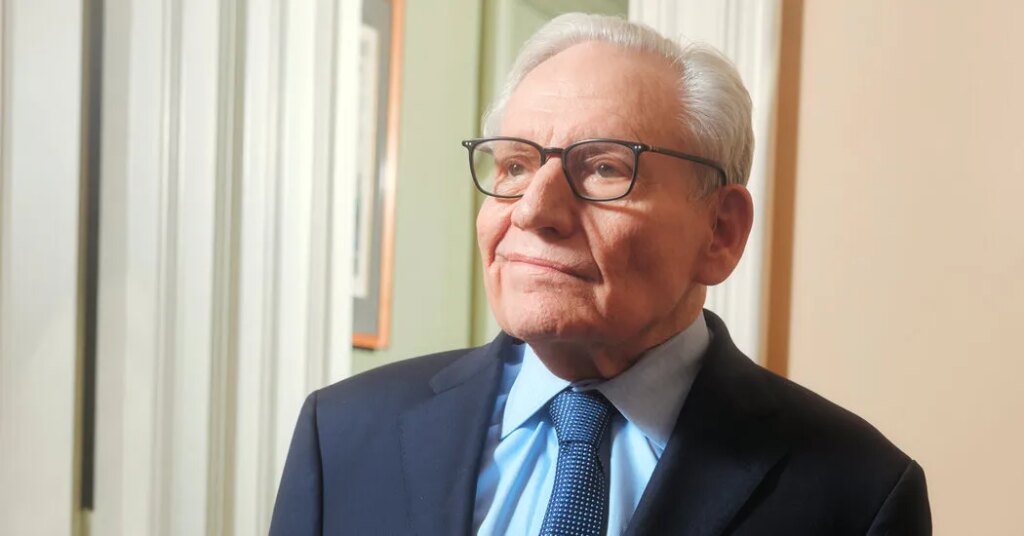
He has interviewed presidents and kings and spies and generals. Along the way, he has extracted some of the most revelatory and enduring stories of the past half-century about the power players who run Washington. So what would Bob Woodward ask if he were interviewing Bob Woodward?
He was sitting in the sunroom of his Georgetown house on a bright autumn day when the question was put to him. He paused a moment before answering. “What is the internal turmoil?” he suggested. Which sounds like a good question. But what would his answer be? Mr. Woodward has long been more comfortable asking the questions than answering.
Perhaps the most renowned journalist of the modern age, Mr. Woodward has turned the lens on himself after 55 years of examining others, with a new memoir called “Secrets” recounting the story of his celebrated career. It may not exactly be a tell-all, but it is a tell-much and has already set Washington buzzing about the revelations it promises when it is published on Tuesday.
For the first time, he names names, disclosing the identities of many sources he has spent a career guarding, either because they have since died or because he obtained their permission. During Watergate, he reveals, some of his sources were President Richard M. Nixon’s own lawyers, who did not think much of their client. He divulges the names of five Supreme Court justices who talked for a book on the court. He identifies cabinet secretaries, White House aides and other officials who whispered secrets over the years.
For Mr. Woodward, the 83-year-old chronicler of modern Washington, this has all turned out to be a “liberating” experience. Not just because at long last he shows his homework, but because he has confronted, not always that willingly, his own story as well: how a boy from Wheaton, Ill., ended up at The Washington Post, found himself in an underground parking garage with a source nicknamed Deep Throat and changed history.
“I can tell the story. I don’t have to leave anything out,” Mr. Woodward said in a lengthy interview at the four-story, 19th-century home where he has hosted the prominent and powerful princelings of the nation’s capital. “Nothing is hidden here. Nothing is hidden. There’s not some story about some information I got from somebody. It’s all laid out there.”
Some of the most illuminating parts of the book hint at that “internal turmoil” he mentions. He writes about how at age 8 he began noticing troubles in his parents’ marriage and how at age 11 he discovered his mother kissing his father’s best friend. He learned that his parents were getting divorced by rifling through his father’s sock drawer where he found a letter mentioning it.
He writes about the fire that gutted the family home when he was a teenager and left him so frightened that to this day he keeps fire extinguishers stashed throughout his house — “at least a dozen,” according to his researcher Claire McMullen. He writes about how unnerved he was as a young Navy officer aboard a nuclear-armed ship with access to codes that could unleash Armageddon.
All of which taught him to be “a snoop” and “a catastrophic thinker,” as he puts it, to assume that there are always secrets and that the worst can happen. “I have lived since age 8 with suspicion about everything,” he said. And so a career was built. He would ferret out official secrets. He would explore worst-case scenarios. “In a way, it’s finding the sock drawer of history,” he said.
The process of writing a memoir after all these years had a predictably teeth-pulling quality to it for a man reluctant to talk about himself. The people closest to him kept pushing him to open up, including his wife, Elsa Walsh, herself an accomplished journalist; Carl Bernstein, the other half of the famed Watergate duo; and Scott Armstrong, his lifelong friend and former reporting partner.
“I said: ‘You’ve got to go deep. This is really the time to do it,’” Mr. Bernstein recalled. “‘The fabric of your life is incomplete unless you marry up both the deeply personal and the professional.’”
Ms. McMullen, a writer who has worked with Mr. Woodward on three previous books, made a point of recording their lunchtime conversations to try to get beyond all the interview memos he kept. The first time they sat down to talk about the memoir, she asked him a question he used to ask others: What was his first childhood memory?
She pored through many of the 500 boxes he has kept over the years containing not just memos of practically every interview of importance going back to the 1970s but other memorabilia and arcana collected over time. Nothing, it seems, was not saved. “Was this a historical sock,” she recalled asking of one discovery, “or just a sock?”
She took to relying on her own sources. “When I couldn’t get through to Bob on getting him to talk about something personal,” she said, “I’d call Carl and get him to tell me.”
Among the personal episodes recounted in the book is the rift between Mr. Woodward and Mr. Bernstein. When they followed up their book “All the President’s Men” with “The Final Days,” about the end of Nixon’s presidency, Mr. Woodward felt that Mr. Bernstein was not carrying his weight. (“It’s true,” Mr. Bernstein says now.) For a while, they stopped speaking.
When they finally made up, they concocted a “boy’s fairy tale” of an idea in which Mr. Woodward would take over as The Post’s Metro editor and Mr. Bernstein would become the Style editor. Then, when Benjamin C. Bradlee retired as executive editor, the two would run the newsroom together. When the idea made its way to the publisher, Katharine Graham, she is said to have quickly shot it down. “Are you out of your mind?” she reportedly exclaimed, adding that the two needed management, not the other way around.
Even so, there are limits to how much Mr. Woodward reveals. He is not by nature an introspective man, and some will undoubtedly finish the book wanting more. At some point, it becomes a recitation of all the important interviews he conducted with presidents and potentates, drawn often in great detail from the memos he kept. This is a record that historians will draw from for years to come, but it is not soul baring.
Mr. Woodward knows the criticism. He has heard it all before. He depends too much on anonymous sources. He has grown too close to power. He treats those who talk with him better than those who do not. He is not a particularly lyrical or analytical writer and does not put his inside-the-room reporting into context. A “stenographer to the rich and powerful,” as the writer Christopher Hitchens once acerbically put it.
To all of this now comes the latest criticism that in “Secrets” he finally identifies sources who have since died. While that has been his practice in the past, it has prompted a new debate about whether the promise of confidentiality survives death in the way that, say, attorney-client privilege does.
Donald E. Graham, the former publisher of The Post and Mrs. Graham’s son, came to Mr. Woodward’s defense recently against the negative reviews his books have received over the years. “They were being reviewed by journalists much less successful than Woodward and they reek of jealousy,” Mr. Graham wrote online.
“In the old days, they typically said, ‘How does Woodward dare to tell us all this astonishing stuff and not name his sources?’” Mr. Graham went on. “In this book, Bob DOES name several now-deceased people who were his sources over a lifetime. His reward is a review and many social-media comments asking how he can dare to name dead sources! Can’t win, I guess.”
Mr. Woodward, once played on the big screen by Robert Redford, concedes that he travels in more rarefied circles today than when he was a 20-something rookie investigating a rogue president. He has written about 11 presidents, interviewed 16 defense secretaries, runs into Supreme Court justices at parties and lives around the corner from cabinet officers.
He is, it is true, now part of the world he covers. But he argues that he uses that access to unearth information that would otherwise remain unknown. “Part of that world does not mean they set the terms,” he said. “I set the terms. And the terms are, I want to know what happened.”
Mr. Bernstein said Mr. Woodward had pulled secrets “out of the black hole of the modern presidency” that no one else could obtain and that have set a foundation for history. “People can argue over it, what the truth and the context is,” he said. “But it’s out there as information that never would have gotten out. And there is nothing comparable in the history of the country.”
That’s not to say Mr. Woodward has no regrets. With hindsight, he believes he missed the mark in “The Agenda,” his first book on President Bill Clinton, by overemphasizing the chaos of a White House that ultimately produced peace and prosperity. He acknowledges that he, like other reporters, was not skeptical enough about claims that Iraq had weapons of mass destruction before President George W. Bush’s invasion. He believes he did not take Covid-19 seriously enough at first.
But perhaps most of all, Mr. Woodward said, he wishes he had recognized the danger that he now believes President Trump poses and had done more before his first election in 2016 to explore what kind of president he would be. “I should have dropped everything and focused on Trump completely,” Mr. Woodward said.
The Trump presidency has been so extreme that it has propelled Mr. Woodward out of his traditional journalistic neutrality. In a new foreword to the 50th anniversary edition of “All the President’s Men” in 2022, he and Mr. Bernstein portrayed Mr. Trump as a greater threat to democracy than Nixon had been.
In the interview this month, Mr. Woodward, who has published five books about Mr. Trump, said the war against Iran demonstrated the danger. “Who starts wars?” he asked. “Tyrants start wars. It’s absolutely mind boggling, and it is a danger to the country.”
He traced his concerns about Mr. Trump to his own Navy days aboard a nuclear-armed ship. “I’m haunted by the danger we are in, having somebody in the presidency with that authority, unchecked, unmonitored,” he said. “It’s frightening. And I go back to that time as a 22-year-old seeing exactly how nuclear war can be started by a president.”
Mr. Woodward, the catastrophic thinker, added: “It keeps me up at night.” And he further added: “The impact of Trump is danger, danger, danger.”
All of which could lead to a little internal turmoil.
The post Turning the Lens Around: Bob Woodward Takes On Bob Woodward appeared first on New York Times.