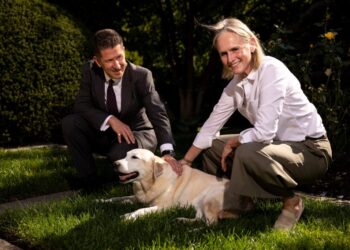
On a recent, raw November evening, Clay Hedden, 44, waited to be let into the darkened auditorium of an Off Broadway theater in Midtown Manhattan. After nearly three months of preparation, it was finally time for the first tech rehearsal of a play he is featured in: “The Curious Incident of the Dog in the Night-Time.”
He had not set foot on a stage for 13 years. Back in his 20s, when he was getting his start on cruise ships and tours, he assumed he was on a road to success. But something about the unstable, unsupported life of an actor began to eat away at his confidence, he told me, eventually leading him to conclude that “my brain was just not good.” The theater, at least as he’d known it, was not a safe place for someone like him.
Many of the other actors arriving for the rehearsal had similar stories. Dominick Mastrodonato, 28, said he’d felt marginalized socially and artistically in college by the coterie of students putting on plays. They viewed him, he said, as “grossly incompetent” — perhaps, he surmised, because of the way he spoke or moved his hands.
For Gerard Riley, 39, a heavy stutter was probably the trait that left him more often cast aside than cast. Teachers discouraged him from auditioning for school musicals. But in visits to “Curious Incident” rehearsals over the course of two months, I noticed something fascinating: The stutter almost completely disappeared onstage.
Riley and Mastrodonato, who teaches Brecht and the Black Arts Movement at Saint Peter’s University in New Jersey, have forms of autism. Hedden now thinks he has what is sometimes called AuDHD: an autism spectrum disorder combined with attention deficit hyperactivity disorder.
Most of their “Curious Incident” castmates have received related diagnoses, which is in fact why they were here. They are members of EPIC Players, a theater company founded by Aubrie Therrien in 2016 to offer neurodivergent and disabled performers what its mission statement calls “performance opportunities, accessible arts education and an inclusive artistic community.”
What EPIC is not, Therrien told me, is philanthropy. “We’re not a dayhab. We’re not drama therapy.” Players must audition, come prepared for rehearsals and meet all professional expectations. They are also paid — about $2,250 for the run of “Curious Incident.” (The show, at A.R.T./New York’s Mezzanine Theater, is scheduled to play through Dec. 6.)
Perhaps most important, they are given the opportunity to express their talent in handsome productions — at $230,000, the “Curious Incident” budget is a big lift for a small nonprofit — with sufficient support to make possible what the “regular” theater almost universally denies them.
“They don’t want to be limited to playing Disabled Character No. 1,” Therrien said about the roles, if any, that neurodivergent actors are typically offered. Instead of pathetic souls in “burden stories” or “magical disabled savior characters, they want to play Hamlet, Mark in ‘Rent’ — and can do it, too.” Both in New York and Los Angeles, EPIC produces readings, cabarets and fully staged revivals like “Spring Awakening,” “Tartuffe” and “The Tempest.”
“You can be born with a disability and born with a talent,” she added. “They are not mutually exclusive.”
For the company no less than for the players themselves — and in some ways, for the larger theater world as well — “Curious Incident” would be an acid test of that idea.
Reclaiming a Breakthrough
“Curious Incident” was in that sense a curious choice. Adapted for the stage by Simon Stephens from Mark Haddon’s novel, its leading role is a classic “Disabled Character No. 1.”
Played by Mastrodonato, he is Christopher Boone, a neurodivergent 15-year-old who sets out to investigate the death of a neighbor’s poodle and the disappearance of his mother. If it is refreshing that he is the hero — pushing past his comfort zone, he solves both mysteries — he is also, as Therrien points out, a kind of “Rain Man” for the stage, a breakthrough built on stereotypes of autism. Among them: He is a math prodigy, he hates being touched, he cannot unpack metaphors, he misreads people’s intentions.
Yet “Curious Incident,” a hit in London in 2012 and on Broadway in 2014, has for years been near the top of the players’ wish list. It has a large cast (16 actors in this production) and roles both comic and complex. It would also be a milestone of sorts: Though neurodiverse actors have portrayed Christopher in a few regional productions, the play has never been performed by an entirely neurodiverse company.
So Therrien, who is also EPIC’s executive artistic director, said they decided to “reclaim” it.
As I watched the work develop over its long gestation — EPIC typically employs an extended rehearsal period to accommodate the actors’ needs and outside jobs — I saw how the neurodiverse casting presented new opportunities to offer a realistic portrait of Christopher. The “stimming” behaviors that some people with autism use for regulation and relief are often exaggerated in conventional productions, so Therrien, directing the play with her colleague Meggan Dodd, encouraged Mastrodonato to use his own. This immediately produced a subtler, stronger sense of distress and self-comfort.
More surprising was the way neurodivergence enhanced the rendering of neurotypical characters. These actors, after all, had been living in and observing a neurotypical world their whole lives. Hedden, playing Christopher’s overwhelmed father, unexpectedly found himself calling on his own childhood, he told me — not from the point of view of the misunderstood, undiagnosed child he was but from the point of view of his “they-loved-me-but-didn’t-know-what-to-do-with-me” parents.
Filtered through the cast’s sensibilities, the anger and oddness of the play’s personalities likewise took on new colors. Sitting in on rehearsals I began to feel that all of the characters, not just Christopher, were neurodivergent, as perhaps one could say of all people and all roles. That would certainly explain a lot of the villains, but also the heroes of dramatic literature, from Shakespeare to Williams. Everyone is on some kind of spectrum, our temperament and habits just an expression of our own kind of wiring.
For Stephens, the playwright, initiating conversations about different forms of neurodiversity was always an aim of “Curious Incident.” But those conversations, he told me, “don’t end” with the first productions; rather, with revivals like EPIC’s, he said, “they deepen.”
Admirable as that is, conversations are not EPIC’s top priority. What the company really seems to want is to support the theatrical creativity of its players and, in doing so, to change the theater itself.
Necessary Resources
But the theater, its protestations of inclusiveness notwithstanding, has traditionally been slow to embrace any kind of difference. Successive waves of racial, ethnic and gender minorities have gained a toehold onstage only after decades of advocacy, excellence and, often, demeaning roles. Actors with physical disabilities have faced obstacles that, being literal, have been even harder to surmount: stairs unclimbable by those who use wheelchairs, sound cues the Deaf cannot hear.
For actors with autism and other forms of neurodivergence, the obstacles are mostly invisible. Some EPIC members find spoken direction difficult to process; some find the formatting of scripts confusing to read. Others respond with anxiety to the traditionally rapid-fire pace of rehearsals, or to the expectation of working through traumatic material alone and without respite. Still others are sensitive to the loud noises, strong smells or tight corners that are common backstage but that neurotypical people barely notice.
Though such sensitivities seem disqualifying to some, and Therrien says that even well-meaning people occasionally express concern that EPIC is coddling its players, the company’s proposition is that obstacles can and should be mitigated. A three-person support team called RAMPS helps the players create workarounds for problems that may be interfering with their lives onstage and off, just as literal ramps are workarounds for people with mobility issues.
Some of this can sound jargony: “EPIC” stands for Empower, Perform, Include, Create; “RAMPS” for Resources, Access, Mental health, Programs and Supports.
But even if many players I spoke to were hard pressed to decipher the jumble of letters, the work RAMPS does is impressive. During a break at the tech rehearsal, James Singletary, a wellness and resource coach, and Taupa Fogo-Toussaint, an emotional support coach, stepped onstage with a reminder that they were available to help with any issues. Soon enough, one actor approached Singletary to discuss a thorny roommate problem. Fogo-Toussaint announced to general excitement an upcoming “town hall” about a problem familiar to most EPIC players: rejection.
Jamie Rose Hays, the third member of the New York RAMPS team — there’s also a RAMPS team in Los Angeles — is the access coach. She sees her work as “strategy seeking”: reformatting scripts with larger fonts, devising cheat sheets for entrances and exits, teaching techniques for memorization. A show like “Curious Incident,” with its immersive sound design, in-the-round staging and four banks of seating, is a new challenge; one of the first agenda items at the tech rehearsal was a tour of the backstage passageways the cast would soon have to maneuver silently and in low light.
But the support you notice most is less tangible. I think the word I’m looking for is kindness. Unlike most rehearsals I’ve attended over many years, some featuring bullies shouting curses or shoving actors, the EPIC process is radically nontoxic.
When Mastrodonato appeared to struggle with a painful moment in Christopher’s story, Therrien asked if he’d like to take a break. (He did, just for a minute.) When an actor could not at first nail her blocking, she was given the chance to run it repeatedly. (No one complained.) Even the stage managers, those unbending guardians of time, radiated flexibility and warmth. One offered me a fidget ball from a big pink box.
Feeling Joy Onstage
For performers often subjected to humiliation and abuse, the effect of this full-spectrum kindness is as transformative as the breathing exercise Riley was taught to moderate his stutter. (Turns out he has a beautifully sonorous basso voice.) Hedden said that EPIC’s extended schedule and embracing atmosphere had eased his anxiety, encouraging him to “take off the mask” he had used in his 20s to disguise his neurodivergence from others and himself. For the first time in years, he said as he marveled at the play’s chic set, he was able to remember what it was like to feel joy onstage.
Hays, the access coordinator, said, “There’s something so authentic about an EPIC player playing anything, because they have less of a filter on how they’re perceived.” Watching them, she often thinks: “I see you being really you.”
It’s true. You are not likely to forget that these actors are neurodivergent; stimming behaviors and periodic yips of “ready spaghetti” offer regular reminders. But why forget anyway? Some great actors, like Meryl Streep, are disappearers, such that you cannot find them in their roles. Others, like David Greenspan, are here-I-am personalities, showing you time after time how the characters they play emerge through the idiosyncrasies of their own bodies and minds.
So when I occasionally wondered, as I spent time with EPIC, whether neurodiverse actors could really succeed in the larger theater environment, I had to remind myself that they already had, whether I knew it or not. I certainly knew it when Jess Thom, a performer with Tourette’s syndrome, finally made brilliant sense for me of Beckett’s logorrheic monodrama “Not I.” But there were probably hundreds of times I failed to grasp that the source of an actor’s capacity to startle came from the gorgeous accident of their wiring.
The better question that EPIC invites is not whether its players can function in the harsh, hidebound, get-with-it-or-get-fired world of theater, but why should they have to. Why should anyone?
The post They Want to Play Hamlet, Not ‘Disabled Character No. 1’ appeared first on New York Times.