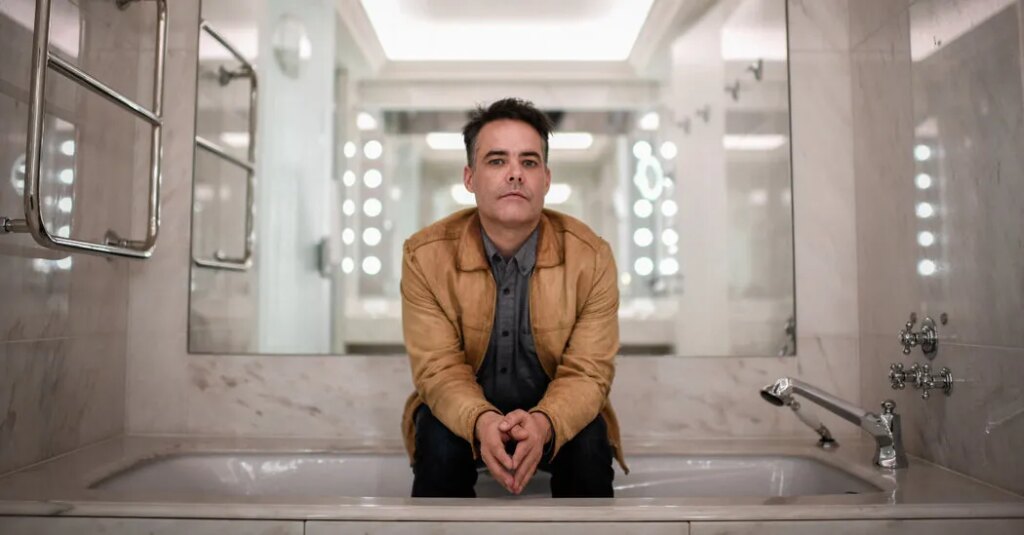
Sebastián Lelio, a director whose nuanced, humane portraits of women confronting isolation and society’s incomprehension won him an Academy Award, died Nov. 6 at his home in Santiago, Chile. He was 52.
His death was announced by Chile’s ministry of culture, which decreed two days of national mourning. In an Instagram post the actress Amalia Kassai, his companion, said that Mr. Lelio had died “due to reasons of health.” Chilean media reported that Ms. Kassai found him dead in their home in the Las Condes district of Chile’s capital.
Mr. Lelio’s compressed filmmaking career centered around a single motif: women faced with daily indignities. His most celebrated work, “A Fantastic Woman,” which won the 2018 Academy Award for best foreign language film, dramatized this struggle by making the central character a transgender woman, Marina, played with subtle precision by Daniela Vega.
Ms. Vega’s moving performance as she navigates routine humiliations highlights both Mr. Lelio’s vision and his unforgiving picture of what constitutes “respectable” society.
Marina’s well-dressed, upper-middle-class tormentors in Santiago have the veneer of civilization, but it is quickly stripped away by the director as he exposes their easy cruelty. Yet they are more than monsters, giving the film layers of complexity.
“Sorry, this is crude, I thought it was just a perversion,” Sonia, the spurned wife of Marina’s recently deceased lover says to her, on their first meeting. “When I look at you, I don’t know what I see … a chimera,” Sonia says. Marina is, literally, a “fantastic” woman.
Ms. Vega circulates in what seems a brisk modern metropolis — Santiago — that hides something much more brutal; for the spectator this evokes Chile’s torment under the long dictatorship of Gen. Augusto Pinochet in the 1970s and 1980s.
“Marina is only a heroine because her adversaries demand it of her,” the Le Monde critic Thomas Sotinel wrote when the film was released. “Absent their prejudices, their narrowness, their violence,” Mr. Sotinel wrote, “there would be nothing ‘fantastic’ about this woman.”
Mr. Lelio had already achieved a breakthrough with the 2013 film “Gloria,” his fourth feature, whose lead actress, Paulina Garcia, won the Berlin International Film Festival’s best actress award. Ms. Garcia, herself a playwright and director, played a lonely middle-age woman, whose previous marriage ended in divorce, seeking solace in Santiago’s dance clubs and edging into an uneasy affair with a retired military man.
As with his later films Mr. Lelio lets the camera and his actors do much of the work, eschewing dialogue in favor of gestures, facial expressions and carefully constructed moods to achieve a distinctive austerity in the film’s language.
The New York Times critic A.O. Scott called it “an unsentimental picture of everyday heroism.” Le Monde noted its “minimalist” style. That effect was quite deliberate, Mr. Lelio’s screenwriting partner Gonzalo Maza wrote in a tribute after his death.
Mr. Lelio set out two rules at the outset of the film’s production, Mr. Maza wrote. “The first: we can never feel sorry for Gloria. The second: Gloria can never say what she feels. No scene where she tells a friend she is lonely. No scene with a therapist. All of that was forbidden.”
The audience is left to infer these things from actors who might have been called on to improvise. “Sometimes he would delete the dialogue from our scripts,” wrote Mr. Maza.
Other films for which Mr. Lelio received acclaim included “Gloria Bell,” a 2018 English-language remake of “Gloria,” starring Julianne Moore, and “Disobedience,” from a year earlier, about the return of a freethinking New York photographer to her Orthodox Jewish neighborhood in North London. Manohla Dargis in The New York Times found “visual intelligence” in the story even if it was told “far too bloodlessly.”
His last major film was the 2022 “The Wonder,” a period drama set in Ireland after the Great Famine of the 19th century and starring Florence Pugh as a nurse from London who goes to a remote village to observe a child who has gone months without eating.
Mr. Maza noted that Mr. Lelio’s filmmaking “antenna” was always up, for his larger project of “building a universal empathy in which no one is ever a stranger.”
Mr. Lelio, explained his decision to focus on a transgender woman in “A Fantastic Woman” in an interview with the newspaper El País in 2017. “Who determines what is legitimate or not, what can be loved and what cannot? Cinema should be more like a question than an answer, and that’s what I’ve tried to do.”
Sebastian Lelio Watt was born in Mendoza, Argentina, on March 8, 1974, the only child of Gustavo Lelio, an architect, and Valeria Eugenia Watt Berg, a ballet dancer. Mr. Lelio was largely brought up in the family of Miguel Eduardo Campos Muñoz, his stepfather, an engineer.
“I remember my childhood always being on the move,” he told the Chilean newspaper La Tercera in 2013. “I never lived in one city for more than three years. My mom would move to a different city, my stepdad would change jobs and travel a lot, and we’d move with him.”
He attended the Colegio Concepción de Chillán, and studied journalism for a year at Andrés Bello National University and then in 1994 studied film at the University of Art and Social Sciences, both in Santiago. The following year he entered the Escuela de Cine de Chile, where he began making short films. His first feature, “La Sagrada Familia,” a family drama centered on intergenerational conflict, premiered at the San Sebastian International Film Festival in 2005.
Besides his companion, Ms. Kassai, Mr. Lelio is survived by his parents; his stepfather; two stepbrothers, José Miguel Campos Cuadra and Juan Francisco Campos Cuadra; and two stepsisters, Daniela Paz Campos Watt and Alejandra Sofía Campos Watt.
“I see cinema everywhere,” he told La Tercera in 2013. “In the sound, the dialogue, the lighting, the movement. Life is cinema.”
John Bartlett contributed reporting from Santiago.
The post Sebastián Lelio, Director of Nuanced Film Portraits of Women, Dies at 52 appeared first on New York Times.