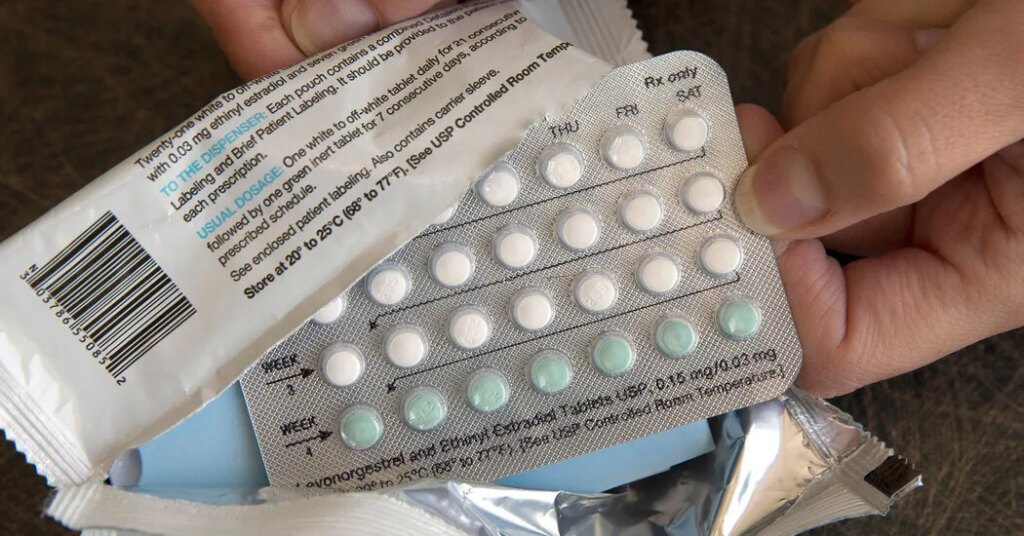
For several years, social media has been awash in doubt about the birth control pill and other forms of hormonal contraception.
In its place, both the right and some on the left have embraced fertility awareness, also called natural family planning, in which women chart their menstrual cycles to determine the days when they will be fertile, allowing them to conceive or to prevent pregnancy.
Now, a new study has found that more women are using fertility awareness to avoid getting pregnant.
Reanalyzing previous survey data, researchers at the University of Utah and the Guttmacher Institute, which advocates for reproductive rights, found that between 2022 and 2023, more than 2.2 million American women aged 18 to 44 used a fertility-awareness-based method to prevent pregnancy — about 7 to 8 percent of the total number of women using some form of contraception.
That number roughly doubles an earlier finding from the National Survey of Family Growth, a government-run survey with data from 2013 to 2017.
Shifting trends in birth control have been hard to quantify because of changes in how national data has been collected in recent years. As a result, the old and new numbers should not be compared directly, the researchers cautioned, but the new findings still indicate an increase. In Idaho, Nevada and Utah, where an exact comparison is possible, fertility awareness use nearly doubled, to 14.5 percent, between 2022 and 2026.
“All lines of evidence really point to there being a true increase,” said Chelsea Polis, a research scientist at Guttmacher who led the study.
The rise in fertility-awareness-based methods does not necessarily mean a corresponding fall in hormonal birth control use. Instead, women adopting fertility awareness may not have been using any contraception before, or may have been using a nonhormonal strategy like condoms.
The researchers statistically analyzed data from four previous surveys, including the National Survey, this time including women who were using fertility awareness and another method for birth control, like condoms or withdrawal. Previously, they had been classified as using fertility awareness only if they were relying on that alone.
Religious conservatives have long supported fertility awareness and condemned hormonal birth control, which has long been celebrated as the key to women’s sexual and economic liberation.
But as distrust in conventional medicine has grown, more women have sought out information about hormones’ effects on their bodies. Some progressives have championed fertility awareness as a route to bodily empowerment, while devotees of the Make America Healthy Again movement and wellness influencers have encouraged cycle tracking as a way for women to connect naturally with their bodies — a rare point of convergence in the highly contested landscape of women’s reproductive health.
The study noted this wide support, finding that fertility-awareness-based methods grew across different religious affiliations. No one religion seemed to be driving its rise, though researchers have found that Christian women were using hormonal birth control less than before.
Other studies had also found that fertility awareness use was growing. In a nationally representative survey of reproductive-age women from KFF, a nonprofit that conducts health policy polling and research, 18 percent of contraceptive users relied on a fertility-awareness-based method this year, including women who were simultaneously using another method. That was up from 13 percent in 2024.
Data on the effectiveness of fertility awareness methods come mainly from small studies that are not considered high quality, said Dr. Polis, who is reviewing the research on fertility awareness’s effectiveness. The little existing data shows that two methods that require women to meticulously chart their cycles by measuring physical symptoms, the Marquette Method and Sensiplan, are comparable to the pill in efficacy. Other methods have an unintended pregnancy rate of 10 to 34 percent, roughly on par with condoms, sponges and diaphragms.
Also fueling the interest in fertility awareness are dozens of apps and other devices that are designed to track women’s menstrual cycles, part of a fast-growing, multibillion-dollar market for women’s health technology.
Allie Beth Stuckey, a prominent conservative Christian commentator and podcaster who has criticized hormonal birth control, recently released a cycle-tracking app, ana kate, which pairs information about women’s cycles with Bible verses and guidance for women who are pregnant, postpartum or trying to conceive.
Research has shown that many women interested in fertility awareness are tracking their cycles on such apps, which often rely on little more than the date of a woman’s last period to predict days of fertility — an approach considered far less effective than charting cycles based on symptoms such as urinary hormones and cervical mucus. Learning how to do so generally requires taking classes from an instructor.
Using calendar-based apps “is not a real way for them to prevent pregnancy,” said Rebecca Simmons, a University of Utah professor who coauthored a study in the Lancet, a British medical journal. “That’s the scary thing that keeps me up at night.”
Despite rising criticism, hormonal contraception — including the pill, intrauterine devices, implants, injections and patches, which all employ synthetic hormones to prevent ovulation or make it difficult for sperm to reach an egg — remains widely popular, according to Julia Strasser, a researcher at George Washington University who analyzed medical insurance claims data at the request of The New York Times.
Decades of research has shown the birth control pill to be safe and highly effective for most women, while also giving them far more control over their lives. And doctors have long urged women to use hormonal birth control, seeing it as the most effective option. But many health care providers and researchers worry that the pill is now falling victim to politically motivated smears and social media-fueled misinformation.
Hormonal birth control has also become more difficult to access in some places, said Dr. Simmons.
Some women may have lost Medicaid coverage under President Trump’s One Big Beautiful Bill Act, making it harder for them to get hormonal contraception. In states including Idaho and Utah, family planning clinics have closed for lack of funding or no longer train clinicians in giving women implants or intrauterine devices.
The Trump administration is also asking family planning clinics applying for federal funding to prioritize expanding fertility awareness programs and helping women get pregnant instead of providing contraception.
But even mainstream health care providers are saying that fertility awareness should be taken seriously. Women who choose to use it because it fits their lifestyle, religious values or preferences need better data and resources, they say.
And in a field that has a history of pushing hormonal birth control more strongly on Black and poor women, clinicians should shift to prioritizing patients’ needs and desires over efficacy alone, said Dr. Polis, Dr. Simmons and several other researchers who were interviewed for this article.
“A lot of people are very frustrated by the lack of available options that are nonhormonal, and I think our field, the family planning field, has spent a long time not listening to that,” Dr. Simmons said, adding, “Many people are hungry to hear what their body is telling them, and fertility-awareness-based methods are a way to get a window into your own body.”
The post More American Women Are Turning to Natural Family Planning, Study Shows appeared first on New York Times.