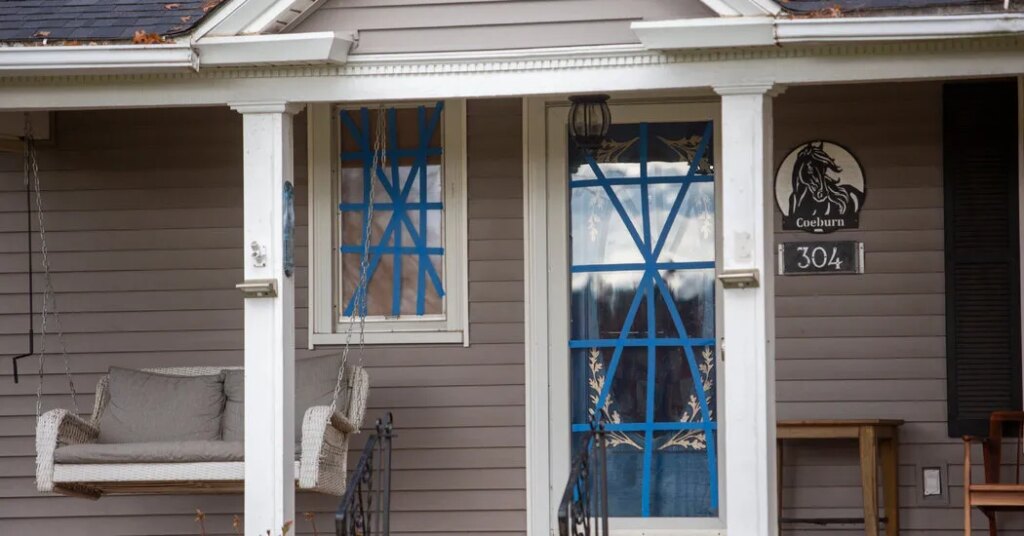
First, the Army planned to detonate a stockpile of dangerously unstable explosives at an Iowa facility on Friday, giving much of the public just a few days’ notice. After an uproar and a court challenge, officials pushed the controlled blast to Monday, then to Tuesday and again to Wednesday, the day before Thanksgiving.
But on Monday afternoon, President Trump mixed it up further, saying he has ordered the Army to wait until the legal challenge is decided.
The president wrote on his social media site that he would not allow the detonation unless Rob Sand, the incoming Iowa governor, also approved. And, Mr. Trump wrote, “If he or the Courts do not agree, we will have no choice but to not proceed with the controlled removal of these hazardous materials, and be forced to hold the incoming Governor responsible for any and all death or destruction caused by this very unfortunate, and long term situation.”
For decades, the Iowa site has stored explosives once used in military detonators. The Army said that five tons of the material, packed into 68 drums, have deteriorated and must be destroyed immediately or risk a spontaneous explosion.
Mr. Sand, the first Democrat to be elected governor in Iowa in 20 years, could not be immediately reached for comment. He has been critical of the way the Army has handled the deteriorating explosives.
“The situation is more dangerous and unpredictable than it ever should have been,” Mr. Sand wrote on X on Sunday evening. He asked why the Army had rejected alternatives and delayed action, and was now rushing to detonation. “Iowans deserve transparency over how we got here, then answers and accountability to stop this from ever happening again,” Mr. Sand wrote.
The planned explosion threatens to send a plume of lead dust over local communities, livestock and farmland, forcing some residents to either evacuate or try to seal themselves in their homes.
The American Lung Association is advising people to stay indoors for 24 to 48 hours after the blast, at one of the year’s busiest travel times. Local residents are studying weather forecasts to figure out where the toxic plume of lead dust may fall. Scientists have been taking soil samples ahead of the blast, in order to establish a base line for lead levels. Farmers are trying to figure out how to shield their livestock.
“We’re feeling less confident that anybody knows what they’re doing,” said Jim Plate, a retired teacher who lives with his wife about two miles south of the Army facility’s fence line. “We’re getting very frustrated by whatever the heck is going on.”
Elected leaders are calling for investigations into how a seemingly avoidable crisis developed.
Iowa’s senator-elect Josh Turek, a Democrat, also said on X that the public deserved answers as to “why the U.S. Army’s communication — both with the public and with Iowa officials — was delayed and inadequate from the beginning.”
In a statement, an Army spokesman said planning a controlled detonation had allowed it “to communicate and work with local, state, and federal leaders to implement public safety measures to the greatest extent possible.” The government had also taken “deliberate steps to minimize and contain the blast and airborne dust, including carefully evaluating weather conditions for the safest possible conditions,” and had adopted safety measures to minimize dust and debris, the spokesman said.
Impending colder weather in Iowa adds to the urgency, the Army said, because freezing temperatures could fracture the unstable crystals inside the barrels, potentially triggering an uncontrolled explosion, which could be far more dangerous than a planned detonation.
But even a controlled detonation is expected to produce a plume of lead dust stretching as far as 60 miles, over communities, farms and the Mississippi River watershed.
Lead is a neurotoxin and there are no safe levels for exposure. It poses a particular danger to children and pregnant women. Lead can interfere with fetal brain development, cause permanent cognitive and behavioral harm and increase the risk of premature births or miscarriage.
On Sunday, a team of scientists fanned out across the rural farmland south of the Army’s facility. Equipped with sensitive air monitors, plexiglass and filters that capture airborne particles, they set up their gear in backyards and placed soil samples in plastic bags with gloved fingers.
“We’ve never done anything like this before,” said David Cwiertny, director of the Center for Health Effects of Environmental Contamination at Iowa University. “The only other place where you can get data like this is the middle of a war,” said Ezazul Haque, an environmental toxicologist from John Jay College, who arrived from New York City last week to study the plume.
Dr. Cwiertny said there is potential for “significantly high concentrations” closer to the blast, and that any lead dispersal would be dictated by the amount of lead spread by the detonation and the size of the particles.
“I don’t know that we have a good sense. I would hope that the Army does,” Dr. Cwiertny said. With the delay to Wednesday, the scientists are once again repositioning their equipment, he said.
The path the plume will take depends on the wind, Dr. Cwiertny said, standing over an array of sensors and instruments near fields of harvested corn south of the Army facility. And without word from the Army on the timing of the detonation, he said, the scientists were left needing to account for different scenarios. “We’re flying blind,” he said.
The Army has said that it would clean up any soil contamination that exceeds federal thresholds and that residents can file claims for resulting damage. The Iowa Farm Bureau has been advising its members to take soil samples before and after the blast for liability purposes. In a message to members, Patrick Wall, a beef specialist, urged farmers to also remove cattle from grazing areas and from ponds and other drinking-water sources, and if possible, move them to indoor shelter.
Last year, the Trump administration weakened tripled the threshold of lead that triggers urgent government soil excavation at contaminated residential sites. The Environmental Protection Agency also raised the level of lead in children’s blood used to set cleanup goals. The changes could make it harder for nearby residents and farmers to secure government-led cleanup or pursue contamination claims.
The E.P.A. did not immediately respond to a request for comment.
About two miles south of the Army’s fence line, Jim and Krys Plate thought they’d be in the clear when the Army planned the explosion of lead azide for Friday, when the winds were blowing northward. Then the blast was delayed, and they found the home they share with their two teenage daughters potentially at the center of a plume of lead dust.
“I’m terrified,” said Ms. Plate, a retired second grade teacher, during an interview on Sunday. “Everybody knows that the acceptable level of lead is zero.”
“We didn’t have any communication from anybody officially,” Mr. Plate said. “This could have been done way better.”
He said that social media has been a swirl of unreliable information, and on Sunday evening the couple was unsure whether or not the blast would come the next day.
“I’m really angry about this. I feel like we’re guinea pigs,” Ms. Plate said.
The family is planning to seal their doors with towels and stay inside for at least 24 hours after the blast and into Thanksgiving, which they plan to celebrate at home.
While agriculture officials were telling farmers to move their livestock indoors, “That’s literally not possible,” said Steve Lucie, a fifth-generation cattle rancher in Hancock County Ill., across the state border from the Iowa blast site. Regarding the potential for a plume of lead dust overhead, he said, “We’re just going to have to weather it if it happens to come over our farm.”
“We don’t trust the government much anymore,” Mr. Lucie said. “Maybe this is why.”
Murray McBride, an emeritus professor at the Cornell College of Agriculture and Life Sciences, said lead dust could settle on leafy crops such as lettuce, making them hazardous to eat. Some of the residue might wash off, he said, but not all of it.
He added, however, that if lead settled on soybean or corn plants, he did not expect it to reach the edible seeds or grains. And while cattle could be harmed if they ingested enough lead-contaminated dust from forage, animals showing acute poisoning symptoms would be an extreme case. Lead, which is relatively immobile and insoluble, was also unlikely to get into the meat or milk, he said.
Still, lead deposited on soil would likely remain near the surface, and if testing showed elevated levels afterward, the surface soil would need to be removed or covered with clean soil. But there were many uncertainties, he said. “There’s no way for me to predict how many grams of this lead would be deposited. So we just don’t know the extent of it.”
A local pastor, Chad Savage, planned to open his church for people who wished to shelter during the blast, whenever it came. “Communication was lacking, and that causes panic,” he said.
Over the weekend, local officials said they had remained in the dark.
“We’re asking the Army, what is going on?” said Laura Liegois, the city manager in Fort Madison, Iowa, a city south of the facility where about 10,000 people live. “What does that plume look like? Will it hit us?” she said.
The post In Iowa, Chaos and Confusion Over Planned Ammunition Explosion appeared first on New York Times.