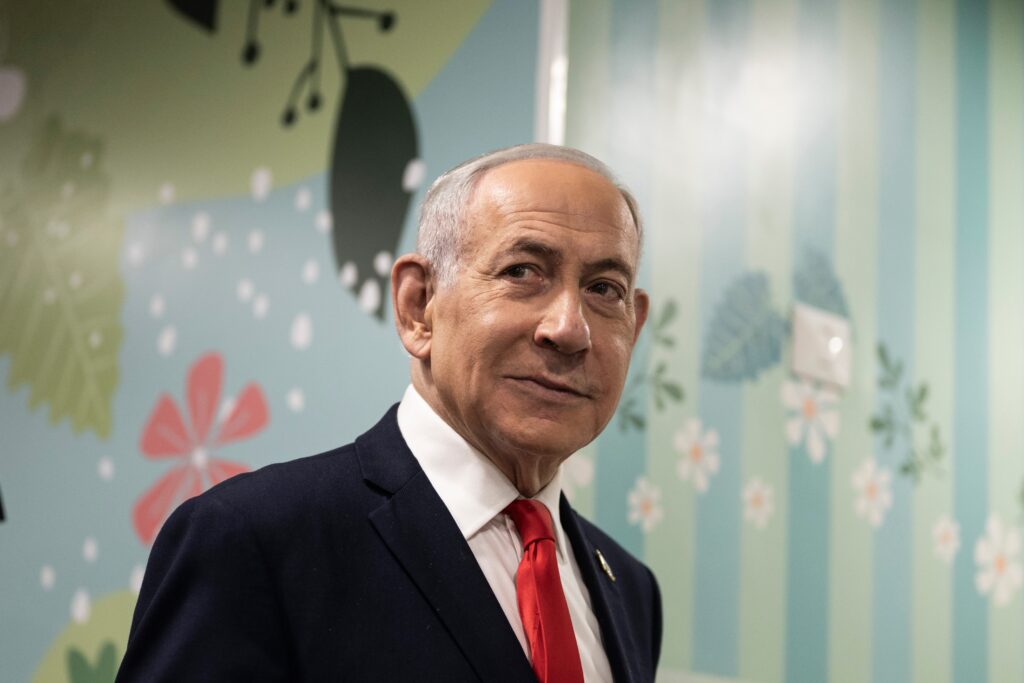
TEL AVIV — If his political opponents succeed in forming a new government, Israel’s Benjamin Netanyahu stands to lose more than just his job as prime minister. Legal experts say he will also lose the heavy leverage the office has given him to fight three corruption cases in which he is charged with fraud, breach of trust and taking bribes.
The three cases are being prosecuted in a single trial. On the eve of his testimony nearly two years ago, Netanyahu said he had been “waiting eight years for this day to present the truth and permanently shatter these delusional, baseless allegations against me.”
What followed, however, was more than a year of delays with many hearings cut short or canceled at Netanyahu’s request. He often cited “security and diplomatic constraints” even though he had insisted that he could function fully as prime minister while also standing trial.
Ultimately, his testimony stretched for a year and a half, over 98 sessions, before ending in June.
“The judges are treating Netanyahu with kid gloves,” said Yael Freidson, the legal affairs correspondent for the newspaper Haaretz, who has covered the case since the indictment was filed in 2020. No ordinary defendant, Freidson said, “would have been given so much time to testify and for the defense case.”
Soon, Netanyahu may have to face his prosecutions without the prime minister’s office behind him. After Netanyahu lost his majority in last month’s election, President Isaac Herzog tasked Gadi Eisenkot, a former military chief, with forming a government. Eisenkot has until early December with a potential 14-day extension to present a coalition.
Eisenkot has accused Netanyahu of blurring the lines between national security and his own political survival by potentially seeking to convince President Donald Trump to renew active military attacks on Iran. That could add pressure on Eisenkot to form a unity government with Netanyahu.
But Netanyahu’s personal legal problems are also a factor in the coalition talks. Israeli media have reported that Netanyahu’s Likud party is pushing for a rotation deal under which Netanyahu would serve first as prime minister and then step aside to become president as the Knesset moves up the presidential election to secure the post for him.
The presidency, largely a ceremonial post, would carry more than prestige. Under Israeli law, the president, who is chosen by the Knesset, cannot be criminally prosecuted during the seven-year term. Such a move would probably draw protests from Netanyahu’s opponents and legal challenges before the Supreme Court.
But some analysts say a move to the presidency could be the key to getting Netanyahu to step aside, because the only objective he cares about more than clinging to power is avoiding prison.
“One thing was clearly evident: Netanyahu fears that the criminal proceedings will lead him to prison,” Haaretz military analyst Amos Harel wrote in his book “06:29 — Anatomy of a Failure.” As the corruption charges piled up, Harel wrote, “Netanyahu’s top priority became personal survival.”
Netanyahu is facing three separate cases, and some of the charges potentially carry a stiff prison sentence if he is convicted. He has long denied any wrongdoing.
In the first case, he is accused of offering favorable regulatory treatment to one of Israel’s biggest media moguls in return for positive press coverage.
Another case charges that Netanyahu considered a deal with the publisher of Yediot Ahronot, in which Netanyahu would try to limit the circulation of a rival publication in exchange for favorable coverage.
In the third, prosecutors have accused him of exploiting his office for personal gain, including his acceptance of extravagant gifts, such as champagne, cigars, jewelry and other items worth nearly $200,000, in exchange for diplomatic and other favors for billionaire associates.
In 2021, when a coalition led by Naftali Bennett and Yair Lapid ousted him, Netanyahu spent a year and a half in the opposition as his trial went on.
During that period, his lawyers negotiated a possible plea deal, but Netanyahu rejected an offer to accept a finding of “moral turpitude,” which would have barred him from public office for seven years.
After he returned to power in December 2022, Netanyahu’s government spent much of its term trying to weaken the judiciary. The government also voted to fire Attorney General Gali Baharav-Miara, whose office is prosecuting Netanyahu.
The High Court unanimously annulled the dismissal, and Baharav-Miara remains in office. Critics said both efforts were driven at least partly by Netanyahu’s legal situation, which he denies.
The trial is now in the defense phase. Judges have ordered hearings five days a week to finish testimony before the presiding judge retires in 2028.
Freidson, the legal affairs journalist, said that some witnesses seemed afraid to testify against Netanyahu after he returned to the prime minister’s post. But regardless of his political status, she said, the judges already had suggested dropping the bribery charge, “a significant weakness in the case.”
Netanyahu’s exposure goes beyond the criminal corruption trial.
A state commission of inquiry is investigating a $2 billion deal for submarines and naval vessels from the German firm ThyssenKrupp. Netanyahu has not been named a suspect in a related criminal case, but some of his closest aides have been implicated.
Two years ago, the commission sent warning letters to Netanyahu and other officials. The letter to Netanyahu said his decisions between 2009 and 2016 on submarine and naval vessel deals with Germany had “endangered state security and harmed Israel’s foreign relations and economic interests.”
The commission is now holding closed-door hearings, in which those who received warning letters can contest the evidence. So far, Netanyahu has not appeared to testify.
In March 2024, a separate state commission investigating a deadly crowd crush that occurred during a religious festival on the slopes of Mount Meron found Netanyahu personally responsible for failures that preceded the 2021 catastrophe in which 45 people were killed.
Harel wrote that those commissions, set up under the Bennett-Lapid government, were the reason Netanyahu has refused to allow an independent investigation into the failures that preceded the Oct. 7, 2023, attack by Hamas.
Eisenkot campaigned on establishing such a commission, and after the election he pledged to immediately advance legislation to create one.
Netanyahu is also facing an International Criminal Court arrest warrant over the war in Gaza, and he is at risk of arrest if he travels to any country that signed the Rome Statute, the treaty that created the court.
During a visit to Israel last year after the return of the last living hostages from Gaza, Trump used a speech to the Knesset to publicly call on Herzog to pardon Netanyahu. Weeks later, Netanyahu formally asked for a pardon, without admitting guilt.
Herzog has not granted it.
Instead, the president said he would consider the request only after efforts to reach a plea deal are exhausted, and he invited the prosecutors and Netanyahu’s lawyers to hold talks. The attorney general and the state attorney agreed, but only if there were no preconditions and the talks would not slow the trial.
The case has grown to enormous proportions, with more than 60,000 pages of transcripts, “an amount of material that will take months to write the verdict,” Freidson said.
“It would be a relief for all sides if this ends in a plea deal,” she added. “But when that will happen isn’t clear.”
The post For Netanyahu, losing power could mean losing key shield in corruption trial appeared first on Washington Post.