The Kennedy Center wasn’t mentioned by name.
Timothy O’Leary, Washington National Opera’s general director, was introducing a performance of “Nixon in China” on Saturday from a makeshift thrust stage inside Constitution Hall near the White House. It’s one of several venues the company has adopted since it broke off from the John F. Kennedy Center for the Performing Arts, an institution that President Trump has tried to remake and rebrand in his name.
Welcome, O’Leary told the audience, to “our new home, for now.” The company’s usual base, he added, is “not a place where we can be just now.”
Since Washington National Opera left the Kennedy Center in January, the president and his allies on the board have announced that the center would be shut down for a two-year renovation; attempted to restore his name to the facade even after a judge had ordered it removed; and threatened to demolish the building. Now it languishes in legal limbo, its theaters dark night after night.
The opera company, however, has kept going. Through emergency fund-raising and creative programming by its artistic director, Francesca Zambello, it was able to resume its season after only a brief pause. And if O’Leary was coyly vague about the Kennedy Center, Washington National Opera’s beliefs could not have been clearer in its performances at Constitution Hall: “Nixon in China” on Saturday and the concert “We the People” on Sunday.
Elkhanah Pulitzer’s production of “Nixon,” whose run overlapped with Trump’s recent visit to China, was an extended argument for the power of facts and documentary evidence. “We the People” presented a vision of the American ethos rooted in popular resistance to tyranny and the insistence that a better future is always possible.
“Nixon” (1987) was written in part at the Kennedy Center, where Peter Sellars, who directed the original production, ran the American National Theater. It was a miracle of collaboration, with a Technicolor score by John Adams and a libretto, by Alice Goodman, that is unmatched in contemporary opera.
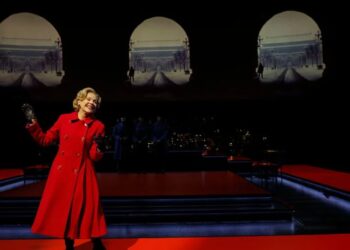
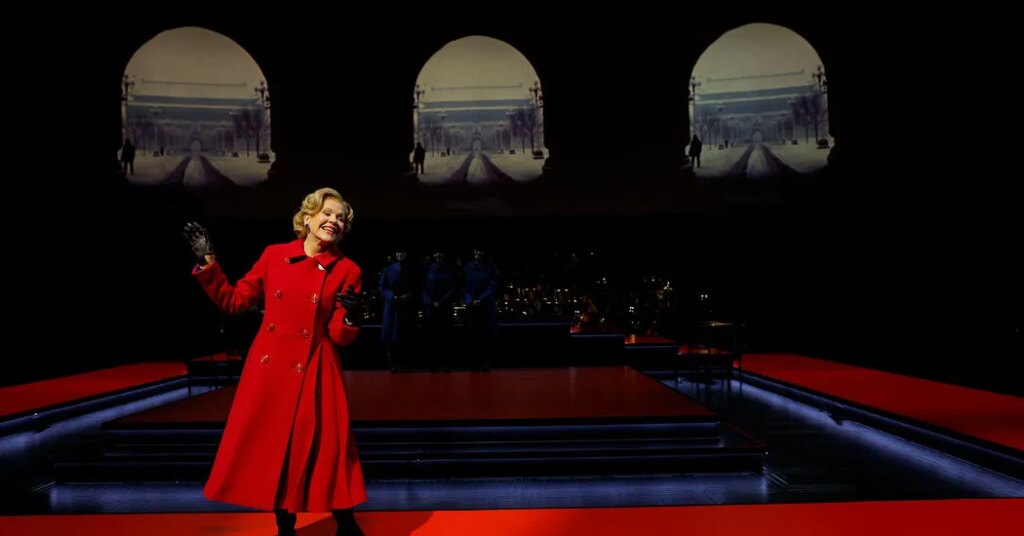
Sellars’s production mixed recognizable images with fantasy; Pulitzer’s, adapted from her concert staging at the Los Angeles Philharmonic in 2017, is all image. At Constitution Hall, videos from Nixon’s 1972 visit to China were shown (in Bill Morrison’s projection design) as triptychs on a wide screen above the orchestra, and on a Jumbotron-like box suspended over the stage.
The audience could see Nixon’s plane, the Spirit of ’76, land in Beijing. When Nixon shook hands with Chou En-lai, the Chinese premier, historical clips matched the action onstage. Jessica Lang’s choreography for an imagined version of the ballet “The Red Detachment of Women” unfolded in front of stills from a recording of the real thing. It all brought fresh meaning to Nixon’s “News” aria, but in an age of deepfakes and alternative facts, it also luxuriated in the truth of an undoctored primary source.
Under Robert Spano, Washington National Opera’s music director and a seasoned Adams conductor, the orchestra’s handling of the score was wonderfully vivid, full of details from individual instruments. As Nixon, the baritone Thomas Hampson often had a dry and hard-edged sound, a contrast to the comfortable, bright tenor of John Matthew Myers as Mao Zedong. Joo Won Kang, with a weighty baritone and dramatic subtlety, stood out as Chou En-lai.
But the finest performances belonged to the women: the soprano Renée Fleming as a charismatic and richly characterized Pat Nixon, and the soprano Kathleen Kim, who brought frightening Valkyrie force to Chiang Ching, Mao’s wife.
Hampson and Fleming returned on Sunday for “We the People,” which also featured the fervent tenor Jonathan Tetelman. Fleming was a shape-shifting wonder, with her velvety timbre on full display in an aria from “Adriana Lecouvreur,” and her dignified stage presence bringing real comfort to “You’ll Never Walk Alone,” from “Carousel.” A pleasant surprise, though, was her straight-toned folk singing in the traditional song “In the Pines”; she could anchor a Dolly Parton tribute if she wanted to.
The headliner for “We the People” was not Fleming, but the emerging artist Amber R. Monroe. She was being given the annual Marian Anderson Vocal Award, named after the pathbreaking Black singer who was once denied a performance at Constitution Hall because of her race. Monroe, with room to grow, nevertheless has a versatile, full-bodied sound that was lush in “O patria mia,” from “Aida,” gospel-inflected in an excerpt from “Harriet Tubman: When I Crossed That Line to Freedom” and crowd-pleasing in “Lift Every Voice and Sing.”
O’Leary returned to the stage during Sunday’s concert, saying it was the capstone of Washington National Opera’s programming for the United States’ 250th anniversary, and of “a year that brought our own declaration of independence.”
This time, he mentioned the Kennedy Center, but only in passing. Winners of the Marian Anderson Vocal Award used to get a solo recital there. Now, instead of appearing with just a pianist, the singer would be joined by a roster of stars and young artists, and supported by a full orchestra. In other words, the company was bucking tradition to try something new, and bigger.
The post Exiled From Kennedy Center, but Sticking to Its National Identity appeared first on New York Times.