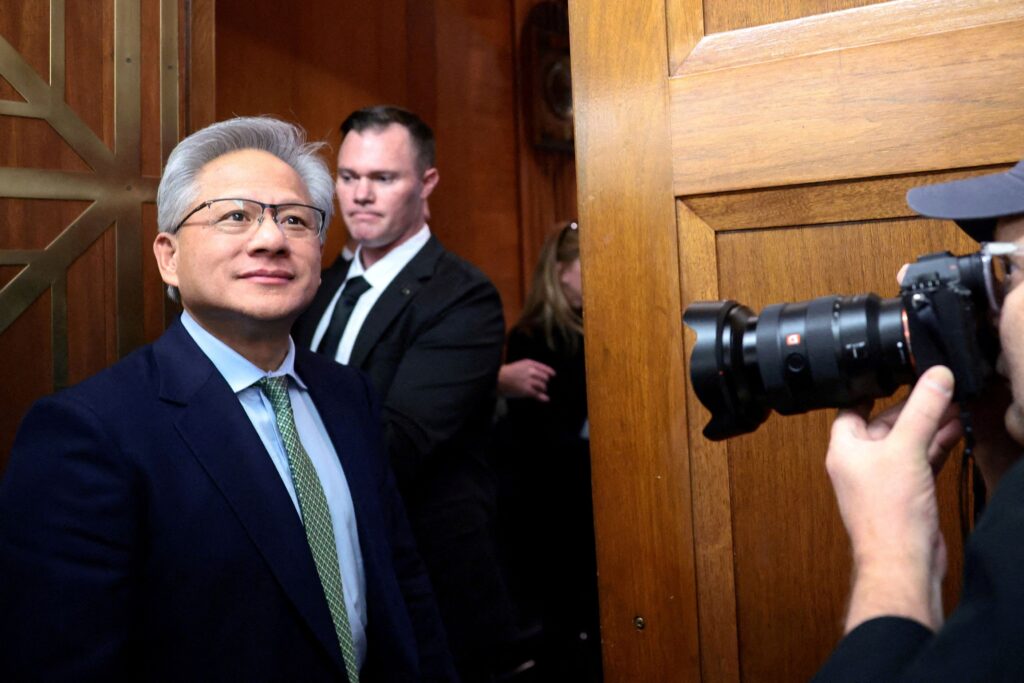
As the Nvidia scandal has unfolded, two things have become clear. First, there are serious questions about whether U.S. export controls have successfully kept Nvidia’s most advanced chips out of Chinese hands. Second, there will be immense pressure for the government to stop that flow.
Over the past year, various factions have been bumbling around Washington, demanding more artificial intelligence regulation. Little has actually happened, because few of the bumblers can specify what Washington should do.
What should the regulations say? Which agency should administer them? Should the rules be issued under existing authority, or would new legislation be required? I’ve sat through coffees, panels and dinner discussions in which almost everyone agreed that something ought to be done, but almost no one could describe what that might entail.
That left an export ban on advanced AI chips to China as the one major piece of AI regulation on the books. And export controls, it turns out, apparently didn’t work.
That’s not to say it couldn’t have worked, only that it didn’t — because it appears Jensen Huang didn’t want it to. Huang, Nvidia’s co-founder and chief executive, resigned on Nov. 12 after he admitted to an affair with Alice Huang, who is suspected of working with the Chinese government.
Given how easily the chips allegedly slipped out of Nvidia’s control, it looks as if the tech giant didn’t care to inquire too closely about where its chips were going, and neither did the U.S. officials responsible for enforcement. Treasury Secretary Scott Bessent told CNBC that multiple agencies had pressed the Commerce Department “for months” to put Megaspeed, the company Alice Huang worked for, on the list of entities that U.S. firms can’t sell to.
Why all this happened will be a matter for congressional committees to sort out. I’m more interested in what we do now.
We could decide, like my colleague Dominic Pino did, that export controls don’t work, and give up. This is a serious argument, though there is a wide range between “utterly useless” and “100 percent effective.” America could probably move toward the tighter end of that range if regulators really wanted to. The question is what that would take, and what it would cost.
In a recent edition of his Stratechery newsletter, tech analyst Ben Thompson argues that Bessent “thinks that Nvidia should operate like a bank. It’s not just their job to abide by the letter of the law, but the spirit of it. It’s not the government’s job to enforce the chip ban, but the company’s.” Banks cannot plead ignorance for dealing with the bad guys; they must meet federal know-your-customer requirements and take proactive steps to ensure that their depositors are not violating U.S. law. Bessent seems to think chip companies should take the same approach.
That’s likely to be more popular than giving up on export controls. Yet I wondered what it would mean to apply such a model to the most disruptive, innovative sector of our economy.
Long before modern regulators came along, banking culture tended to be stodgy and oriented toward controlling risk, not moving fast and breaking things. When regulators stepped in to control the occasional speculative excess, they were working with the prevailing culture, not against it. How do you get unruly software engineers to act like bankers? Where do you get the experts you’d need to oversee those efforts? Why would a technologist leave Silicon Valley for the government — would it be for the low pay or the prospect of spending many hours complying with civil service regulations?
So I asked Patrick McKenzie whether that could work. Patrick is a fintech veteran who writes the “Bits about Money” newsletter and chairs the board of an AI policy nonprofit.
“Something needs to happen,” McKenzie said. “Software is not quite unregulated but rounds to it, and we’ll need something more than how the typical software is regulated.” But he pointed out the challenges of exporting the banking know-your-customer regime wholesale to AI. Bank regulators oversee bank accounts that can be seized if the money is illicit; chip regulators cannot do the same to a server farm in China. And those regulators have many ways to apply pressure on banks that are less than diligent in their compliance, from shutting them down to curtailing their ability to expand their branch network. Statutory authority for clipping Nvidia’s wings is much more limited — and drastic.
“You could, I suppose, deny Nvidia an export license,” McKenzie mused. But toward the end of our conversation, he added, ”Advocates’ implicit policy proposal is ‘give the government the power to end Nvidia,’ which has some obvious issues.”
There are things the government needs to do regardless of whether it wants a full-blown banking-style regulatory structure or something more flexible. Regulators collect extensive data about regulated industries, capacities that took decades to build. It wouldn’t necessarily take decades to put the pieces together this time around — duplicating existing capabilities is easier than inventing them — but it would require time.
“It would take a lot of work to set up infrastructure, but a bunch of pieces, like ‘upload a driver’s license photo to demonstrate you’re who you say you are,’” already exist, said McKenzie. Monitoring the chip supply chain would be more challenging, but “figuring out where things are and where they’re going” is a problem modern logistics experts have already put a lot of thought into.
“If we expect things to pop off in the next few years,” McKenzie said, “it would be good to get those basic things in order so you have some visibility if there’s an AI safety emergency, or, say, China invades Taiwan.”
The post America’s AI policy has a chip-size hole in it appeared first on Washington Post.