For many people, face masks are a relic of the covid-19 pandemic, something tucked away in a drawer and largely forgotten. But with flu season off to an early start, measles outbreaks all over the news (plus the announcement that the United States has lost its measles-elimination status) and millions of Americans preparing to travel for the holidays, is it worth digging out those old N95s?
Wearing a mask in everyday settings isn’t a must for most healthy people, according to the U.S. Centers for Disease Control and Prevention. But masking can offer an extra layer of protection for those who are traveling to spend the holidays with loved ones who are more vulnerable to serious illness or complications — particularly adults over 65, people with weakened immune systems, pregnant women and babies, said Jodie Guest, senior vice chair of epidemiology at Emory University’s Rollins School of Public Health.
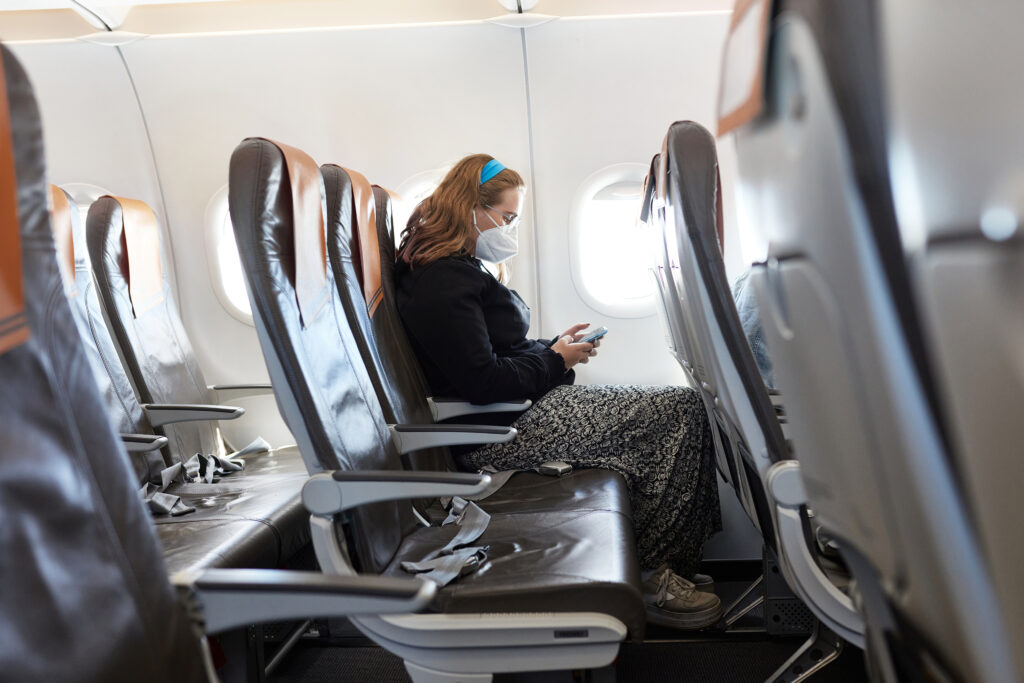
Even if you’re not particularly concerned about getting seriously ill, you may just want to avoid spending your holiday in bed with the flu. Anne Rimoin, associate dean for global health at the UCLA Fielding School of Public Health, wears a mask on airplanes most of the time, but particularly during respiratory virus season. “It’s a really small inconvenience compared to losing several days of a trip due to any number of things that you can catch,” she said.
The right mask acts as a filter, reducing the number of infectious particles you breathe in. When worn correctly and consistently, a well-fitting mask can help protect you against respiratory viruses including flu, covid-19 and RSV. Certain masks can also provide an added layer of protection against measles — which also spreads through airborne particles — but they are no substitute for vaccination, Guest said.
Not every expert considers masking on planes necessary, though. Here’s how to weigh your risk, when wearing a mask makes the most sense and which types offer the best protection.
The risk of getting sick on a plane
Sitting shoulder to shoulder with hundreds of strangers in a confined space for hours may seem like the perfect conditions for catching a virus, but Joseph Allen, a professor at the Harvard T.H. Chan School of Public Health and director of its Healthy Buildings Program, said airplanes have some of the best ventilation systems of any indoor space.
“I don’t wear a mask on an airplane,” he said. “I think this idea that airplanes are a high-risk environment is overstated.” (Although he doesn’t routinely mask on flights, he said he supports the decision of anyone who chooses to do so.)
About half the air supplied to the cabin comes from outside the aircraft, while the other half is recirculated through high-efficiency filters that capture 99.97 percent of particles, including bacteria and viruses, he said. Additionally, cabin air is refreshed 20 to 30 times an hour, which is a higher rate than in most office buildings, according to the CDC. Air is also delivered near each row, helping reduce the buildup of particles, Allen added.
But good ventilation doesn’t mean there’s no risk of infection. “I agree that modern aircraft actually have a very good air filtration system, but you know, that said, if you’re sitting next to someone who’s infectious for five hours, the airplane ventilation isn’t necessarily going to eliminate that risk,” Rimoin said.
Guest also wears a mask when she flies, particularly on long-haul trips. Her reasoning is twofold: “I want to be able to participate in the party and the family gatherings when I get there, and I want to keep everyone else there safe.”
If you’re feeling under the weather, masking will also help protect others from you, Guest said.
When and where you should consider a mask
Your flight isn’t the only potential point of exposure to viruses. The airport is a “mass mixing event and potentially with less ventilation,” Guest said. For people concerned about their health or that of someone they’re visiting, she recommends putting on a mask when entering the airport and keeping it on until you reach your destination.
Rimoin agreed, noting that the risk of infection isn’t limited to the time you spend in the air. “It’s going to exist throughout your entire travel experience,” she said, from taking public transportation to get to the airport to waiting at the gate.
Other higher-risk times are during boarding, deplaning or deicing, when airlines probably do not have the air ventilation systems running, Allen said.
And anytime you’re in close contact with someone who appears to be sick would be a smart time to mask.
Bottom line, think beyond the flight itself. The precautions you take on the other parts of the trip matter too, Allen said.
Which masks offer the best protection
The most protective mask is a National Institute for Occupational Safety and Health-approved N95 respirator, which filters at least 95 percent of airborne particles under standardized testing conditions. These masks typically have a rigid cone shape, two straps that go around your head and a moldable nose piece that helps create a tight seal against your face, Rimoin said.
But the best mask is one that fits well and is comfortable enough to wear consistently. KN95 and KF94 masks (the Chinese and Korean equivalents of N95s) are good alternatives for people who find N95s uncomfortable during long flights, Rimoin said. Guest personally prefers KF94 masks, which have more of a tentlike shape, because they fit her face better.
Whatever style you choose, look for a mask that rests snugly around your nose, cheeks and chin without leaving large gaps that allow air to leak around the edges.
Experts say to skip the surgical masks. They provide some protection, specifically against large-particle droplets, sprays or splatter that may contain germs, “but they’re generally less effective for protecting the wearer because air leaks around the edges,” Rimoin said. This can allow smaller particles to still reach your nose and mouth.
And you can go ahead and toss those pandemic-era cloth masks. “Those are not what we would consider helpful in protecting you or protecting others around you,” Guest said. (Cloth masks probably provide more protection than no mask at all, but they are much less effective than N95s and even surgical masks, so if you’re really concerned about getting sick, a properly fitting N95 is the way to go.)
Speaking of tossing masks: Are those unused N95s or KF94s you have shoved in the back of a drawer still good to use? Many disposable N95 respirators have a manufacturer-designated shelf life of about five years, although it varies by product, Rimoin said. Over time, components such as the elastic straps and nose foam can deteriorate, making it hard for the mask to form a seal, she added. But an expiration date doesn’t mean it suddenly stops working.
Before using an older mask, inspect it carefully. If it has been stored in a clean, dry, temperature-controlled environment, the straps are still tight and the mask forms a snug seal against your face, it may still provide protection. But if it’s damaged, misshapen, dirty, damp or doesn’t fit properly, buy a fresh supply before your trip, Rimoin said.
What else you can do to stay healthy
Ultimately, masking is one of several ways to reduce your risk of getting sick — all three experts emphasized the importance of staying up-to-date on vaccinations, such as for flu, COVID19 and RSV when appropriate for your age and risk factors.
Allen also recommended improving the ventilation at holiday gatherings whenever possible. Crack open some windows to create a cross breeze and turn on the fans and any exhaust fans that vent outdoors. If you have a portable air purifier with a HEPA filter, Allen recommends running it at its highest speed.
Although many people have moved on from masking, that doesn’t mean the practice no longer has a place. Respiratory illnesses existed long before covid-19, and they’ll continue to circulate. A well-fitting mask can help reduce your exposure, Rimoin said.
“You don’t have to wear them everywhere all the time, but there are times when they can make really good sense,” she said, “and that is particularly during respiratory virus season.”
The post Should you mask up for holiday travel? Here’s what experts say. appeared first on Washington Post.