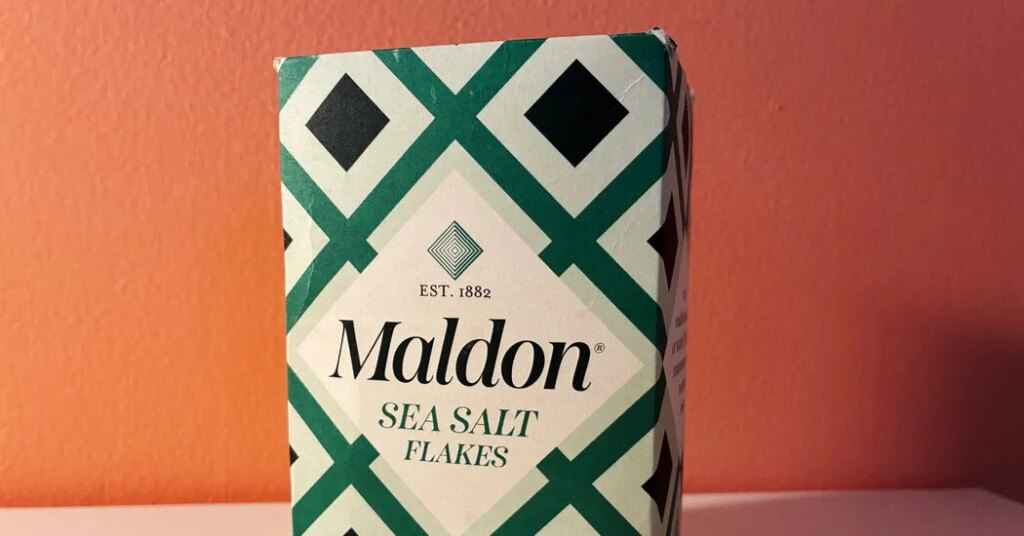
What makes a box of flaky, artisanal seasoning worth its salt?
Culinary connoisseurs are mulling that question as scrutiny is directed at the credentials of a cult-favorite brand of salt.
Maldon Sea Salt, a popular flaky variety found in pantries around the world, was at the center of the shake-up. Fans of the brand, which include Nigella Lawson and Ina Garten, have lauded its taste and pyramidal shape, finishing fancy dishes or desserts with a sprinkle.
Contributing to its popularity was Maldon Salt’s story as a homegrown business, founded some 140 years ago in the English town of Maldon in the county of Essex that was once a site for an Anglo-Saxon era battle. Its salt flakes, the company said, are hand-raked from the town’s River Blackwater estuary.
An investigation published Sunday by the British newspaper The Observer has complicated that image. Maldon, according to the report, was not made only with sea salt from local seawater. Trucks with rock salt imported from mines in Germany were spotted at a production facility — a fact that Maldon had not widely publicized on its packaging or its website.
The company said in response to The Observer that the imported salt came from an ancient sea, and that its “100 percent sea salt” labeling was accurate. Food regulators, including in Britain, where there is no strict definition for artisanal sea salt, approved the product.
Still, the revelation that one of Britain’s most popular artisanal brands included imported German salt rocked aficionados of seasoning.
Some took it with a pinch of salt, adding that the raw material — the inorganic compound sodium chloride — was at least authentic. Others, including food influencers, said they felt deceived, and raised questions about whether the product lived up to its premium, artisanal branding.
Then, there were those amused or exasperated by the newly nicknamed “Saltgate,” with several outlets calling it a “posh” scandal over a brand that some perceive as a status signaler. People online joked about the “salty comments.”
Salt can come in many forms: Table salt, kosher salt, sea salt, Himalayan rock salt. While common forms are industrially produced and inexpensive to buy, manufacturers of more traditional salt brands, which rely on age-old methods, can command higher prices because of their distinct texture, taste and methods.
Maldon Salt, founded in 1882, has in recent decades built a passionate following by influencers and chefs alike who often sprinkled it as a finisher over steaks, in breads or atop chocolate chip cookies. The company made about 39 million pounds, or $51 million, in revenue in the financial year that ended March 2025. (An 8.5-ounce box of salt costs about $13 at Walmart.)
Days after the investigation published, the company said it would review packaging and be more transparent about its process.
“Our previous information focused on the finished flakes and the craft of our salt makers, without giving enough detail about how we prepare our brine,” the company said on its website, adding that it took responsibility for “not sharing that story openly on our packs and website sooner.”
By Friday, Maldon’s website had been updated to include details about its “salt-on-salt” method, which it said was behind the success of the product. Seawater from salt marshes near Maldon is filtered over pure rock salt from Germany, the company said, making a concentrated brine. The mixture is then evaporated in salt pans and harvested by hand.
A spokesman for K+S, a German miner of rock salt whose trucks were spotted at a Maldon Salt facility, declined to comment on specific deliveries. But he said the supplier used rock salt deposits derived from the Zechstein Sea, an inland body of water that evaporated 250 million years ago.
The filtering process was an “essential step” to achieve the product’s signature flake, Maldon Salt said in an emailed statement on Friday. “There is no Maldon sea salt without pure rock salt.”
In Britain and in the United States, there are no specific regulations that define “sea salt” when used on labels. Other countries, such as Canada and France, have stricter rules around such labeling.
Other artisanal salt brands, perhaps seeing a marketing opportunity, posted on social media to suggest alternatives for discerning sea salt users.
“Our sea salt is made from 100 percent Anglesey seawater,” Halen Môn, a Welsh artisanal sea salt company, posted on social media Friday. “Absolutely nothing is added.”
The post Maldon Salt’s Authenticity Is Questioned, Leaving Foodies Shaken appeared first on New York Times.