Five years ago, a 71-year-old man with a history of heart failure went into cardiac arrest while shoveling snow outside his home in Trollhattan, Sweden.
A doctor passing by began CPR as Sven’s wife called emergency services. In just over three minutes after dispatch, according to a case reportpublished in the New England Journal of Medicine in 2022, a drone arrived with an automated external defibrillator (AED), which analyzes heart rhythm and can deliver an electric shock to restore a normal heartbeat.
A neighbor retrieved the AED, which had landed just 33 feet from the victim. The first shock was delivered shortly before emergency responders arrived.
The man regained consciousness after three more shocks in the ambulance en route to the hospital. He survived and made a full neurological recovery, according to the case report.
Once just a dream and a pilot program, AED-carrying drones are now integrated into many emergency response systems in western Sweden, covering 15 percent of the region’s population, according to regional officials. As of February 2025, drone operator Everdrone reported about 300 successful AED deployments.
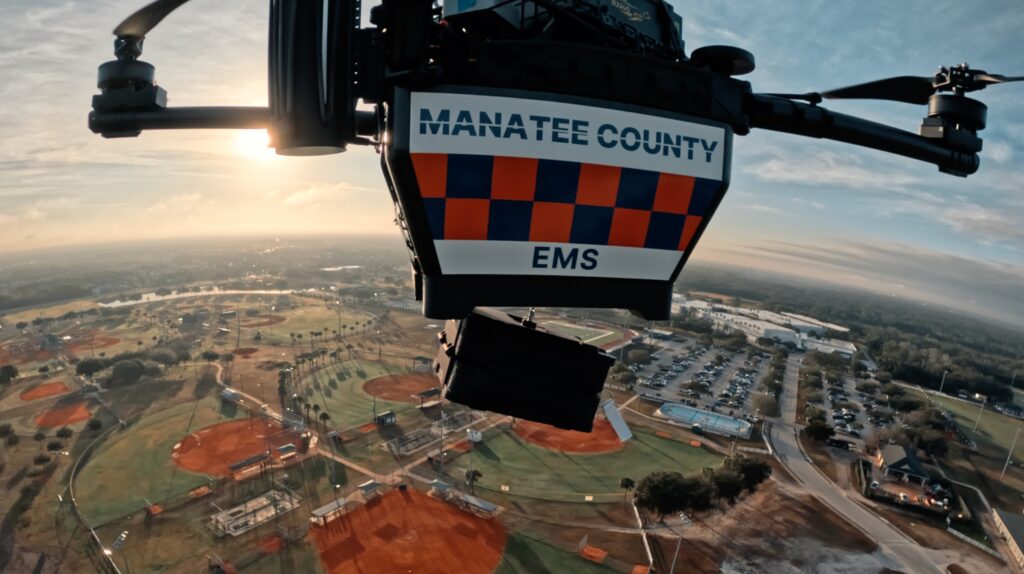
In parts of Florida, local emergency services have been following in Sweden’s footsteps since May 2024, dispatching drones carrying AEDs, part of a slow-going effort in the United States to provide emergency medical services via drone.
Since the program’s launch, Archer First Response Systems, the company that runs the drones, has made 15 emergency deployments between the two counties, said Gordon Folkes, ArcherFRS’s founder and CEO.
Prepackaged payloads can contain Narcan for overdoses, epinephrine for severe allergic reactions, albuterol for asthma attacks, tourniquets and an AED.
In one example, drone’s-eye video captured the drop-off: The aircraft cruises 2.8 miles over swaths of trees, then hovers 200 feet off the ground to lower a package to the wife of a man who had collapsed.
“And then she got the AED pads on the chest about four minutes before ground units even arrived on the scene,” said Folkes, whose company operates through contracts with emergency-response agencies.
In this case, the device didn’t advise a shock, as the heart was in “a non-shockable rhythm,” Folkes said, and the man died.
Still, “in cardiac arrest, getting a defibrillator to someone quickly is absolutely crucial.” said Robson Gilmour, a resident doctor in the United Kingdom who researches drone-based organ transportation.
The American Heart Association estimates a victim’s chance of survival decreases by 7 to 10 percent for every minute after a cardiac arrest without defibrillation.
Despite successful pilot programs and emerging real-world applications — including a first-of-its-kind Cleveland Clinic prescription-delivery initiative launched in July in partnership with drone delivery company Zipline — medical drone service has still not gained much traction across the United States.
Obstacles include aviation regulations and infrastructure needed for reliable delivery. Some applications — like organ transplantation — face more hurdles than others.
“Blood products, pathology samples and medications are probably more likely to become routine before organ transportation,” Gilmour said. “I think these applications make sense as a starting point, because they’re generally more frequent and easier to integrate into existing health care systems. They also help build the infrastructure and confidence needed for more complicated deliveries later on.”
Now, ArcherFRS is moving into delivering blood by drone.
Described by the county as the first of its kind in the nation, the system will initially cover 70 square miles. Folkes expects operations to go live in a few weeks, when paramedics can request temperature-controlled whole blood — which contains red and white blood cells, platelets and plasma — via mobile app. The system is designed to get blood to the scene in 3½ minutes or less.
“Paramedics could be responding to a traffic crash, postpartum hemorrhage, medical or trauma patients, or shooting or stabbing victims whose loss of blood is so significant that waiting to get to the hospital for a blood transfusion might be too late to save a patient’s life,” Hillsborough County said in a release.
Transporting organs
In April 2019, the first unmanned delivery of a kidney took off, propelled by eight rotors. The flight to the University of Maryland Medical Center took just under 10 minutes. Trina Glispy, then 44, had spent eight years on dialysis and was the recipient of the kidney.
Project leader Joseph Scalea was on the surgical team that performed the successful transplant. The physician’s support for the new kind of transportation was fueled by frustration with the logistics of getting organs to dying patients.
“Fifty people touch the organ from the time that the donor goes to the operating room, to the time that organ arrives and is transplanted in a recipient in a different hospital,” he noted.
Those handoffs are necessary, he added. “I just thought, wouldn’t it be amazing if you could just hit the easy button on your cellphone, and the drone lands on my hospital?”
Transportation delays can compromise organ viability. The clock starts ticking from the moment the donated organ is chilled until it begins rewarming in the recipient’s bod
Despite the successful pilot program, the process hasn’t taken off more broadly.
In an October review, Scalea and colleagues concluded that organ transplantation has advanced in immunosuppression, surgical techniques and organ preservation, but the infrastructure of organ movement remains stagnant.
Federal Aviation Administration rules are among the biggest hurdles in the U.S., said Gilmour, the U.K. doctor. Drones generally must remain within the pilot’s visual line of sight. In Glispy’s kidney-transplant case, officials obtained a waiver for the milestone 2.8-mile flight over Baltimore. Such waivers aren’t necessarily a straightforward route to running a large, routine delivery network, Gilmour added.
He added that the FAA is working on measures to allow for these types of operations, but the timing is unclear.
Gilmour also cites reliability considerations: weather, battery life, range and airspace restrictions.
“You can’t really afford a delivery to be delayed or canceled when you’re transporting an organ,” he said. “We know drones can physically carry organs, but what effect do vibration, movement and the forces during flight have on the organ?”
Gilmour and Mekhola Hoff, a transplant surgeon at the Royal Infirmary of Edinburgh, are conducting a large-animal pilot study examining how flight conditions affect organ tissue compared with conventional road transport and storage.
“The Baltimore kidney delivery was a massive milestone because it showed that you could actually transport a human kidney by drone and successfully transplant it,” Gilmour said. “I do think we’re getting closer.”
Signs of progress
On Oct. 21, the University of Michigan announced a pilot with drone company Blueflite to test the delivery of donated organs by drone, with an eye toward developing flight infrastructure.
In June, NASA’s Langley Research Center in Hampton, Virginia, teamed up with the United Network for Organ Sharing to study transporting human kidneys by drone beyond the pilot’s visual line of sight; preliminary findings showed no negative impact to the organs.
More routine medical drone deployment can be found in countries where challenging topography and bad roads make transportation challenging. A September review in the journal Global Health Action highlighted sub-Saharan Africa, where drones transport blood products, antimalarial medicines, vaccines and diagnostic samples. Researchers found significant reductions in drone delivery times compared with ground transport.
California-based Zipline has made medical drone deliveries to thousands of health care facilities in the region, partnering with Rwanda in 2016 to deliver blood, vaccines and medicines. The company has worked with Ghana since 2019, making over 4,000 blood deliveries last year.
“I think having governments properly commit to these programs has been a big part of their success,” Gilmore said. “There’s a difference between running a few successful trials and having a service that hospitals can actually rely on every day.
“These programs have been particularly useful in areas where road journeys are difficult or take a long time,” he said. “I’d imagine there are plenty of similar situations in rural parts of the U.S. where drones could make a real difference.”
The post Emergency medical services could be delivered by drones appeared first on Washington Post.