The diagram was small, barely filling one corner in a set of engineering drawings for new construction near Flatbush Avenue in Brooklyn.
Still, engineering experts said, it laid out a plan to protect a neighboring apartment building that should have prompted skepticism — or outright rejection — from the New York City Department of Buildings officials who reviewed it in March.
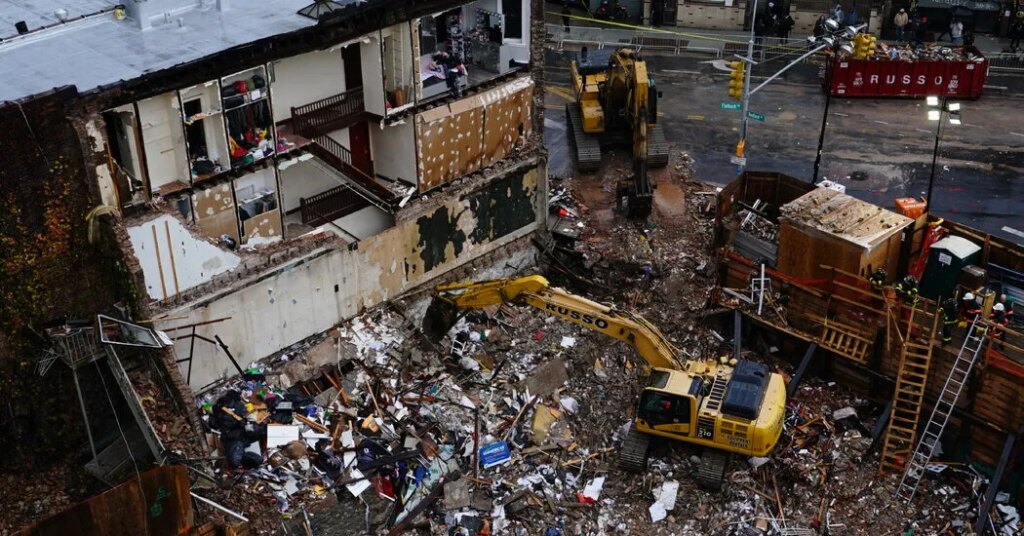
Instead, they stamped their approval, and excavation began at 2625 Bedford Avenue, where, months later, the neighboring building would collapse amid the work, killing eight people and displacing dozens more.
The apparent lapse in oversight raises concerns about not just the city’s handling of the ill-fated project in Brooklyn but its ability to oversee similar work across the city, a New York Times examination has found.
It also raises questions about the officials’ decision nearly a decade ago to effectively disband a special unit in the Buildings Department that was dedicated to reviewing the type of work that was occurring in Flatbush when the building fell.
Andrew Rudansky, a spokesman for the Buildings Department, said in a statement that the city has “robust safeguards” for excavation and that the agency still proactively conducts construction site inspections.
At a City Council hearing on Friday, the department’s deputy commissioner of enforcement, Yegal Shamash, said that officials were still investigating the collapse, but he added that he believed the city’s construction safety standards were “the most rigorous in the country, if not the world.”
Robert Fischman, a real estate investor tied to the limited-liability company developing the project, did not respond to requests for comment. Neither did representatives of the general contractor, Townhouse Builders, or LMW Engineering, which drafted the excavation plans, including the diagram.
In the wake of the collapse, at least four lawsuits have been filed by eight construction workers who said they were injured when the building fell and accused the developers and contractors of unsafe working conditions and ignoring warning signs.
City investigators have yet to determine what caused the building to fall, but a Times visual analysis found that the apartment building most likely collapsed because the excavation had weakened its foundation.
The excavation diagram filed as part of the construction project showed the property line dividing the site from 1321 Flatbush Avenue, the three-story apartment building that toppled, and a plan to dig near its foundation before erecting a new mixed-use building next door.
The plan called for using an excavation technique, sometimes known as berming, that involves digging out soil near the base of the building and pouring a series of concrete steps that slope away from its foundation, with the goal of preventing soil from shifting and destabilizing.
The method is legal and has been safely used for decades across New York, building officials have said. But several building experts who reviewed the plans at the request of The Times said the approach was inappropriate for the site, especially given that the plans lacked details on how to ensure safe excavation.
A chief reason they cited was the composition of the ground beneath the apartment building. It was made up of rough fragments of stone and debris known as rubble, which is weaker than a base of poured concrete. Such conditions often require adding a system of steel columns, beams and a concrete base to shore up the building. No such system appeared to have been in use across a crucial portion of the Flatbush building before it fell.
Even before it submitted the excavation plans to the city, the developer had been advised to use a different approach.
In a report prepared for the developer in November 2025, months before excavation began, engineers hired by the development team said the builders would need to use underpinning, an often costlier support technique that involves pouring concrete beneath the existing foundation of a neighboring building, one small section at a time, to prevent movement. A separate report prepared in March 2026 noted that the nearest wall of the apartment building, which was at least 96 years old, was in “poor condition” and had visible cracks.
Steve Bongiorno, a structural engineer with experience in forensic analysis, said the recommendation to use underpinning should have been followed. But he and four other engineers who reviewed the plans at the request of The Times said they saw no evidence the technique was used on that part of the property.
More troubling, Mr. Bongiorno said, was the lack of detail in the plans as to how to support the wall during the excavation.
“There is no way to achieve this picture without exposing that adjacent building to destabilization,” Mr. Bongiorno said, referring to the diagram and the documented poor condition of the apartment building. “You’ve got to be nuts to try to do something like this.”
Pat Arnett, a principal at TYLin, an engineering and advisory firm, said the berming technique can be performed safely by, among other things, digging farther away from the neighboring building’s foundation and using a less severe slope. Those added precautions, however, can take up more land during construction, he said.
Allyn Kilsheimer, another forensic engineering expert who has spent decades examining major disasters, said any number of things might have gone wrong at the site, even if the excavation plans were perfect on paper. Inaccurate assumptions can sometimes appear on planning documents, he said. And even if everything was accurate, work crews don’t always follow directions.
The developer’s plans for the new construction at 2625 Bedford Avenue called for a nine-story, mixed-use building with 64 apartments and a grocery store. But as the workers were excavating the site, the city had yet to approve a project of that size, having signed off only on earlier plans for a smaller, three-story building.
The distinction meant that the project was not subject to stricter on-site safety requirements.
In past years, such work was closely monitored by an excavation unit within the Buildings Department that had been created under the administration of Mayor Michael R. Bloomberg.
In 2008, less than a year after it was formed, the team conducted 2,772 inspections on 1,685 sites, forcing half of those with active excavation to stop work at least temporarily. Conditions at about 300 sites were so bad that a full engineering audit was ordered; only two passed.
But in 2018, the excavation unit and other specialty teams were reorganized, and the unit’s oversight functions were moved to other divisions of the department. A new compliance unit was made responsible for inspecting excavations.
Philip Mezzatesta, who worked for the Buildings Department for 16 years, including as a chief inspector, said the dedicated inspection team might have made a difference at the Flatbush site.
“If the excavation unit was in effect right now, this would have been caught,” said Mr. Mezzetesta, who now works as a private consultant.
Mr. Rudansky, the buildings department spokesman, disputed that claim, saying that construction-related incidents have fallen 63 percent since 2018, when the excavation unit was reorganized.
Even without such a dedicated unit, the city has ample means to make sure buildings don’t collapse, said Anil Agrawal, the chairman of the civil engineering department at the City College of New York. But, he added, the Buildings Department has to ensure that its inspectors are top-notch.
“The question is about skill levels available in compliance units to review and approve plans and drawings,” he said. “A drawing signed by a professional engineer is not necessarily safe.”
Mr. Mezzatesta, the former building official, said that too often, line-level workers at the department do not possess that high skill level.
“This city has hired people with two, four, five years experience that know absolutely nothing and made them supervisors,” he said. “That’s a problem in itself.”
Luis Ferré-Sadurní contributed reporting. Susan C. Beachy contributed research.
The post Before a Fatal Building Collapse, Officials Signed Off on a Dubious Plan appeared first on New York Times.