The number of new Ph.D. students studying science, engineering, health, mathematics and computer science at major research institutions in the United States fell substantially during the first year of President Trump’s second term, according to a new federal survey.
The decline, about as steep as what occurred during the Covid-19 pandemic, was largely — but not entirely — driven by a drop in international students. It indicates that schools are pulling back on research in a range of fields amid the turbulence in higher education.
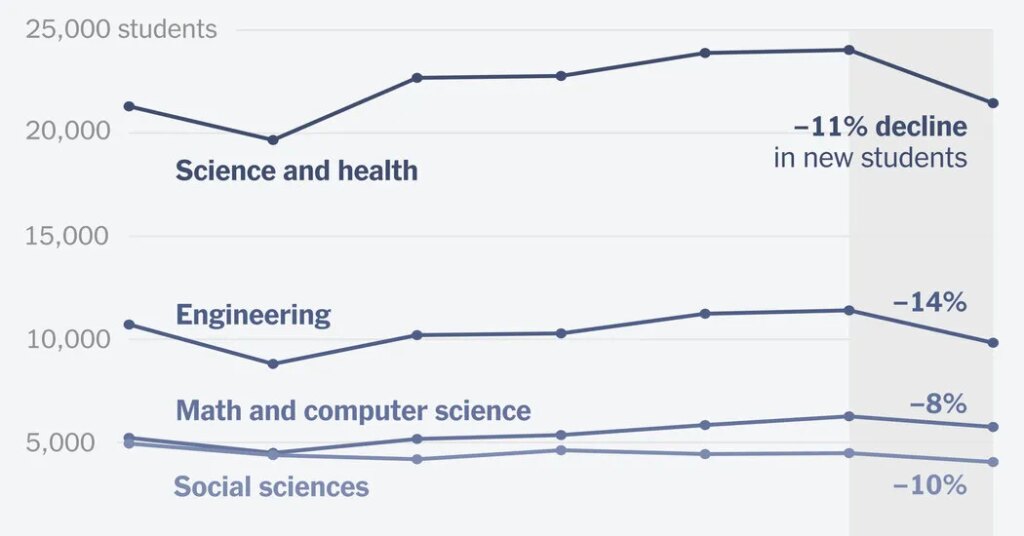
According to an analysis of the survey data by The New York Times, the overall number of new full-time doctoral students in the surveyed fields at the nation’s 187 top research schools fell by about 5,100 in 2025. That number represented a decline of 11 percent from the prior school year. A similar trend held across the survey’s broader set of schools, which saw a decline of 10 percent.
Plummeting enrollment among international students accounted for nearly three-quarters of the drop at the top research schools, a sign that those students may have been dissuaded from studying in the United States by the Trump administration’s crackdown on immigrants and efforts to limit visa stays.
A White House report released over the summer, which committed to initiating a “new golden age” of American science, described an “overreliance” on international talent as an issue of national security. “The United States has funded large cohorts of foreign students and tolerated technology transfer abroad under lax security standards,” the report read. “This reliance on foreign talent sidelines American students, a deep domestic talent pool that remains undersupported by its own government.”
But according to the survey data, the number of U.S. citizens and permanent residents enrolling in full-time doctoral programs also dropped. At top research schools, 1,450 fewer of these students enrolled in 2025 than in the previous year.
Funds that support doctoral research have been disrupted as the federal government cut or threatened grant money, agencies lost staff and the Trump administration shifted to new priorities.
The total number of full-time doctoral students remained essentially flat. But the declines are the first time that new enrollments have fallen since 2020, when they dropped due to pandemic restrictions before rising again in 2021 as those restrictions eased.
The data does not capture any changes this school year, but information collected from a group of major research schools shows even steeper declines among doctoral enrollments this fall.
“Graduate students are both today’s and tomorrow’s scientific work force, and a sustained decline in doctoral enrollments could affect research capacity for years to come,” said Travis York, a director at the American Association for the Advancement of Science. “It’s the people entering doctoral programs today that will lead discoveries in biotechnology, computing, energy, engineering, A.I. and other fields over the next decade.”
The new figures come from an annual survey by the National Science Foundation of institutions across the United States that offer graduate degrees in science, engineering or health programs. Known as the Survey of Graduate Students and Postdoctorates in Science and Engineering, the findings offer broad insight into enrollment and completion trends for master’s and Ph.D. students in STEM fields.
In 2025, 93 percent of the 635 surveyed institutions responded, including all 187 classified as schools with the highest levels of research spending and Ph.D. production, also known as R1 institutions.
Of those elite research institutions, 132 enrolled fewer new doctoral students in the surveyed fields in 2025 than in 2024.
The Times analyzed trends at these schools, and found that new, full-time Ph.D. enrollments in engineering programs fell by 14 percent. In science and health fields, the collective drop was nearly 11 percent, while mathematics and computer science enrollments together fell by 8 percent.
A previous Times analysis of new Ph.D. enrollments at 27 major research universities in the country found similar trends.
Some fields, like biology and biomedical programs, civil engineering and medical research, were hit especially hard. But no field saw an increase in incoming Ph.D. students.
In addition to physical and life sciences, such as chemistry and biology, the federal survey also includes data on social sciences like anthropology, economics and sociology. New enrollments in those fields declined by about 10 percent.
The survey’s findings are in line with other data showing a substantial decline in international students choosing to pursue degrees in the United States. New enrollments by doctoral students on temporary visas fell by almost 17 percent at major research universities in the N.S.F. survey, more than twice the rate of declines among citizens and permanent residents.
The drop in the number of foreign students embarking on master’s degrees was even larger, with enrollments declining 28 percent at major research universities. The number of U.S. citizens and permanent residents entering those programs increased by 9 percent.
While most universities saw a decrease in new graduate enrollments, a handful saw a significant rise.
The University of Texas at Austin had one of the largest increases of incoming Ph.D. students, both domestic and international, among all R1 universities. Its mathematics and computer science programs saw enrollment rise from 56 students in 2024 to 94 in 2025. University administrators credited the increase to a dedicated strategy to support growth in federal research funding.
While many universities have seen funding disruptions under the Trump administration and individual researchers have lost grants, some schools have seen increases, often in areas linked to government priorities.
U.T. Austin already had a research portfolio “that really aligns with federal priorities,” said Fernanda Leite, the university’s vice president for research. That includes artificial intelligence, energy, quantum computing and material sciences.
David Vanden Bout, dean of the college of natural sciences at U.T. Austin, said that the university also made a choice not to cut back on Ph.D. admissions despite funding uncertainties and visa restrictions.
“There has been a hope that that would actually give us a competitive advantage,” he said. “Because as other schools cut back on their admissions, we were going to get a greater lion’s share of the really top students.”
Dr. York noted that, while the survey provides a broad snapshot of graduate enrollment trends across the nation, many questions remain, including how the declines impacted students of different socioeconomic backgrounds and where prospective Ph.D. students went instead. He also emphasized that this data only reflects the first year of the second Trump administration.
As more data comes out, he said, it will “illuminate how funding or immigration uncertainties are currently influencing university and student decision making.”
The post New Ph.D. Enrollment in the Sciences Dropped 10 Percent Under Trump appeared first on New York Times.