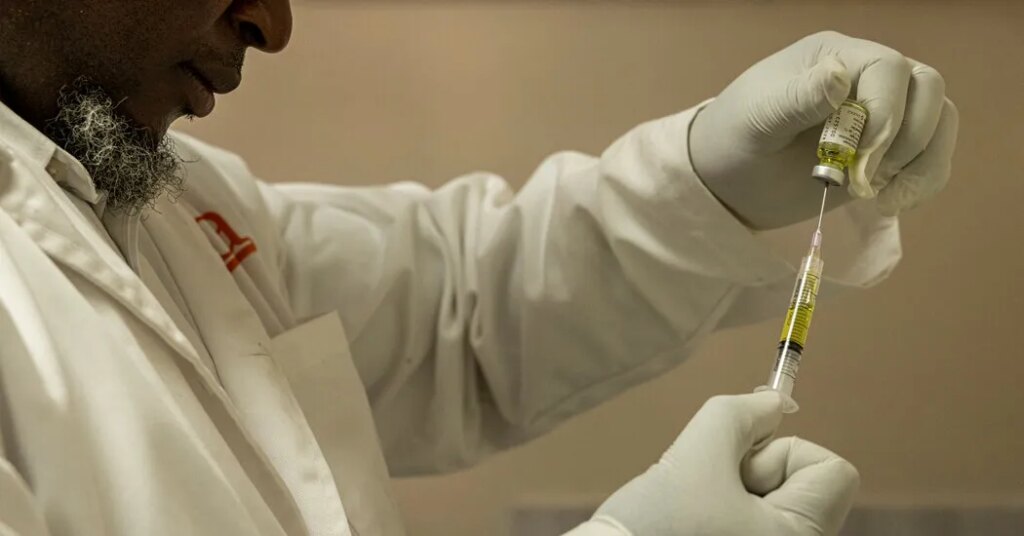
Under escalating pressure from scientists and activists, the Trump administration on Friday belatedly jump-started the process of financing four large research networks that test vaccines and treatments for H.I.V., tuberculosis and emerging infectious diseases.
The decision elicited relief among scientists who have fretted for months about cuts and delays to work aimed at ending the H.I.V. epidemic, which President Trump had made a priority during his first term.
But the start of the funding process came with a twist that reflected the second Trump administration’s suspicion of vaccines. Gone was the word “vaccines” from the names and research agendas of any of the four networks.
Instead, a vaccine-focused research network is now known as the Immune-Based Prevention Clinical Trials Network, a signal that it also supports research on broadly neutralizing antibodies and the effect of diet and the microbiome on immune function.
The networks had been enlisted early in the Covid pandemic to ramp up critical testing of new vaccines and treatments.
“Why not call vaccine research ‘vaccine research?’” said Dr. Chris Beyrer, an H.I.V. epidemiologist and the director of the Duke Global Health Institute. He added: “Fuzzy language can lead to confusion.”
Emily Hilliard, a spokeswoman for the Department of Health and Human Services, said that H.I.V. vaccines would “continue to be evaluated in this new network” and that the name change “reflects that it is designed to evaluate immune-based approaches and strategies for H.I.V. prevention, not limited to just vaccine candidates.”
The formal call for proposals, published on Friday by the National Institutes of Health, came a day after Dr. Jay Bhattacharya, the agency’s director, faced sharp questioning about funding delays at a meeting convened by U.S. Business Action to End H.I.V., a coalition of businesses.
Dr. Bhattacharya responded testily to what he described as “false” assertions about the N.I.H.’s handling of the process. Asked about delays in publishing the so-called notices of funding opportunities, he said the agency was shifting its focus away from developing and testing H.I.V. vaccines, especially at overseas sites, and toward better deploying existing treatments within the United States.
“We’re shifting some of the portfolio toward things that are in this country,” he said, according to a video of his remarks obtained by The New York Times. He went on to promise a record amount of spending on H.I.V. research.
Dr. Joshua Sharfstein of Johns Hopkins University, who moderated the conversation with Dr. Bhattacharya, said on Friday that he had pressed the N.I.H. director because “people were worried about the future of clinical trials, the research infrastructure that has taken decades to build, and the potential consequences for people at risk for and living with H.I.V.”
The call for proposals said that applications for renewed funding would be due in March, and that they would be reviewed through next summer and fall.
Health officials said that meant the networks should be able to continue their work without a gap in funding when the existing grants expire in November 2027, but only if funding legislation is passed without the government shutting down.
Scientists warned that the margins were thin because the federal government had already delayed so long in publishing the call for proposals and that the safety of participants in clinical trials was at stake.
“Even another week of delays could have irreversibly derailed the forthcoming submission and review processes, destabilizing and disrupting sophisticated scientific networks that have been at the forefront of innovative infectious disease research for decades,” said Jeremiah Johnson, the executive director of PrEP4All, a nonprofit that pushes for improved access to H.I.V. prevention tools.
Activists also urged the administration to keep supporting research into H.I.V. vaccines and cures overseas, arguing that existing treatments are insufficient to stop the epidemic, which still affects more than 40 million people worldwide and kills more than 500,000 people each year.
“It is inconceivable that major advances in H.I.V. and TB research can happen without international collaborations,” said Mitchell Warren, the executive director of AVAC, an organization that lobbies for H.I.V. prevention and treatment.
Dr. Bhattacharya has been a staunch supporter of existing treatments, namely lenacapavir, which includes injections taken twice a year and is used to prevent H.I.V. infection. He has pushed for more spending on how to deploy those treatments.
At the H.I.V. meeting this week, Dr. Bhattacharya said, “What’s changed is a grabbing of the opportunity of the moment based on the availability of these amazing new technologies.”
The post H.I.V. Research Networks May Again Seek Federal Funding, With a Twist appeared first on New York Times.