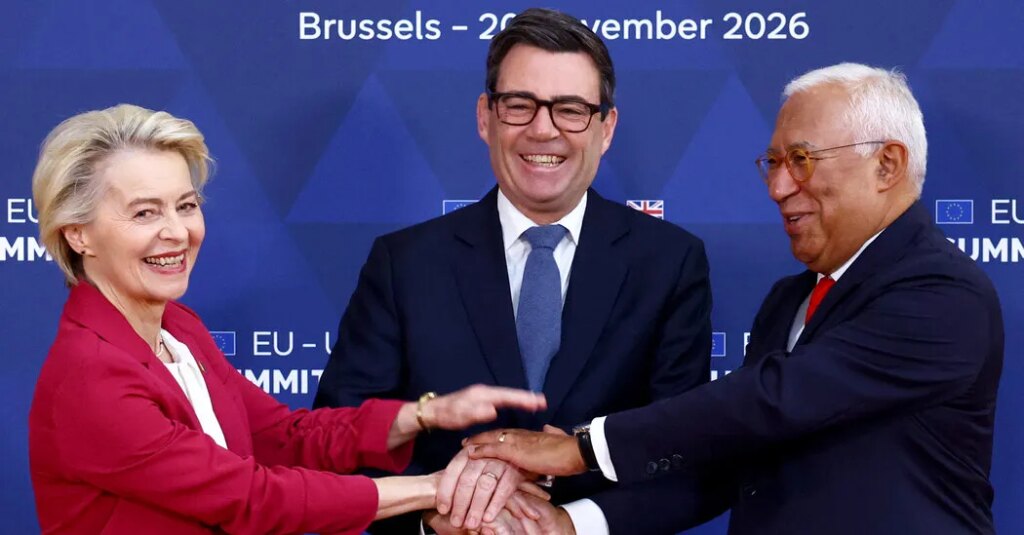
Ten years ago, when the Brexit vote triggered a major rupture between the United Kingdom and the European Union, Donald Trump hailed the decision as a great victory.
These days, President Trump’s policies, along with an aggressive Russia and an economically dominant China, are helping bring Europe and Britain back together.
Andy Burnham, Britain’s prime minister, has made clear that he wants to pursue a much closer relationship with the 27-nation bloc as Russian aggression in Ukraine underscores the need for European solidarity and Mr. Trump calls into question eight decades of American economic, political and security support.
On Friday, the prime minister took concrete steps toward that goal, knocking down some pieces of the Brexit agreement that walled Britain off from its neighbors.
Under plans he announced in Brussels, many trade barriers on food and agricultural products will be cut. Regulations on emissions will be linked. And 100,000 young people in Britain, along with an equal number in Europe, will again have the freedom to work, live and study for up to three years on either side of the English Channel.
The changes will make trade easier for farmers and retailers, travel easier for students, and regulatory compliance easier for companies. At times in the last decade, they were almost unthinkable amid the rancor of the Britain-Europe political divorce.
Mr. Burnham wants to go even further.
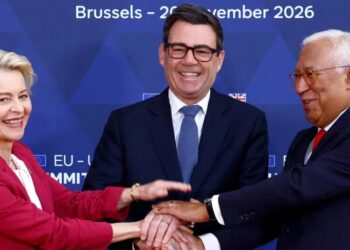
On Friday, he and the European Union’s two top leaders agreed to conduct what he described as a yearlong “brainstorm” about what a deeper relationship with the European Union might look like.
“Incremental steps only take you so far,” Mr. Burnham said.
Brexit damaged the British economy, and its continuing cost to businesses and economic growth helped turn a majority of the public against it. But the geopolitical backdrop has played a vital role in the debate.
The postwar world order has been upended by Mr. Trump’s policies, which have come alongside China’s continued economic rise and Russia’s territorial aggression. In a world that looks increasingly hostile, Britain and Europe have been left looking for close friends. And as the trans-Atlantic relationship ruptures, they have found one another again.
“London has increasingly given up on its post-Brexit great trans-Atlantic hopes that Washington would give us a free trade deal and a new lease of life to the special relationship,” said David Lammy, a member of parliament and former deputy prime minister in Britain.
To many foreign policy veterans in Britain, Mr. Trump has spent the first two years of his second administration making it more and more difficult for Britain to feel special. His trade war dragged its already sluggish economy. His relative indifference toward NATO has upended global security. His friendliness with Vladimir Putin has come as a shock.
The same challenges have rocked Europe, another close U.S. ally, and Mr. Trump’s threat to take over Greenland drove home the deterioration. Europe has been looking for alternatives — striking deals with Canada, Australia, Indonesia and Latin American countries.
And as middle powers unite, Europe and Britain have been creeping closer.
Ursula von der Leyen, president of the European Union’s executive arm, suggested that Europe was willing to discuss a deeper relationship.
“We welcome this brainstorming.” she told Mr. Burnham at the news conference, following his suggestion. “So count on us.”
Britain started on its path toward drawing closer to Brussels last year, under the previous Labour prime minister, Keir Starmer. Friday’s summit delivered detailed decisions on several agenda items that his government had begun.
Mr. Burnham said Friday that his government would introduce a bill into Parliament next week to implement the deal and pledged that “we will not waste any time whatsoever in getting on with implementation, rebuilding the bridges that were broken all of those years ago.”
But Mr. Burnham has also been clear that he favors an even more substantial reversal of Brexit after what he called “a decade of drift and division” that has left his country poorer and weaker. He has promised to present options for changes to the long-term relationship to the British public in the months to come, while insisting that any final decision would only take place after the next general election, which must be held by 2029.
The prospect of another fierce debate over Britain’s place in Europe is already roiling politics in the United Kingdom, where Mr. Burnham’s rivals have accused him of going back on a Labour promise not to re-litigate the public’s decision in 2016. And in Europe, it is unclear how high support for a drastically closer relationship will be after a series of elections next year.
Kemi Badenoch, the Conservative Party leader, said this week that the prime minister “wants to reopen arguments from 2016 because he has no answers for the world as it is.” Nigel Farage, an architect of Brexit and leader of the populist Reform U.K. Party, said Mr. Burnham wanted “to be part of a globalist governmental structure, as opposed to the nation state democracy.”
Still, Mr. Farage acknowledged Brexit had not gone well. “Yes, of course, we cocked things up, but that wasn’t the fault of Brexit — that was the fault of the government not getting it right,” he said in an interview with The Times of London.
Britain remains far from actually rejoining the 27-nation bloc. It took nearly five years for the nation to exit the union, and reversing that would be a complicated and contested process.
“We have seen an improvement in the relationship,” said Fabian Zuleeg, chief executive of the European Policy Centre, a think tank. “But it has been a slow improvement, because a lot of trust has been lost.”
At the same time, deeper ties seem increasingly urgent.
“Brexit has not been good for the U.K. economy — and meanwhile, the trans-Atlantic situation has gone from bad to worse,” said Rebecca Christie, a senior fellow at the Brussels-based think tank Bruegel.
Mr. Trump hammered that point home when he met this week with Presidents Vladimir V. Putin of Russia and Xi Jinping of China, two autocrats whom he described as his friends. Afterward, Mr. Trump called European and British officials and reiterated that the war in Ukraine was costing lives and money.
Europe views the outcome in Ukraine as vital to its security and has been nervously watching as Mr. Trump takes an often-sympathetic tone toward Mr. Putin and an often-hostile one toward President Volodymyr Zelensky of Ukraine.
Russia is another factor pushing Europe and Britain closer, with both worrying that Mr. Putin’s ambitions do not end in Ukraine. They are also motivated by an economically ascendant China, which is churning out solar panels, electric cars and cutting-edge artificial intelligence models, threatening European industries.
In remarks on Friday, Mr. Burnham accused Russia of spending the last 15 years trying to break apart “the cohesion of like-minded countries and particularly the E.U.” He said that Russia’s efforts were “designed to weaken our ability to stop them in terms of what they were seeking to do” in Ukraine.
“We are going to have to work in a different way to make the next decade different,” Mr. Burnham said. “That will depend upon closer cooperation.”
António Costa, the president of the European Union’s political leadership arm, prompted a ripple of laughter as he joked about how far Britain, and its prime minister, might be willing to rebuild ties with Europe.
“Dear Andy, welcome to Brussels,” Mr. Costa said. “You are always welcome in the European Union.”
The post Britain and Brussels Have Begun a Brexit Rollback. How Far Will It Go? appeared first on New York Times.