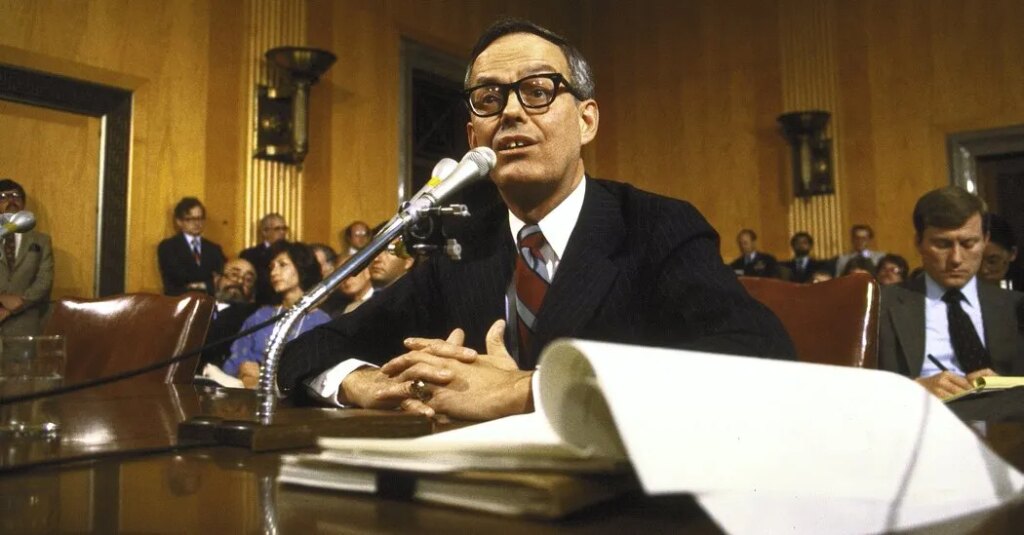
Bobby Ray Inman, a senior intelligence official in the Carter and Reagan administrations who was later nominated by President Bill Clinton to be secretary of defense, only to startle Washington by withdrawing from consideration a month later, died on Thursday in Austin, Texas. He was 95.
The death, in a hospital, was confirmed by his son Thomas, who did not provide a cause.
An admiral who was the director of naval intelligence from 1974 to 1976 before entering government service, he was the archetype of the electronic-age spy, overseeing the uncovering of secrets through technological wizardry in contrast with the timeworn image of the shadowy trench coat agents engaged in intrigue on enemy soil.
President Jimmy Carter named Admiral Inman in July 1977 to serve as director of the supersecret National Security Agency, which was charged with eavesdropping on foreign communications, codebreaking and averting the penetration of American secrets and other sensitive information from abroad.
Having taken the post a year after a Senate committee found that the N.S.A. had improperly engaged in domestic surveillance, Admiral Inman supported the adoption of the 1978 Foreign Intelligence Surveillance Act, which required the approval of a special court to intercept international communications involving anyone in the United States.
“I became convinced that for almost anything the country needed to do, you could get legislation to put it on a solid foundation,” he told The New York Times in 2006. “There was the comfort of going out and saying in speeches, ‘We don’t target U.S. citizens, and what we do is authorized by a court.’”
Admiral Inman also helped establish a voluntary system under which scientists publishing codemaking and codebreaking material submitted their research to the N.S.A. for clearance, to prevent the Soviet Union from obtaining such sensitive material.
He forged close ties with the press, and he won support from Senate and House committees through briefings that legislators regarded as knowledgeable, forthright and devoid of a political agenda.
“One of the things that’s always helped him is his willingness to admit things that may go against his department’s interests,” Senator Patrick Leahy, the Vermont Democrat who served as vice chairman of the Senate Intelligence Committee during Admiral Inman’s tenure at the agency, told The Times in 1993. “When he would disagree with me and he’d make his case, I felt I could believe what he was saying.”
Admiral Inman served as director of the N.S.A. until February 1981, when President Ronald Reagan, in his first full month in office, nominated him as deputy director of central intelligence under the newly installed director, William J. Casey, who had managed Reagan’s presidential campaign.
Admiral Inman played a critical role in planning a hugely expensive enhancement of C.I.A. surveillance capabilities. But his relationship with Mr. Casey was strained, and he fought to maintain controls on domestic intelligence-gathering that had been imposed by Presidents Carter and Gerald R. Ford. He resigned after 16 months, saying he was tired of “petty bureaucratic intrigue” and wanted to enter the business world.
After retiring as a four-star admiral, he advised a House intelligence panel, founded a consortium to spur technological research, served as chairman of a holding firm for military contractors and was chief of a Reagan administration commission on embassy security.
In mid-December 1993, President Clinton nominated Admiral Inman to succeed Les Aspin, a former congressman, as defense secretary. Administration officials cited his credibility with the military, his strong administrative skills and his ability to clearly articulate policy in public settings.
“I am an operator, hopefully with a strategic view,” Admiral Inman said.
A trim 6 feet 2 inches with a military brush cut, he was described by The Times as possessing a “gaptoothed smile and self-deprecating demeanor” that “conceal a steely center, an extraordinary intellect and a remarkable ability to shape quietly the opinions of other officials.”
But he seemed lukewarm about the prospect of running the Pentagon.
Standing alongside Mr. Clinton in the White House Rose Garden, he said that in order to accept the nomination, he had needed to attain a “level of comfort” with him. “I would tell you up front, honestly, I did not vote for President Clinton,” he said, referring to the 1992 presidential race, in which Mr. Clinton defeated President George H.W. Bush. “I voted for President Bush, even though I was mad at him about his handling of the economy, but because I considered him a personal friend.”
He said he had neither sought nor wanted the defense secretary’s post but had agreed to be nominated for considerations of “duty and country.”
Congressional hearings on Mr. Inman’s nomination were expected to go smoothly, but in mid-January 1994, he shocked the administration by announcing that he was withdrawing from consideration.
He lashed out at what he called a “new McCarthyism” in the news media, citing particularly what he viewed as longtime hostility and unfair criticism of him by the Times columnist William Safire, who called Admiral Inman “manipulative and deceptive” after his nomination was announced.
Admiral Inman’s relationship with the press having soured, he also said that he had heard reports that Mr. Safire and Senator Bob Dole of Kansas, the Republican minority leader, had plotted to derail his nomination, though he acknowledged he did not know whether that was true. Both Mr. Safire and Mr. Dole denied the reports.
“I did not want this job,” Mr. Inman said. “I’m at peace with myself.”
Bobby Ray Inman was born on April 4, 1931, in Rhonesboro, Texas, the second of four children of Herman and Mertie (Henson) Inman. His father owned several business, including a service station, a drugstore, a drive-in, and worked with Shell Chemical during World War II.
He went to high school in the nearby city of Mineola and graduated from the University of Texas at Austin at 19. He enlisted in the Navy in 1951, was commissioned as an ensign and served on an aircraft carrier where he was trained to decode secret messages.
In 1961, he began a 33-month stint as a military intelligence analyst at N.S.A. headquarters, keeping watch on the Soviet Navy.
“The idea of going back to be director had always been one of those wonderful dreams that appeared to be unobtainable,” he told James Bamford for his 2001 history of the N.S.A., “Body of Secrets.”
But he rose through the ranks, became the Navy intelligence chief and subsequently a vice director of the Defense Intelligence Agency, then obtained his dream job of running the N.S.A.
In addition to his son Thomas, Admiral Inman is survived by his wife, Nancy (Russo) Inman, and another son, William.
Although he had been responsible for keeping some of America’s most closely guarded secrets, Mr. Inman suggested that openness might be the best course for the N.S.A. after Edward J. Snowden, a former contractor, released a stream of the agency’s documents in 2013.
“My advice would be to take everything you think Snowden has and get it out yourself,” he told The Times. “It would certainly be a shock to the agency. But bad news doesn’t get better with age. The sooner they get it out and put it behind them, the faster they can begin to rebuild.”
Ama Sarpomaa and Gabriella DePinho contributed reporting.
The post Bobby Ray Inman, Intelligence Official Under Carter and Reagan, Dies at 95 appeared first on New York Times.