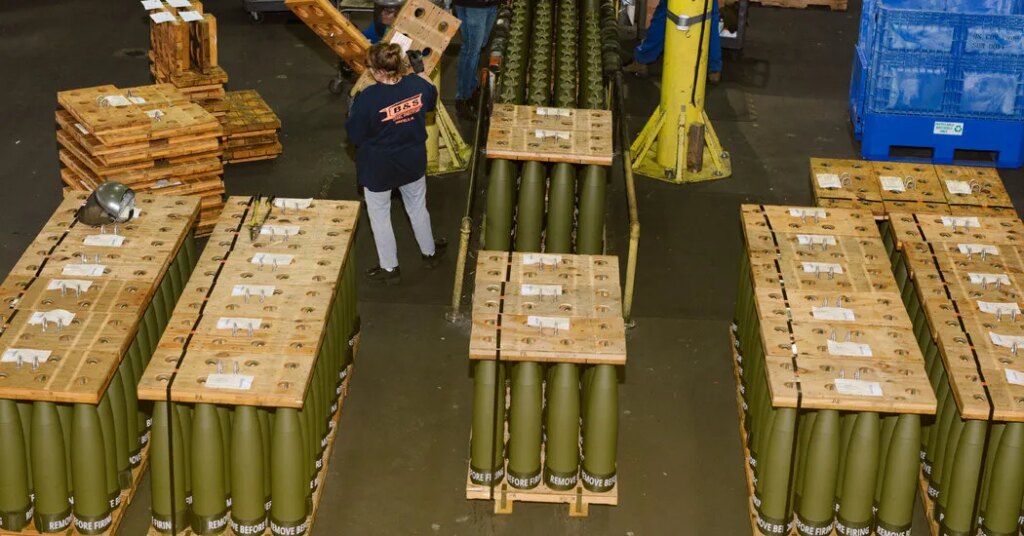
The U.S. Army has postponed its planned detonation of a stockpile of unstable ammunition in Iowa until Monday, pushing back a blast originally scheduled for Friday. The controlled explosion had been expected to send a plume of toxic lead dust as far as 60 miles across communities and farmland in the region.
A spokeswoman for the Army, Justine Barati, confirmed the delay late Thursday.
The decision followed a chorus of complaints from residents, environmentalists and elected leaders that the state and local communities hadn’t been adequately informed of the plan and its risks.
The material being destroyed, lead azide, is an explosive used to detonate military munitions. The Army had said that the stockpile, stored at an Army facility in Iowa, had become dangerously degraded and was at risk of explosion if moved, requiring Friday’s planned detonation.
There are no safe levels for exposure to lead, a neurotoxin, and it poses a particular danger to children and pregnant women. Lead can interfere with fetal brain development, cause permanent cognitive and behavioral harm and increase the risk of premature births or miscarriage.
Mason Mauro, a spokesman for Iowa Gov. Kim Reynolds, a Republican, said the state had learned of the planned detonation only on Monday, following a public advisory from the Army. The governor’s staff and state agencies had since been meeting with the Army about the situation, Mr. Mauro said.
Governor-Elect Rob Sand, a Democrat, said in a statement on Facebook that there had been “an unacceptable lack of communication and clarity” that has made Iowans “understandably concerned and angry.” He added that “the public deserves to know, if this is the safest option, why other options were worse.”
On Thursday, elected officials in Illinois downwind from the ammunition site — including Gov. JB Pritzker and Senators Richard J. Durbin and Tammy Duckworth — joined the call to postpone. They wrote to the acting Secretary of the Army, Adam Telle, and to the administrator of the Environmental Protection Agency, Lee Zeldin, saying that they had “grave concerns” about the operation and urging them “to consider delaying this detonation until there is an opportunity to explore safer alternatives.”
“Alongside our neighbors in Iowa, we are also demanding answers about how this could affect our people’s health and safety,” Gov. Pritzker said in a post on the social media site X. Illinois Senator-elect Juliana Stratton and Iowa Senator-Elect Josh Turek, both Democrats, signed onto the statement.
On Thursday, environmental groups had filed a lawsuit seeking an emergency order to stop the detonation.
In a statement on the social media site X late Thursday, Mr. Telle, the acting Army secretary, said he had ordered a postponement until Monday. “Public safety is the Army’s top priority,” he said. “This will delay the detonation until the latest possible moment,” he said, when weather changes risked the ammunition destabilizing further. Falling temperatures, he said, could make the material increasingly unstable.
Governor Reynolds said she had spoken to Mr. Telle and had asked him to delay. “I’m grateful for his decision to do so,” she said late Thursday.
The Army had recommended that nearby residents evacuate during the planned Friday blast. It said the explosions could also shatter windows and that the public might be exposed to the airborne lead.
The Environmental Protection Agency had issued an emergency permit for the detonation, saying on its website that the explosion risk from the material presented “an imminent and substantial threat to human health and the environment.”
According to the permit, the stockpile of 68 barrels of the explosive at the Iowa plant had degraded and become extremely unstable.
Removing the material from the military base is impossible, the Army said, because of how sensitive it has become to movement and friction. Transporting the explosive poses an “unacceptable risk of accidental detonation,” the Army said in documents published on its website. “Destroying it in place is the only responsible option,” the Army said, and doing so “restores vital military-industrial readiness.”
Erik D. Olson, senior director for environmental health at the Natural Resources Defense Council, said on Thursday, “The idea that there’s no other alternative to open detonation of something like this is just staggering to me.”
In a lawsuit filed on Thursday afternoon, environmental groups including the Iowa Environmental Council and the Sierra Club Iowa Chapter had challenged the emergency permit from the E.P.A., arguing that it “utterly fails” to prevent releases of lead into air, water and soil and does not ensure the protection of human health and the environment. The groups are represented by the environmental-law firm Earthjustice.
The groups said in the filing that widespread notice was not provided until five days before Friday’s planned explosion, and that “it is unclear how many potentially affected residents still do not know about the looming risks to their health and homes.”
The Army did not respond to a request for comment on the lawsuit. The EPA declined to comment on the lawsuit.
According to the court filing and statements from the Department of Defense, the Army determined in March that 68 drums of lead azide, which had been stored for more than two decades in reinforced underground concrete bunkers, were deteriorating. The material had been bathed in ethanol and water to keep it stable, but workers discovered that it had recrystallized, making it more sensitive to friction and shock.
Over the next nine months, the Army tried to figure out how to dispose of the material, the filing said. On Nov. 13, the E.P.A. approved a permit for on site detonation and on Sunday, the Army released a notice that the explosion would take place five days later.
In an environmental assessment released on Wednesday, the Army said that its planned blast would cause a brief loud noise and a short-lived cloud of dust and lead particles. The explosion, the Army added, would “temporarily startle” birds and other animals nearby but would “not result in significant health impacts to the public or the environment.”
An Army spokeswoman, Lori McFate, said on Wednesday in a phone interview that rain had been forecast for Saturday, which could help clean lead dust off surfaces from a the original planned Friday detonation. “We are all banking on a good wash,” she said.
In their court filing, the environmental groups argued that lead in the air does not disappear; it settles into soil and water. “The idea that widespread lead dust can simply be rinsed away with no harmful effect is absurd, counterfactual, and extremely harmful misinformation to share with the public,” they wrote.
The U.S. military for decades used lead azide as a primary explosive, a small, highly sensitive charge used to initiate a larger, main explosive. But the Pentagon has been phasing out its use for environmental and safety reasons. That has left behind aging stockpiles of the chemical.
The dilemma about what to do with old, unstable munitions is not new, said Jacob Hamblin, a historian at Oregon State University who focuses on science, technology and the environment. For decades, the military simply buried dangerous waste like lead, cyanide and radioactive materials, or dumped them at sea. Stronger environmental regulations and scrutiny have cut down on that practice.
“It seems that the Army and E.P.A. are trying to avoid a future disastrous explosion by doing a controlled one now,” Dr. Hamblin said. “But they are courting long-term controversy over health effects, given the known links between lead inhalation and illness.”
The post Amid Outcry, Army Delays its Plan to Blow Up Toxic Ammunition in Iowa appeared first on New York Times.