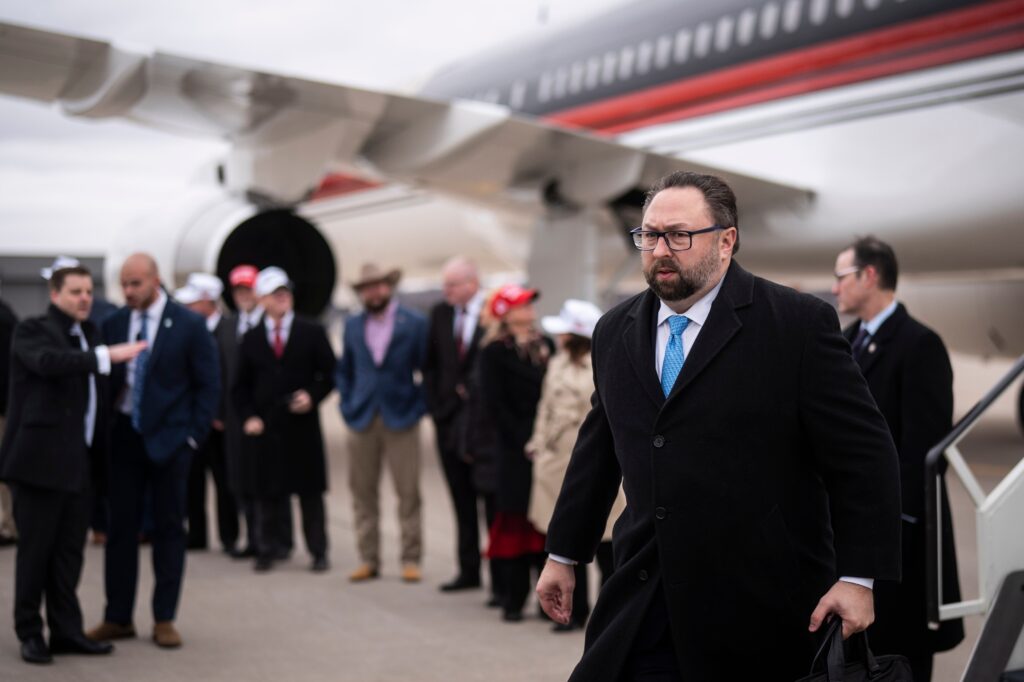
Jason Miller was tapped to be Donald Trump’s first White House communications director, but a scandal ended that job in December 2016 before it even began. Miller stayed loyal, advising Trump’s next two campaigns and regularly defending him on cable news shows.
In 2023, Miller’s accountant put his total income at about $879,000. Then, Trump was elected president a second time. And Miller proceeded to make more money than he had in the previous seven years combined.
For the 12 months that ended in September 2026, he put his income at about $15 million, nearly all of it revenue from his two firms, according to a sworn financial statement he filed in court. In that time, Miller was a registered foreign agent for the governments of India and Romania and was in talks to join Trump’s White House as an unpaid adviser and began appearing there regularly this summer.
Miller’s consulting firm continued receiving payments — about $1.3 million from July through September, bank records show.
The details — some of which have not been previously reported and were recently included in the filings of a long-running Miami court case — offer a rare look at how lucrative Trump’s return to power has been for one of his most loyal aides. And they show how much money can flow to a presidential adviser without ever appearing in public disclosures.
It took a child support fight — with the campaign aide at the center of his 2016 scandal — to bring that into view.
In a statement to The Washington Post, Miller said, “I take all ethics, lobbying registration, and financial disclosure obligations seriously and have complied with all applicable requirements.”
He said he was under no obligation to discuss his financial records or his court case. Miller did not respond to detailed questions about his time in the White House, his work and specific payments, including what they were for. Testimony about Miller’s income during the trial this week was first shared on social media by Grant Stern, a Democratic activist and executive editor of Occupy Democrats, who has followed the case for years.
Miller’s bank records filed publicly in court show large payments from the government of India, the hedge fund Bridgewater Associates, the media company formerly called Paramount Skydance and a Japanese conglomerate — along with millions of dollars from sources the records do not identify.
His gross income had already begun to climb in 2024, while he worked on Trump’s campaign; his accountant put it at about $1.6 million that year. In the 12 months that ended in August 2025, it reached about $4 million. By this fall, Miller’s two firms — SHW Partners and a second company, Scipio Strategic, both of which he owns outright, according to his filing — had together brought in about $15 million over a year.
Scipio, which took in $6.7 million of that, does not appear in any public lobbying or foreign-agent filings, so who paid it, and for what, is not publicly disclosed.
Most senior White House officials must publicly disclose their finances. Miller was different. His public lobbying and foreign-agent filings — which, by law, cover only payments received for disclosable activity — account for about $2.4 million of his income over the past two years.
On Nov. 3 — Election Day — Miller wrote in a sworn financial affidavit he filed in the case that he “is currently an unpaid special government employee.” Where the form asks for his pay rate, the filing says “unpaid employee.” Where the form asked for his employer, he wrote “the White House.”
In an unsigned statement Thursday, the White House said: “Jason Miller was never an SGE [special government employee] at the WH. We have enjoyed many different thoughts and opinions throughout this administration and will continue to do so. Our campus remains open to friends old and new, from either side of the political spectrum.” The White House did not respond to further questions about what Miller’s role was.
When asked about the White House’s statement, Miller said, “I never completed the formal onboarding process.”
Had Miller become a special government employee, he would have been exempt from federal limits on outside income and employment that apply to most White House staff, according to the Office of Government Ethics. But conflict-of-interest law would have barred him from working on government matters affecting his own financial interests or those of his clients, unless he received a waiver, said Kathleen Clark, a law professor at Washington University in St. Louis who studies government ethics.
She said his lack of official status meant he could operate without committing to follow rules. “What you are describing is someone who has not sworn allegiance to this country, who doesn’t even purport to act in the interest in the public and is allowed to go running roughshod around the White House,” she said.
Contact our reporters
From scandal to the West Wing
Few people have been as close to Trump’s political operation and for as long as Miller. He was the chief spokesman for Trump’s 2016 campaign, and after the election Trump named him White House communications director. But within days, Miller withdrew amid reports of his extramarital affair with A.J. Delgado, another campaign aide who gave birth to their son in 2017.
He spent the next decade working his way back — as a senior adviser on Trump’s 2020 and 2024 campaigns, as chief executive of Gettr, the pro-Trump social media platform, and as a vocal Trump booster. Joining the campaign in 2020, he said he was “humbled by the opportunity for a second chance to serve President Trump.”
This summer, Miller started showing up regularly at the White House. Delgado, meanwhile, has sought child support from him in court since 2017; the case had never gone to trial until this month. Ahead of that trial to set regular child support, she subpoenaed his financial records.
The firms’ bank statements, filed as an exhibit in the case, identify many payers by name. But for some wire transfers, they show only a date and an amount. In a summary she filed with the court before the trial, Delgado identified the senders of those wires. In Florida family cases, parties must exchange financial records, and Delgado also subpoenaed Miller’s bank records; not all of those records were filed with the court. Her monthly totals closely track the income Miller reported under oath.
Most of Miller’s income last year came through his lobbying firm, SHW Partners, according to his filings. Its clients have included India, as the country has negotiated for better trade terms, the hedge fund Bridgewater Associates and the public relations firm Teneo, bank records show.
Some clients had business before the Trump administration.
A foreign government, a hedge fund and a media giant
In April 2025, SHW Partners signed a $150,000-per-month contract to provide “strategic counsel, tactical planning, and government relations assistance” for India, according to documents filed with the Justice Department. India paid the firm $900,000 in 2025 and $750,000 in 2026 before Miller stopped working for the country in June, the documents show.
As part of his work for India, Miller met with U.S. administration officials including Treasury Secretary Scott Bessent, Commerce Secretary Howard Lutnick, then-White House chief of staff Susie Wiles and others. In January, Miller traveled with Bessent to Minneapolis for a speech by Bessent to the Economic Club of Minnesota. At the time, India was paying his firm $150,000 a month to lobby, and Miller listed Bessent among the officials he contacted on India’s behalf.
Paramount Skydance, through a subsidiary called Viacom, paid Miller’s firm SHW $420,000 in March and June, bank records show. At the time, Paramount was seeking the Trump administration’s approval to acquire Warner Bros. Discovery. The Justice Department cleared the $111 billion deal on June 12, without major conditions — nine days after the last payment to SHW. When the deal closed in October, the newly formed company rebranded as Skydance.
The trading firm Susquehanna International Group, co-founded by billionaire Republican donor Jeff Yass, paid SHW about $234,000 in 10 payments from April 2024 to February 2025, bank records show. Susquehanna is one of the largest investors in ByteDance, TikTok’s Chinese parent company. On his first day back in office in January 2025, Trump paused enforcement of a law that would have banned the app.
Spokespeople for Skydance and Susquehanna declined requests for comment.
Other large payments came by wire, and their senders are identified only in Delgado’s summary. She attributed about $1.5 million — most of it in installments of $120,000 — to the Brooklyn Nets. The team is owned by Joseph Tsai, a co-founder of Alibaba, a Chinese tech giant that the Pentagon added in June to its blacklist of companies it says aidChina’s military. Alibaba has said there was no basis for its inclusion.
The Lawfare Defense Fund, a nonprofit that has raised at least $36 million to help pay legal bills for people it considers unjustly targeted by the legal system, according to the New York Times, paid Miller’s firm more than $1.4 million in fees, according to Delgado’s summary — including $300,000 in late September. Miller told the Times in June that “any payment that my firm may have received from the Lawfare Defense Fund would have been for communications consulting services.” The group has not issued any public press releases.
A second firm, and a $3.35 million wire
Miller’s other firm, Scipio, which he started in 2025, received most of its money in a handful of large payments, bank records show. After June, when Miller was in talks to join the White House, it stopped receiving deposits entirely; the payments that followed went to SHW.
In December 2025, Scipio received a $3.35 million wire transfer that Delgado identified as coming from Celebrus Investments Limited, an investment holding company registered in Mauritius, an island nation that is a hub for offshore finance.
Miller registeredin May to work for Romania’s presidential administration for a fee of $300,000 as part of a $3.4 million lobbying contract held by the law firm Eversheds Sutherland, aimed at swaying U.S. energy investments, economic development and U.S.-Romania military cooperation.
Bank records show that Eversheds paid Miller’s firms $2.45 million, starting about five months before he registered. The records do not say what the payments were for, and it is not clear whether they were related to the Romania work.
In April this year, Scipio received a $100,000 transfer from a sender Delgado identified as Semafor, a week after the news media company hosted its World Economy 2026 summit in Washington.
In an unnamed statement, a spokesperson for Semafor confirmed the payment to Miller’s firm Scipio and said it was for consulting services related to guest bookings at events. It’s a practice the company does with consultants from both sides of the aisle, the spokesperson said.
The spokesperson also said that Semafor no longer has a relationship with Miller’s firm.
Three corporate clients — Divergent Technologies, Mesabi Metallics and OKBL USA Holding — paid SHW about $700,000 in total to lobby for them in 2025 and 2026, federal lobbying filings show, and the bank records match. But OKBL also paid Scipio $500,000, in January and June. Because Scipio is not registered to lobby, that money does not appear in the filings; the records do not say what it was for.
Representatives from India and Romania, as well as Mesabi, Eversheds, Tsai and Divergent did not respond to requests for comment. OKBL declined to comment.
From inside the White House
Even before this summer, Miller appeared at events and alongside Cabinet members and other advisers. In September last year, he committed to contribute $300,000 to Trump’s White House ballroom project, The Washington Post previously reported, and attended a dinnerat the White House a month later for nearly 130 donors to the project.
The Post reported in late June that the White House was in talks to bring Miller on to help with its messaging ahead of the midterm elections. By late July, he was photographed in the Oval Office.
The payments continued. In the first days of July, SHW received $300,000 from Eversheds and $75,000 from Teneo; later that month came $75,000 from Bridgewater. On Aug. 18, a $450,000 deposit arrived with no payer listed. Delgado wrote in her summary that Miller testified in a Nov. 9 deposition that he did not know its source. In late September came two wires, for $300,000 and $120,000, that she attributed to the Lawfare Defense Fund and the Nets.
Miller’s registration as an agent of Romania remained active until Aug. 4, and SHW reported lobbying for three corporate clients through July 31.
By the fall, Miller was appearing at key moments alongside the administration’s most senior officials. Last month, Miller reportedly interrupted an interview that Katie Zacharia, the new press secretary, was giving the Wall Street Journal in her West Wing office, telling her that Vice President JD Vance wanted to speak with them. She did not return to the interview, and her time as press secretary soon ended, the Journal reported.
In late October, Miller was part of a small group that helped secure a charter jet to fly Flávio Bolsonaro — a Brazilian senator and the son of former president Jair Bolsonaro — from Argentina to Miami after he lost Brazil’s presidential runoff election, the Wall Street Journal reported. Brazil’s Supreme Court had barred Bolsonaro from leaving the country. Trump has said he can stay in the United States “as long as he likes.”
The bank records reviewed by The Post do not show payments from the Bolsonaro family.
Beyond the Florida child support case, Delgado has also sued Miller in New York, accusing him of sexual assault. Miller has denied the allegations.
This week, Miller agreed to pay Delgado $22,000 a month in child support, reaching a settlement in the Florida case after years of fighting that has spilled into public view.
Kevin Crowe and Scott Nover contributed to this report.
The post A child support fight exposed a Trump adviser’s $15 million income appeared first on Washington Post.