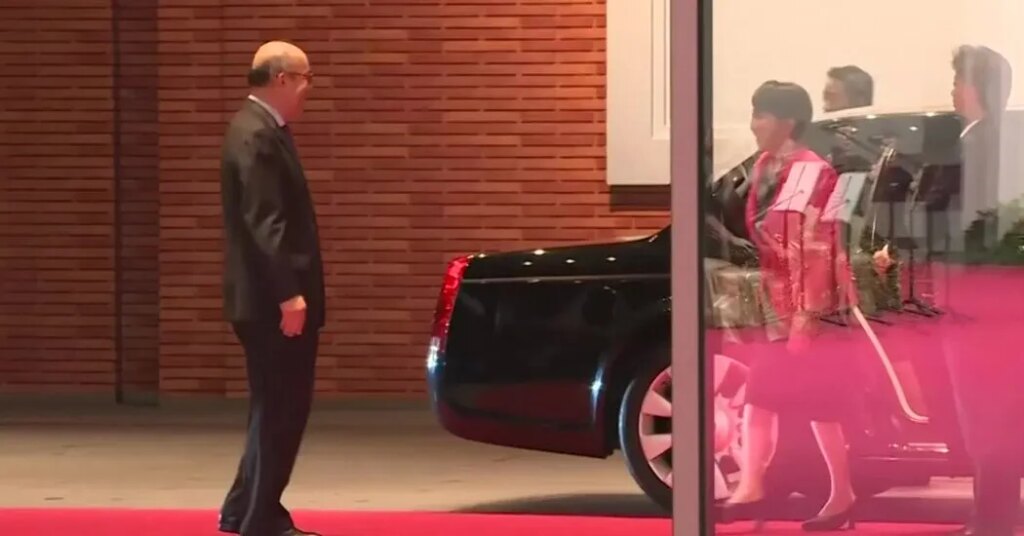
As they arrived for a banquet in Shenzhen, China, on Wednesday, world leaders were welcomed with fanfares by Chinese musicians. They played “America the Beautiful” for President Trump, the folk song “Cielito Lindo” for President Claudia Sheinbaum of Mexico and the traditional ballad “Drifting Ferns, Floating Clouds” for Vietnam’s leader, To Lam.
When Japan’s prime minister, Sanae Takaichi, entered the hall, the band offered a more unconventional choice: “Ue o Muite Arukou,” also known as “Sukiyaki.” The song, which was released in 1961 and became a global hit, was inspired partly by protests against the U.S. military presence in Japan after World War II.
Was China, which has been locked in a bitter political feud with Japan for a year, trying to send a musical message to Ms. Takaichi, a defense hawk and close American ally?
“It’s only natural to suspect that the choice of song was carefully choreographed,” said Ken Moriyasu, a senior fellow at the Hudson Institute in Washington and a former foreign correspondent for Nikkei.
The point, he added, was clear: “A song rooted in opposition to the U.S.-Japan alliance, being played to welcome a Japanese prime minister in China.”
China has been at odds with Japan since last year, when Ms. Takaichi suggested that Japan could be forced to get involved militarily in case of a Chinese attack on Taiwan. Beijing considers Taiwan, a self-governed democracy, part of its territory.
The Chinese leader, Xi Jinping, has since attempted to drive a wedge between Ms. Takaichi and her allies, including Mr. Trump. In speeches, diplomatic talks and propaganda, Mr. Xi’s government has tried to portray Japan as an aggressor and a resurgent military power that cannot be trusted.
Ms. Takaichi has seemed eager to make the most of the forum in Shenzhen, despite some signs of frostiness. While other leaders were greeted by cheering crowds at the airport in Shenzhen, she received a far more subdued welcome on the tarmac.
Ms. Takaichi briefly met Mr. Xi before the banquet — their first encounter in more than a year — but he did not appear to respond when she tried to engage him in conversation. The two leaders shook hands and posed for a photo.
On Thursday, Ms. Takaichi appeared to have a lot to say to Mr. Xi when they met again before the day’s discussions. It was unclear what she told him, but Mr. Xi nodded and offered a slight smile.
For her part, Ms. Takaichi, an amateur heavy metal drummer, appeared pleased by the rendition of “Ue o Muite Arukou.” She smiled and bowed her head to the musicians.
“Ue o Muite Arukou,” which was sung by Kyu Sakamoto, with lyrics by Ei Rokusuke, was the only Japanese-language song to reach the top of the Billboard Hot 100 chart in 1963. The title translates roughly as “I Walk Looking Up.”
Mr. Ei has written that the song was about the “sense of defeat” he felt at the time about negotiations over a security treaty with the United States. He had taken part in protests opposing the treaty.
The song itself does not directly speak about protest or war, but describes feelings of loneliness and heartbreak:
I look up as I walk
So that the tears won’t fall
But the tears well up as I walk
For tonight, I am all alone
Kiuko Notoya and Hisako Ueno contributed reporting.
The post Was China Sending a Musical Message to Japan’s Leader? appeared first on New York Times.