This week, in the wake of system failures, network crashes and flight stoppages, which left many people fearful, frustrated and generally on edge, Liz Howard had a simple message.
“I told you this would happen,” Howard sang in a singsong video to hundreds of thousands of online followers, adding, “And it’s going to get worse from here.”
Howard, a California-based cybersecurity expert known as Liz the Developer, is just one of a raft of online oracles preaching to a new breed of anxious followers who have been alarmed by a series of seemingly cascading crises but are also determined to adapt and survive whatever mayhem the digital world might conjure.
It’s a cohort whose message has suddenly taken on a deeper resonance after an array of recent disruptions, as well as the potential real-world consequences of other meltdowns, from the merely inconvenient to the dangerous: loss of navigational tools, power outages, banks being down; loss of communications and access to medical records; civil unrest and institutional collapse.
These are all worries that overlap with those of more traditional preppers, but the digital variety also has their own brand of futuristic fear: stolen data, password breaches, digital surveillance and — more than anything — malevolent artificial intelligence, with dire warnings and even scarier predictions.
“Tech has become evil,” said Howard, who founded The Multiverse School, an “unconventional” coding and A.I. school, and sports a shock of aquamarine hair in their droll videos. “I kind of know how bad it can get. And with A.I., it’s really getting bad.” (On Monday, Google, in fact, announced that autonomous A.I. agents were outpacing the ability of humans to fight them,the same day Howard posted their “I told you so” about that exact topic.)
To counter those perceived threats, as well as the terror of — gulp — the loss of internet service, Howard and others are collectively creating a kind of online survivalist’s guide for this nervous moment. It’s a grab-bag — or maybe a go-bag — complete with Faraday-field fanny packs, which block electromagnetic signals, and MacGyver-like hacks on creating batteries out of a magnet, two padlocks and a USB charger. Others preach a got-no-signal self-sufficiency, with tutorials on downloading maps, first aid guides and even the entirety of Wikipedia, as well as places to escape to in the event that everything goes south.
“There’s a feeling of kind of helplessness that you can have around all of this stuff that sucks,” said Deana Burke, a tech writer and A.I. literacy influencer who recently began a series on “lowkey prepping,” complete with discussion of long-range radio devices. “You can sort of just bear witness to it. Or you can try and have a little agency.”
The enemy in many of these disaster scenarios is pretty clear, said Dr. Avriel Epps, a computational social scientist and an assistant professor at the University of California, Riverside, whose video about trying to ditch her smartphoneearned more than 100,000 likes on TikTok.
“The products that are being developed by this industry are really in service of their leaders, not in service of the consumers,” Epps said in an interview. “It’s like: ‘We don’t want this. Why do you keep shoving it down our throat?’”
Epps, who also has tried to “de-Google” her life, has found other ways to unplug, like “Screen-Free Sundays” — with no tablets, no phones, no TV — something she admitted was an acquired taste.
“Neither of my kids liked it,” she said, “But I enjoyed it.”
That antipathy toward Big Tech seemingly reverberates in acts of sabotage on Flock cameras and the popularity of D.I.Y. content creators like Jake Cochrane, a.k.a. Dirtbag America, who posts snappy videos about how to build things like a pallet cabin while offering a satirical commentary about “spiting our corporate overlords.”
Many of the digital doomsayers talk about a “polycrisis”: overlapping and seemingly interconnected threats. (Or “an advent calender of societal collapse,” as the comedian Jon Stewart called the recent spate of computer meltdowns.)
By its very nature, polycrisis is not limited to America. The threats of global warming, war and pandemics also simmer in these channels, not surprising considering a rash of fierce weather events, turmoil in Ukraine and the Middle East, and Covid, which inspired renewed interest in preparedness and stockpiling.
Stateside, some newcomers also say they have been activated by the actions of U.S. Immigration and Customs Enforcement, which resulted in a series of shootings by federal agents and the killings of two civilians this year in Minneapolis, raising concerns about the unpredictability of law enforcement personnel and governmental overreach.
Indeed, once written off as paranoid fantasy, and largely the domain of those with conservative and libertarian views, prepping itself has rapidly joined the mainstream and, in some quarters, has taken on a liberal bent: Rather than hiding away alone, armed to the teeth, there is an emphasis on building resilience and connections among people.
“The days of being like a lone wolf, Mad Max, off on your own, a nomad — that’s kind of fantasy land,” said Cliff Colón, the Seattle-area preparedness guru who calls himself the Urban Prepper. “I think people are moving away from that. They know that, ‘Hey, to survive an emergency, I have to be part of some kind of team.’”
Messages about how much to worry have been muddled. On Monday, for instance, Vice President JD Vance told Fox News that he wasn’t worried — that much.
“I’ve had a lot of my friends reach out and say, ‘Should we be preparing to build a bunker or to stock up on food and water?’” Vance said. “And my answer to that is no.”
He added, “But you have to be prepared for everything.”
Of course, the perceived lack of government response has also upset many Americans in recent weeks, including some prominent Republican lawmakers.
Other governments seem a little more proactive. In late October, the British government launched a three-year campaign called “Be Ready” — for events including “severe weather to cyber attacks.” In early November, European leaders issued new guidelines for emergency preparedness, including “72-hour self-sufficiency” and educating children to develop “preparedness skills from an early age,” without, it noted, “creating fear or anxiety.”
That may be wishful European thinking.
“If you look at what drives people to the space, it’s fear,” said Bill Fulton, a former Army infantryman and a co-author of “Survive and Thrive,” a 2023 disaster prep book that describes its mission as teaching how to survive without “ammo, camo, or eating your neighbor.”
Preppers have existed in the culture for decades, with survivalist-tinged reality television shows running parallel to a “Doom Boom,” complete with Substacks, billionaire bunkers and multiday survivalist workshops, all servicing the “panic industry.”
Dorian Lynskey, the author of “Everything Must Go: The Stories We Tell About the End of the World,” said humanity’s obsession with the end times dates back millenniums, with books and movies about killer comets, doomsday machines, and a near-overnight ice ages. (Such a fascination might also explain the recent rise of “A.I. doomers.”)
And those who preach preparedness are finding large audiences in real life, said Kristopher Sarratt, whose YouTube channel — City Prepping — has 1.3 million subscribers. He says he has seen a big shift in the prepping community, with more “younger people, people living in cities and suburbs, families.”
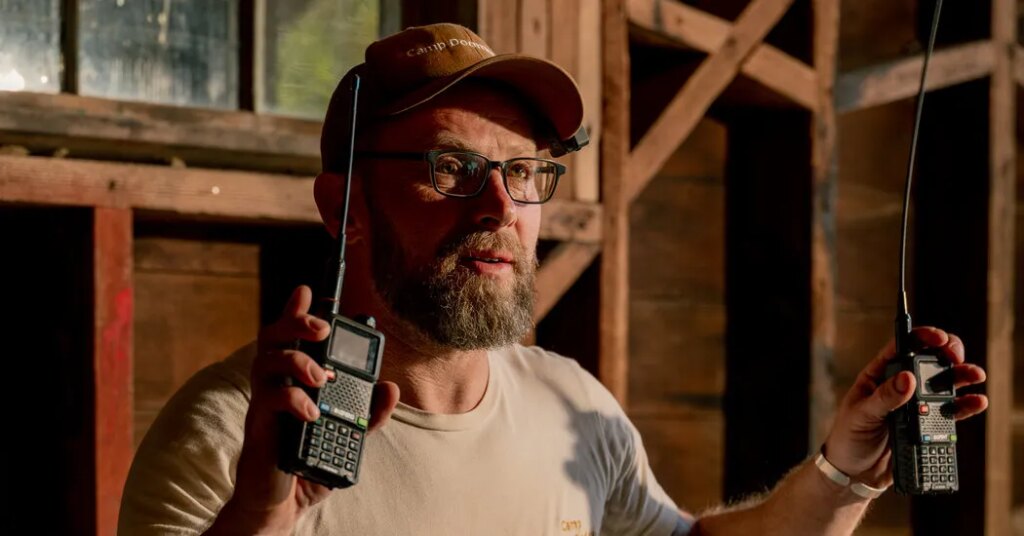
Sure enough, in early October, dozens of would-be survivalists descended for a weekend-long preparedness workshop — Camp DoomsDaddy — run by Sam Bloch, the former director of emergency response with World Central Kitchen, the humanitarian feeding program founded by the chef José Andrés.
“Our institutions are kind of collapsing,” Bloch said as the weekend began. “As our needs are escalating.”
The camp, held at a sun-dappled farm in Sonoma County, Calif., drew concerned citizens, including many Californians reeling from devastating fires in 2025, to learn lessons on emergency and evacuation plans, first-aid and fire skills and how to stuff wounds and patch tires. (Oddly, they are very similar.)
Most end-of-the-world influencers touch on the same broad categories: communications, medical, food and “tactical,” a term for weapons. There are mundane specialists like pantry experts and avid canners — meat chunks, anyone? — as well as permaculture enthusiasts and “food forest” fans, aiming for maximum ecological balance. There are also seekers like Chris Morello, a “utopian field researcher,” who has visited dozens of alternative communities and offers tips on “how to find a commune near you.”
Some at Camp DoomsDaddy were also seemingly eager to prove to themselves that they were able to manage a crisis.
“DoorDash is not an emergency plan,” said Patrick Torrey, who works as stockbroker in the Bay Area and attended the DoomsDaddy weekend.
One of Bloch’s major focuses was how to stay connected in the event of disaster — whether natural or artificial. To that end, Bloch preached the benefits of GMRS, or general mobile radio service — basically powerful, sophisticated walkie-talkies — and mesh phones, which allow users to text and use some other functions, sometimes over long distances, without needing cellphone towers.
“We’ve all become so dependent on our phones,” he said. “And it’s one of the first things that goes out.”
Such sentiments are echoed by companies like Solomon Survival Tech, whose motto is “Be ready when the internet isn’t,” and sells a $129 drive containing millions of Wikipedia articles and more than 6,500 books, as well as maps and a way to jump-start computers whose operating systems are down. The company’s mysterious, camo-balaclava-and-ski-goggle-wearing spokesman also offers free tips on “digital sovereignty,” offering alternative sources for everything from security cameras and communications to calendars and emergency updates.
Some are not sold on whether prepping, digital or otherwise, will be enough. Jem Bendell, a renowned expert on sustainability, was the author of the 2018 paper “Deep Adaptation,” which suggested people should prepare for “societal disruption and collapse” as a result of climate change.
Bendell himself checked out, leaving an academicposition in England and starting a regenerative farm school in Indonesia. And in an email interview, he was simultaneously supportive of preppers and more pessimistic about the outlook.
“They are doing a responsible thing by becoming someone who won’t be an immediate burden on their neighbors if suddenly the lights go out,” Bendell wrote.
But, he added, just preparing for “momentary emergencies” isn’t enough. “It involves a reassessment of basic choices in life — where we live, what we work on, what we aspire to, how we maintain our physical and mental well-being,” he said.
But is there hope? he was asked.
“Hope is boring,” he wrote.
“Hope typically means wishing the bad news isn’t real, or that someone else will rescue us, or that we must believe a fair tale to stay motivated to do the right thing,” Bendell continued, adding he preferred “love and wonder” as motivators. “But the bad news is real.”
And tech isn’t going anywhere: Howard, the cybersecurity expert, has trained some three million people to code. But Howard also spends much of their time warning about online threats, and estimates a 10 percent chance that human extinction will be brought about by A.I., which they said is now better at hacking than any human — and can’t simply be turned off.
“But,” Howard added, “I’d say that we have a 90 percent chance of figuring it out, because everyone on Earth is really incentivized to not die.”
The post They’re Prepping for a Broken Digital World appeared first on New York Times.