It was called ELIZA, after Eliza Doolittle, the George Bernard Shaw character who was trained to pose as a British aristocrat even though she was just a flower girl from the London slums.
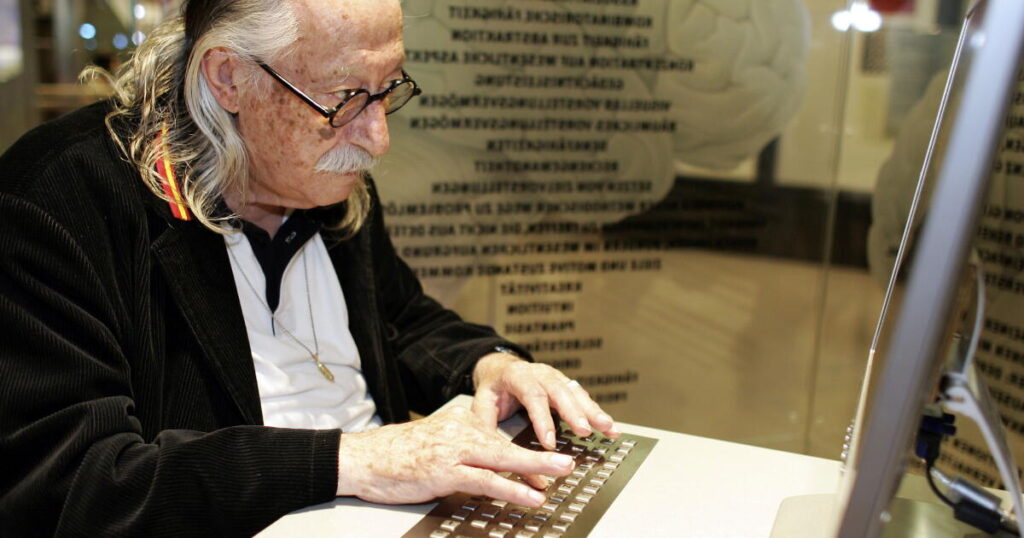
As Shaw did with his Eliza, MIT computer science professor Joseph Weizenbaum vested his creation with a persona that fooled onlookers — in his case, gulling its human inquisitors into thinking they were conversing with a human. (Actually, exchanging teletyped messages, since voice interactions hadn’t been invented yet.)
“People who conversed with the program thought it was a person, a phenomenon that Weizenbaum devoted much of the rest of his career to lamenting and debunking,” Janet H. Murray of the Georgia Institute of Technology wrote in her succinct introduction to a new book exploring the history of ELIZA and its implications for today, titled “Inventing ELIZA: How the First Chatbot Shaped the Future of AI.”
ELIZA as a historical artifact is well-known, especially within the computer science world. But the book reveals much that isn’t well-known, including how the Berlin-born Weizenbaum himself reacted to how people used it. In short, he was appalled. His efforts to make clear his own purpose in inventing ELIZA and challenge what he saw as its misuse and misinterpretation made him a pariah among his scientific colleagues.
But his concerns about the dangers of ceding to AI actions and judgments that should remain under human agency remain true today. Weizenbaum was not only a pioneering inventor, but a pioneering, and ferocious, critic of AI itself.
The book explains the background to the most famous iteration of ELIZA, which was a script in which it posed as a psychotherapist. ELIZA itself, the book explains, was the platform, or template, that Weizenbaum developed in the mid-1960s and described publicly in 1966.
The therapist program, which was called DOCTOR, was just one of many scripts that computer science students and experts developed for ELIZA, including some in which in which ELIZA seemed to converse in learned terms about math, poetry, color, France and New England. Weizenbaum’s own initial idea had been for ELIZA to take on the personality of a barman, but he thought that a therapist bot would be more interesting.
ELIZA demonstrated Weizenbaum’s instinctive grasp of human psychology.
“There’s this automatic tendency of humans to converse,” says Jeff Shrager, a cognitive scientist and member of the team that produced the book. “What ELIZA picked up on and scripted so effectively was this kind of social imperative. What made it so effective was that it seemed to be conversing.”
Weizenbaum endowed DOCTOR with a roster of keywords that would prompt it to issue predetermined responses. If a user made reference to his or her father or mother, it would issue a question about the user’s family.
If the user’s question included the words “me” or “I,” DOCTOR would echo the user’s question while substituting “you.” Hence, DOCTOR’s most famous dialogue (evidently written by Weizenbaum himself), begins with a user complaining, “Men are all alike.” For the system, “alike” was a keyword, prompting the response, “In what way?” The user responds, “My boyfriend made me come here.” DOCTOR responded, “Your boyfriend made you come here.”
Weizenbaum programmed the script to goad users into continuing their interaction. If their statement didn’t include a keyword, DOCTOR would reply, “Please go on” or “Hmmm” or “I see.”
“DOCTOR was the killer app for the ELIZA platform,” says Mark C. Marino, director of the Humanities and Critical Code Studies lab at USC and another member of the “Inventing ELIZA” team. “It pointed to the human need to connect with someone who asks you how you’re doing and appears to be listening.”
Weizenbaum wrote later that he himself was “startled to discover how quickly and how very deeply people conversing with DOCTOR became emotionally involved with the computer and how unequivocally they anthropomorphized it.” Even “extremely short exposures to a relatively simple computer program could induce powerful delusional thinking in quite normal people,” he wrote.
Among them were people who knew what was going on behind the curtain, and therefore must have known they were interacting with a machine. One was his secretary, who had watched him work on ELIZA for months — but who after a few exchanges with ELIZA asked him to leave the room, as though he were intruding on a private conversation between humans.
Weizenbaum had designed ELIZA as a research program into how people could interact with computers using natural English, rather than the stunted language of computing instructions. But the reactions to DOCTOR led him to think harder about the relationship between the individual and the computer.
This new research path would become ever more important as computers evolved from room-sized machines operated by experts into personal appliances perched on every desktop. Pondering users’ reaction to ELIZA, Weizenbaum wrote, vividly demonstrated “the enormously exaggerated attributions even a well-educated audience is capable of making … to a technology it does not understand.” If the public’s views are “wildly misconceived, then public decisions are bound to be misguided and often wrong.”
It wasn’t merely that people tended to anthropomorphize machines — he wasn’t concerned about people giving their cars pet names or imagining that they had human-like personalities. It was that people might be misled into ceding moral, ethical and social judgments to machines that were not capable of weighing such important issues. Indeed, he broke off a collaboration with a therapist who started to consider whether something like DOCTOR could function as a therapist itself.
As the authors of “Inventing ELIZA” report, Weizenbaum was alarmed about “how our inclinations toward companionship, social trust, and community could be manipulated by computer interfaces.” Computers, Weizenbaum wrote, do not understand but only calculate.
“Computers have no sense of morality, no sense of justice or rights, and they certainly are unable to take on a responsibility toward others,” the authors write of his insights. “Weizenbaum foresaw correctly that the development of conversational systems would likely result in a severe clash of values between the safeguards of social norms on the one side and … the priorities of a technocratic class using computers to control and manipulate people.”
Weizenbaum’s vociferous criticisms of this tendency alienated him from his computer science colleagues. His 1976 book “Computer Power and Human Reason” was crafted as a sort of manifesto challenging those he labeled the “artificial intelligentsia.”
He identified with the antiwar left during the Vietnam War and agitated against universities’ contributions to war-making technology, which unnerved scientists whose work was heavily dependent on funding from the Pentagon through its Advanced Research Projects Agency, or ARPA.
In 1996, he moved back to his native Germany, where he died in 2008 at 85, a prophet without honor in his chosen field.
Weizenbaum’s alarm at the misuse and misinterpretation of computer technology is more important than even he might have conceived, because the power of the technological elite is so much greater now than it was in his day —and more determined to make the technology serve their own commercial interests.
“Chatbot developers have all learned from ELIZA,” Marino told me. “But they read ELIZA not as a cautionary tale, but as a how-to manual.” For instance, Meta’s chatbot Muse, he says, “is like a modern-day Joe Camel,” referring to the cartoon figure that the government accused the tobacco company RJ Reynolds of using to induce young people to take up smoking. “It’s a cute animated figure meant to distract you from the real harms, that it’s extracting your data, that you’re giving away your privacy, et cetera, et cetera.”
Weizenbaum “was pointing at things which at the time were real problems and continue to be real problems,” Shrager says. “We need to dig into his critique and modernize it, like what kind of licensing and regulations do you need?”
Weizenbaum’s most important perception was that people tend to attach mystical, even magical, properties to technologies they don’t understand. That’s where we are now. If people understood that AI bots are just calculating machines, albeit of tremendous power, they would know that the answer to the question of whether the machines could become conscious and take over the world is “no.”
The post The very first AI chatbot was released in 1966. It turned its creator into AI’s most ferocious critic appeared first on Los Angeles Times.