When Matt Damon’s astronaut character Mark Watney finds himself stranded on the Red Planet with dwindling food supplies in the 2015 sci-fi film “The Martian,” he mixes the soil there with freeze-dried astronaut poop to grow a bumper crop of potatoes.
Real-life scientists pointed out that Martian soil has too much salt and heavy metals for the space spuds to be safe to eat. Yet researchers now say a bit of organic fertilizer broken down by worms may solve that problem — and allow NASA astronauts to one day grow potatoes on the moon’s surface alongside a long-term base.
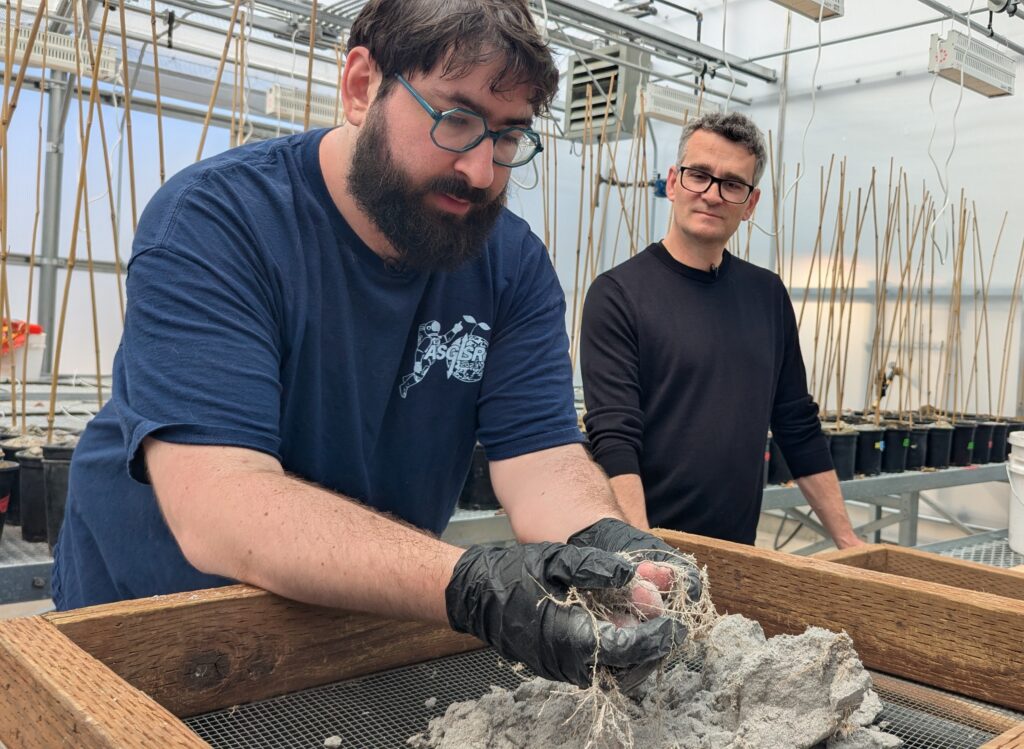
In a peer-reviewed study published Thursday in the journal NPJ Microgravity, plant scientists at Oregon State University utilized vermicompost, a nutrient-rich organic fertilizer made by earthworms. That was mixed with simulated lunar soil, called regolith.
The simulated regolith is similar to the geological makeup of soils in the moon’s volcanic zones, in lunar highlands that have been pelted by meteorites for millennia and at the lunar south pole, where NASA wants to establish a base.
Potatoes grown in this mixture developed like a control group of plants grown in Earth soils, while those without the vermicompost had more toxic chemicals and stunted growth, according to the study.
Previous studies showed that plants fail to grow in regolith brought back from the Apollo missions. This one is the first to find that the right mix of fertilizer and soil might overcome that problem. The organic matter formed a chemical bond with the heavy metals, the researchers found, keeping them in the soil and preventing them from damaging the potatoes’ roots and leaves.
Aymeric Goyer, author of the NASA-funded study, foresees a day in the future when astronauts chop up potatoes for a moon-base meal.
“Yes, they are safe to eat,” he said of the taters his team cultivated.
Goyer, professor of botany and plant pathology at Oregon State, said the “Martian” scenario of mixing human waste with soil might work on the moon.
“Everything would have to be a closed loop,” he said. “Carbon dioxide that plants need would come from astronauts breathing out. Nitrogen that plants need would come from human waste because transporting fertilizer to the moon would be way too costly.”
And potatoes grown in the first months or years of a lunar greenhouse might be used as plant compost, then later mixed with human waste and regolith to form a healthy soil, Goyer noted.
Experts say the right soil recipe is just one aspect of a successful moon garden. Future astronauts also will have to protect the plants from radiation, which over time damages DNA in both plant and human cells.
“Radiation could create some mutations in the potato genome, so those plants that we would grow year after year may change genetically,” he said. “That’s something that we need to monitor to make sure that it doesn’t affect yield and taste.”
Another detail to be figured out is the effects of microgravity on plant growth, and astronauts will have to build mechanical devices to mix the air inside the moon base’s greenhouse to make sure the plants get the right amount of nutrients, water and carbon dioxide, according to Marshall Porterfield, professor of agricultural and biological engineering at Purdue University. Ensuring that a consistent supply of water reaches plant roots has been difficult during botany experiments on the International Space Station, he said.
“We’re going to have to engineer root zone systems that can deliver water and oxygen in the proper ratios,” he explained.
Porterfield is leading a NASA experiment called LEAF to place a small terrarium on the lunar surface during the Artemis IV mission, which the space agency is hoping will get off the ground by 2028. Grass seedlings will grow inside the mini-fridge-size module for a week before returning to Earth.
But will lunar soil ever have enough nutrients and vitamins to keep future astronauts healthy? Porterfield remains skeptical.
“Ultimately we’re going to need that connection back to the Earth,” he said.
The post One small step for potatoes? Scientists explore growing food on the moon. appeared first on Washington Post.