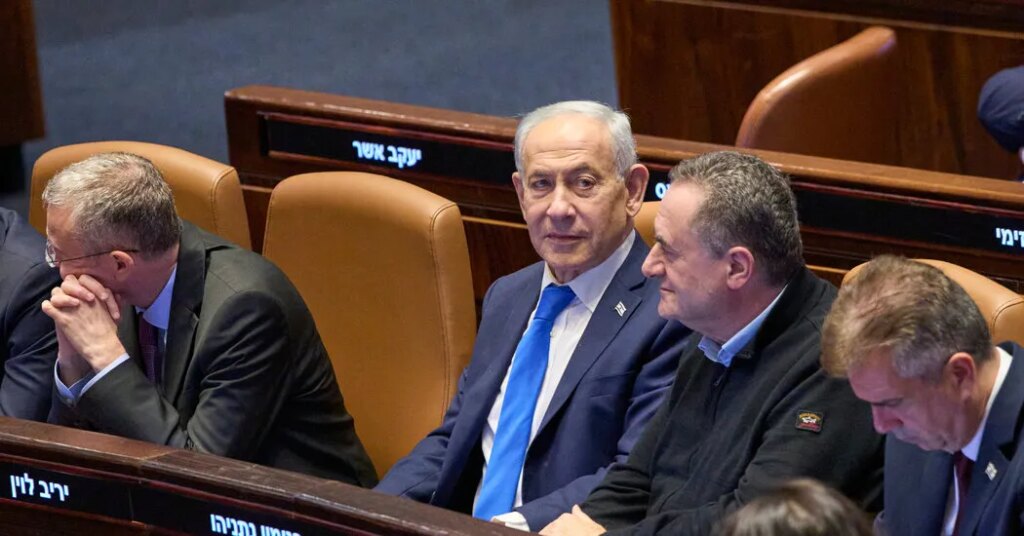
After Prime Minister Benjamin Netanyahu and his allies failed to win an outright majority in last month’s Israeli election, he insisted the vote was stolen, arguing that record turnout by Arab voters was part of a conspiracy to rig the result.
As evidence for his claims, Mr. Netanyahu seized on the arrests of three activists for Raam, an Arab-led opposition party, on the morning of Election Day. The Israeli police said at the time that the men were believed to have been planning to bribe voters, adding that officers had seized envelopes of cash that might have been part of a plot.
Raam denied the allegations, and the activists were ultimately released without charge. But what Mr. Netanyahu did not say at the time was that his own chief of staff and a former aide had been involved in the initial outreach to the police that led to the arrests.
Both aides acknowledged their involvement this week. The suggestion that Mr. Netanyahu’s office had a hand in the arrests of his political opponents has prompted calls for an investigation. The Israeli attorney general, Gali Baharav-Miara, said on Tuesday that she and the state prosecutor were looking into the matter.
Ram Ben Barak, a centrist lawmaker from the opposition Together party and a former deputy chief of the Mossad intelligence agency, said that the allegations evoked repressive states such as President Vladimir V. Putin’s Russia, in which the police are weaponized as a political tool.
“I would never have imagined that this kind of story would emerge from the Israeli prime minister’s office,” Mr. Ben Barak added.
Mr. Netanyahu’s aides initially denied reports, including in The New York Times, that the police who arrested the three Raam activists on Oct. 27 were acting on a telephone tip provided by the prime minister’s chief of staff, Ido Norden. But on Sunday, after an investigative report by the Israeli broadcaster Channel 12 unearthed new details about the episode, Mr. Netanyahu’s office changed course.
“Criminal information reached Ido Norden, the chief of staff,” his office said in a statement. “He carried out his duty, like any other citizen.”
After an election that left neither Mr. Netanyahu nor the opposition with a clear path to forming a government, critics of the prime minister say the episode shows how far he will go to maintain his grip on power. They also say it reinforces fears that Mr. Netanyahu and his allies have bent Israel’s security agencies to serve their personal agendas, which the prime minister has denied.
The Israeli prime minister’s office did not respond to a request for further comment, nor did the Israeli police or the Shin Bet domestic intelligence agency.
On the morning that Israelis headed to the polls, Mr. Netanyahu trumpeted news of the arrests in bluntly racial terms, appealing to right-wing Jewish Israelis to vote because more Arabs were voting than Jews.
“This is an emergency appeal,” he said. “They are trying to steal the elections from us.”
Mr. Netanyahu’s Likud party secured more seats in Israel’s Parliament, the Knesset, than any other, even though the opposition parties collectively have a majority.
Gadi Eisenkot, who leads the opposition Yashar party and is Mr. Netanyahu’s main political rival, has demanded a criminal investigation into the arrests. He has accused Mr. Netanyahu of potentially “planting evidence and deploying the police against Arab citizens of Israel without valid search or arrest warrants.”
The surge in turnout among Arab voters handed the Arab-led parties a historic 19 seats in the 120-member Knesset. After the vote, Mr. Netanyahu initiated an aggressive push to delegitimize the results, at times echoing President Trump’s “stop the steal” campaign after the 2020 U.S. elections.
Israeli election officials have repeatedly said there is no proof of widespread fraud that could affect the results. That has not deterred Likud, which continues to assert that the election was tainted, warning in a statement that the Arab parties would bring about “the Islamification of Israel.”
Raam, the party of the three arrested activists, is a pragmatic Arab-led grouping with Islamist roots. It is one of the two main Arab parties in Israel. Portraying Raam as being linked with possible criminality has some benefit for Mr. Netanyahu as it could complicate any effort by Mr. Eisenkot to form a coalition that relied on the Arab party’s support.
The Shin Bet, Israel’s domestic intelligence agency, is separately investigating potential foreign funding in the election — an inquiry that Likud has also invoked to assert that the vote was flawed. But the investigation has not found any widespread bribery or tampering with the election results, Noam Sohlberg, a conservative judge who chairs the Central Elections Committee, said on Tuesday.
Now, after the revelations about the initial contact with the police, Mr. Netanyahu’s rivals say that the real meddling on Election Day may have been perpetrated by the prime minister’s associates.
On Monday, Israel’s national broadcaster, Kan, named the tipster as Daniel Greenberg, who worked in Mr. Netanyahu’s office from 2023 until a few months ago. In a government document, reviewed by The Times, Mr. Greenberg is described as an “adviser on Arab affairs.”
A lawyer for Mr. Greenberg, Avichai Yehosef, confirmed in an interview that his client was the source of the tip, but denied that he had tried to improperly influence the election, saying that Mr. Greenberg had merely passed along information about the activists’ intention to bribe voters.
Mr. Yehosef said that Mr. Greenberg had learned the names of the three Raam activists from an Arab lawmaker. He declined to name the lawmaker.
The three Raam activists were arrested before dawn on Election Day, Oct. 27, at their homes in southern Israel, court filings show. At least two of their homes were searched without warrants, the police later admitted in court.
One of the activists, Dr. Sayyaf Abu Riash, 38, said in an interview that he woke up at roughly 4:30 a.m. that day when the police demanded to enter and search his home. Officers refused to say what they were looking for, Dr. Abu Riash said, before telling him to accompany them to a police station, where he was interrogated him about his involvement in the party.
Dr. Abu Riash said that he campaigned on behalf of Raam but did not hold a formal role. He said Israeli leaders should look favorably on Arab citizens turning out in such high numbers.
“It shows that they feel like they’re part of the country,” he said.
Instead, he said that his arrest had been “used to inspire fear” about the prospect of Arab citizens exercising their democratic rights.
Judge Merav Amar Cohen, who ordered Dr. Abu Riash’s release, criticized the police, saying officers had lacked an evidentiary basis to hold him.
“The investigation files show that the defendant is involved in advocating for the Raam party and even involved in house meetings with candidates,” she wrote in a judgment ordering his release. “But that’s not a crime.”
The post Netanyahu Associates Acknowledge Role in Setting Off Election Day Arrests appeared first on New York Times.