The Egyptian writer and activist Abdelrahman ElGendy won the top prize for nonfiction for “Huna: A Memoir of Revolution, Prison, and Becoming.” The book chronicles his arrest at 17, along with his father, during mass protests in Cairo following the military coup that ousted Mohamed Morsi, Egypt’s president.
The memoir, published by Hogarth, follows ElGendy’s years of imprisonment, exploring his struggle for political resistance, survival and liberation under an authoritarian regime.
ElGendy was not able to collect his award in person after the U.S. government denied his visa to travel to New York for the ceremony, according to an article he published in The New Yorker last week.
Changes made in 2024 by the National Book Foundation, which administers the awards, opened eligibility to authors who are not U.S. citizens. This week, The New York Times found that ElGendy’s memoir, “Huna,” appeared to be ineligible for the prize by the foundation’s own criteria because he was not living in the U.S. at the end of 2025 — a finding the foundation emphatically refuted.
ElGendy’s victory fomented a message of solidarity and unity in a charged political climate, as finalists agonized over discrimination, the ongoing war in Gaza and attacks on freedom of speech.
“If you’re listening to this, then a yearslong dream of mine has come true, and I’m not there to live it with you,” ElGendy wrote in an acceptance speech that was delivered by Helen Thomaides, his editor at Hogarth. “May all borders be abolished, may all prisons fall.”
Hannah Lillith Assadi took home the top prize for fiction for “Paradiso 17,” a story told from its narrator’s deathbed about a life lived in exile from Palestine. Loosely based on the experiences of the author’s father, the novel, published by Knopf, is “a study in inheritance, in the afterlife of ideology, in the way history seeps into every curated idyll,” Zain Khalid wrote in The New York Times Book Review.
“Perhaps this is the Palestinian story on this earth, so beautiful, so painful, and isn’t that story all of ours?” Assadi said in her acceptance speech with tears in her eyes. “I want to thank the judges, I could kiss you. I might.”
The National Book Award, established in 1950, honors literature published in the United States, and is considered among the most prestigious literary prizes in the country. Past winners include some of America’s most celebrated literary voices, like Ta-Nehisi Coates, Robert Caro, Flannery O’Connor and Ralph Ellison.
This year’s roster of finalists included authors of Egyptian, Palestinian, Haitian and Colombian descent, and the titles up for the awards grappled with Gaza, displacement, immigration, disability, imprisonment and gender identity. Two of the fiction finalists identify as transgender and wrote novels about trans experiences. All but one of the nonfiction nominees were at least partially works of memoir.
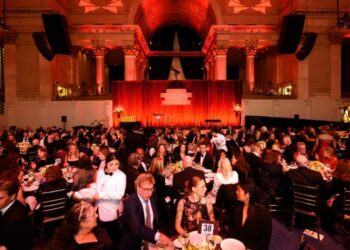
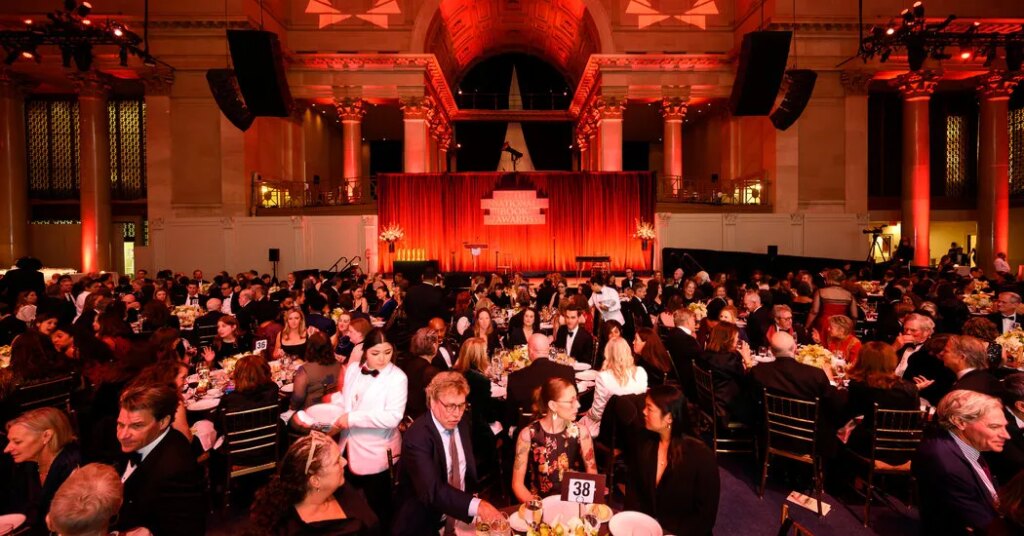
“We have a lot of books this year that were directly about A.I., that were about authoritarian politics,” said Robert Warrior, who led the nonfiction judging panel, as he walked to his table for dinner at the black tie event at Cipriani Wall Street in Lower Manhattan. “I kept looking for these books that would directly explain those things,” he added. “I realized these books are actually books that do that.”
Mingling among other authors, editors and publishers, the fiction finalist Julián Delgado Lopera celebrated the recognition that transgender writers received throughout the evening.
“Like any other community, trans people produce amazing work,” Lopera said. “It’s really great that we are getting recognized for it too. It seems like it was overdue.”
Sara Nović, the author of “Mother Tongue,” a memoir about hearing loss, said she considered her nomination to be part of a recent recognition of disabilities in the arts.
“Deaf and disability history are really an important part of American history and that’s something that we haven’t really seen represented very much,” she said, speaking through an interpreter.
The event was hosted by the actor Kyle MacLachlan, who started his speech with a quote from the children’s book “Paddle-to-the-Sea,” which he read as a child, and joked that he prepared his remarks without A.I. “That would be a cheat, a total misrepresentation and completely unethical,” he said. “I hired someone to write this for me while taking the credit for it myself.” MacLachlan, best known for his starring role in “Twin Peaks,” also mentioned economic tumult in the publishing industry. “No wonder you’re drinking so heavily,” he quipped.
The musical guest, Michelle Zauner, the lead vocalist of the indie pop band Japanese Breakfast, performed songs including “Be Sweet” and “Magic Mountain” in a sleeveless emerald green gown that showed off her tattoo sleeve. Her 2021 memoir, “Crying in H Mart,” spent more than a year on the New York Times best-seller list.
Standing at the bar during a crowded cocktail hour, Colin Asher, the author of “The Midnight Special, and a finalist for nonfiction, seemed bemused to be wearing a medal around his neck.
“I’m a guy who is accustomed to sitting in a pair of ratty army shorts and a hoodie behind a keyboard and so this is very disorienting,” he said.
Valeria Luiselli, a finalist for fiction for her novel “Beginning Middle End,” tried to absorb the moment. She recounted a conversation with her therapist. “I was complaining about something and she said, ‘Well, but did you write the book you wanted to write?’ And I said, ‘Yes.’ ‘What are you complaining about?’”
Luiselli was seated at a table with two other fiction finalists — Edwidge Danticat, author of the novel “Dèy,” and Assadi. All three shared the same editor, John Freeman, an executive editor at Knopf.
“I grew up in a family with three children and we all felt loved, so hopefully that’s happening here,” Freeman said, sitting among his authors.
Assadi, a mother of three small children, said she learned that she was nominated while she was sick in bed with a stomach bug that was swept through her household. “So it was the most high, low day of my life,” she said. ”So it was a very surreal.”
David Levithan and Gabriel Duckels won the prize for young people’s literature for “The Fight of Our Lives: AIDS in America,” published by Knopf, a nonfiction book that chronicles the HIV/AIDS crisis, focusing on the 1980s and 1990s.
“That’s not a simple story to tell. It’s not an easy one to hear. It’s not a story that’s finished,” Duckels said in his acceptance speech, adding, “People living with HIV matter, people living with AIDS matter.”
The Medal for Distinguished Contribution to American Letters, a lifetime achievement award, went to the author Salman Rushdie, whose most recent work, a memoir called “Knife,” chronicled a 2022 attempt on his life. The crowd heralded him onstage with a standing ovation. Previous winners include Toni Morrison, Joan Didion, Arthur Miller and Tom Wolfe.
In his speech, Rushdie described himself as a boy born in Bombay 79 years ago at the end of the British Empire who ended up on a stage in New York City with a medal dangling from his neck. “If that’s not magic realism, I don’t know what is,” he said.
The Literarian Award for Outstanding Contribution to the American Literary Community went to Dr. Perri Klass, a pediatrician and author who is the national medical director of the nonprofit Reach Out and Read. The organization works with medical professionals to encourage parents to read aloud to their infants and young children. Past recipients of the award include Maya Angelou, Terry Gross and, most recently, Roxane Gay.
The prize for translated literature went to “Centroeuropa,” a genre-bending novel set in 19th century Prussia. Written by Vicente Luis Mora and published by Bellevue, it was translated from the Spanish by Rahul Bery, who, in his acceptance speech, described it as an “absolutely insane novel.”
Brenda Hillman won the poetry award for “Still House in the Desert: An Eco-Contemplation,” published by Wesleyan University Press, which takes an ecological journey into Hillman’s childhood and is the fourth and concluding volume in a quartet about time. “I’m 75. I’ve been writing poetry for 65 years,” Hillman said. “I hope I don’t have a heart attack right now.”
She added, “Thank you for keeping poetry in your lives, if you would keep it all the time, not just at weddings and funerals.”
The post National Book Award for Nonfiction Goes to Writer Denied Visa to Attend appeared first on New York Times.