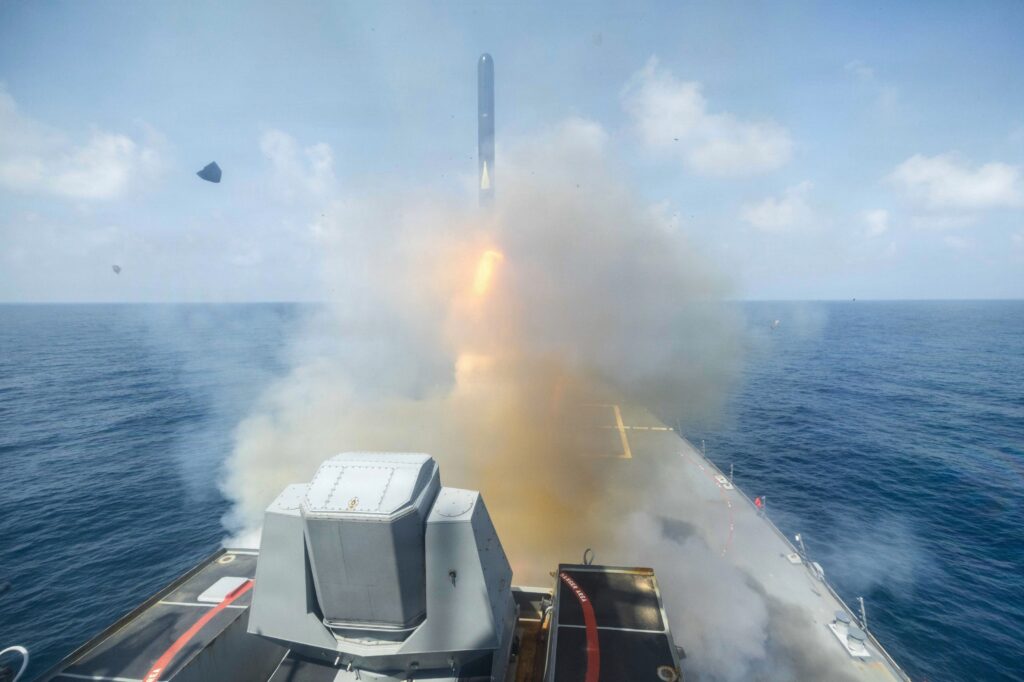
The Iran war has “heightened the importance” of addressing a “persistent” shortfall of key munitions in the Pentagon’s arsenal, according to a congressionally mandated government study released Thursday, contradicting assertions from senior Trump administration officials who’ve said repeatedly that there are no shortages.
The report, produced by the independent Government Accountability Office, assesses that the Defense Department lacks an “overarching munitions plan to improve inventory levels” and says that the creation of such a road map must be prioritized.
“Meeting munition requirements and rebuilding munition inventories is a highly complex challenge that will require a department-wide solution,” the report states. “While DOD is taking steps to focus on munitions shortages, it is not positioned to address these gaps.”
President Donald Trump, Defense Secretary Pete Hegseth and other senior U.S. officials have repeatedly disputed media reports detailing how the Iran war — initiated by the Trump administration in concert with Israel — has depleted the U.S. military’s stockpile of Tomahawk cruise missiles, Patriot interceptors and other advanced munitions.
The GAO’s director, Diana Moldafsky, said in an email to The Washington Post that her office’s research found that the Iran war exacerbated munitions shortfalls. She called them “persistent” in recent years. The Pentagon did not dispute the GAO’s findings when presented with them, she said.
A White House spokeswoman, Anna Kelly, downplayed the findings, saying in a statement that the U.S. military “has more than enough munitions, ammo and stockpiles to serve all of President Trump’s strategic goals and beyond.”
Operation Epic Fury — the administration’s name for the Iran war — has “exposed what happens when you mess with the United States,” Kelly added. “Even still, many defense contractors have heeded the President’s call to constantly produce more made-in-America weapons, which are the best in the world.”
The Pentagon, in a statement, also dismissed the report’s significance, saying it would not comment on studies conducted by “outside organizations.”
“The United States maintains the world’s most capable military, fully equipped to strike at the time and place of the President’s choosing, and has already conducted successful operations across multiple combatant commands while preserving a deep, ready stockpile to defend our people and interests,” the Pentagon said.
The supply of key U.S. munitions has been an issue dating back to the Biden administration, when some Republicans joined Democrats in advocating for the provision of U.S. arms to Ukraine in response to Russia’s full-scale invasion beginning in 2022.
Others in the GOP, including Trump, questioned whether the United States was providing too much to the government in Kyiv. The president, in July 2025, accused his predecessor of having “emptied out our whole country giving them weapons.”
In the run-up to his reelection in 2024, Trump campaigned on a promise to avoid new wars. But soon after taking office, he authorized Operation Rough Rider, a bombing campaign targeting Iran-backed Houthi militants in Yemen.
In that case, as with the ongoing conflict against Iran, some senior administration officials voiced concerns about extended operations further drawing down the U.S. arsenal. Trump ended the Yemen campaign after several weeks as the president said the Houthis had promised not to target U.S. ships in the region.
In February, less than a year later, Trump and Israel started the Iran war, prompting weeks of heavy fighting.
Trump dismissed concerns about U.S. stockpiles almost immediately, saying in a social media post after several days of fighting that the United States has a “virtually unlimited supply” of some weapons “at the medium and upper medium grade” and that wars could be “fought ‘forever,’ and very successfully, using just these supplies.” He added that the Pentagon had a “good supply” of certain weapons “at the highest end,” but wanted more.
Hegseth suggested much the same. In a news conference in March, he said there was “no shortage of munitions.” The supply of defensive and offensive weapons “allow us to sustain this campaign as long as we need to,” he claimed.
In June, Hegseth again dismissed concerns about the military’s weapons supply, telling CBS News that it was a “manufactured story.” U.S. stockpiles, he asserted, “are great, and they’re only getting stronger.”
More recently, Trump said in an interview with Time magazine published in October that discussion of munitions shortages was “mostly fake news,” though he acknowledged that “some forms of ammunition are a little bit lower than other forms.”
The GAO report does not address comments made by Trump and Hegseth, and it does not disclose the number of key munitions that remain in the U.S. arsenal. The Pentagon deemed the release of such information “classified or sensitive.”
The report urges Hegseth to identify “an office or entity” and empower its leaders to implement the munitions plan. It also calls on Michael P. Duffey, the undersecretary of defense for acquisition and sustainment, to scrutinize how the munitions inventory is tracked.
In a letter included with the report, the Pentagon concurred with the GAO’s recommendations to develop a plan to manage munitions requirements, designate a specific office to oversee the issue and set timelines to scrutinize inventory. It partially concurred with GAO’s fourth recommendation for a data management plan, saying Duffey’s office has experts that can handle the issue instead.
On Tuesday, acting Navy secretary Hung Cao told the Senate Armed Services Committee that demands for Tomahawk missiles have prompted the service to use some of the weapons that had been considered “expired.” They were “recoded” to make them usable, Cao said, comparing it to something he saw in childhood.
“You know, I came from a poor family, right? Things like bread doesn’t expire,” Cao said. “You just rub some water on it, microwave it for 15 seconds and it’s good to go.”
The post Iran war has worsened U.S. munitions shortage, government watchdog finds appeared first on Washington Post.