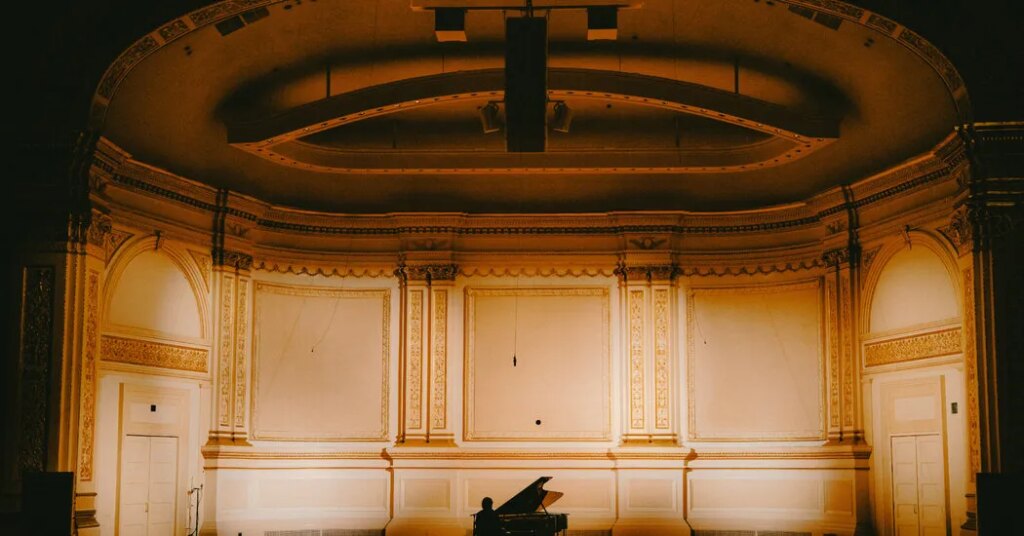
“Cameron Winter at Carnegie Hall,” the latest Paul Thomas Anderson Experience, is pretty much as its title advertises. On Dec. 11, 2025, Winter — the precocious co-founder of the New York rock band Geese and, at the time, just 23 — played a solo concert at the storied auditorium before a sold-out crowd. Seated at a Steinway grand piano on a starkly lit stage, he performed 12 songs almost uninterrupted for roughly an hour and change. A live album of the concert was released in October, and now comes the movie, a document that’s essential viewing for Winter enthusiasts and Anderson completists.
Many of the songs are from Winter’s first solo album, “Heavy Metal” (2024). Stripped down and without studio sweetening, they drone rather than pop, often hypnotically, sometimes prettily, and tend to sound similar. That’s especially the case because during the concert Winter didn’t take many pauses between them. The lyrics, when you can make them out, are eccentric, gnomic, at times hilarious and, given his youth, predictably self-conscious. You can hear some of the influences that he has name checked in past interviews, like Bob Dylan and Leonard Cohen. I also heard “Moonlight Sonata,” Nick Drake and a touch of Raymond Scott, though maybe I imagined that; Winter’s meanderings can take you to unexpected places.
Winter’s music is an acquired taste, and his stage presence in the documentary is serious, borderline monastic. For almost the entirety of the concert, as cameras move and the lighting dims and brightens, Winter remained seated and unsmiling, and barely acknowledged the audience. He didn’t bother with banter; if I remember right, he announced only one of the songs. Winter’s entire presentation of self here evokes that of an especially serious classical concert pianist. He hunches over the piano and sits upright, caresses and hammers the keys. This sobriety extends to his concert black clothing, including the high collar that evokes a clerical shirt. His outfit may just be a fashion choice; it’s definitely a statement.
The most striking part of the concert staging is that Winter performed almost entirely with his back turned to the audience, a position that means most attendees couldn’t see his face. Yet, because Anderson and his crew continually moved around — including on the stage — the film’s audience enjoys a far more privileged view of Winter. He has a nice face, pale and smooth, with boy-band bangs that brush against his caterpillar brows. That he obscured it suggests that he wanted concertgoers to focus on what he played, not on how he looks, though no such prohibition extends to the film’s viewers. Given Anderson’s meticulousness, the movie’s sound is unsurprisingly very fine though I assume the concertgoers enjoyed better.
Working with five camera operators (including the filmmaker-actor Benny Safdie), and shooting on both 16 and 35 millimeter film, Anderson moved around the hall from every imaginable angle. His approach translates into a master class in how to make something — or, in this case, someone — that is relatively visually inert come kinetically alive. The cameras capture shadows and pooling light, peep through a small hole in the center of the stage’s back wall, push in close (and closer) to Winter and peer down from up on high, like a concertgoer seated in a tier. At one point, an operator heads down an aisle with a bobbing camera, as if returning from a trip to the bathroom. On several occasions, a camera travels directly onto the stage through double doors, which are opened with flair by attendants.
Although the camerawork often shares the audience’s point of view, and can seem very embodied, when a camera moves through the doors onto the stage it signals that Anderson was performing alongside Winter. Anderson was the livelier, more exuberant player, but they complement each other. Even so, when Winter sings from “Cancer of the Skull” — which has the memorable line “I’ve been getting spanked by everybody lately” — it is worth remembering that in December 2025, Anderson was riding high. A few months earlier, his film “One Battle After Another” had opened to acclaim; a few months after the concert, he would pick up a handful of Oscars. It must have been a strange time for Anderson, however electric, and may help explain why he seemed to have had a far better time at this gig than Winter.
Cameron Winter at Carnegie Hall Not rated. Running time: 1 hour 15 minutes. In theaters.
The post ‘Cameron Winter at Carnegie Hall’ Review: A Duet of Piano and Camera appeared first on New York Times.