Joe Holley is based in Austin and writes about Texas politics.
ROMA, Texas — The year is 1952, and moviegoers across the country are watching mustachioed Marlon Brando and intense Anthony Quinn in Elia Kazan’s acclaimed “Viva Zapata!” Early in the movie, the two sibling revolutionaries are dodging burros and a herd of cattle as they rally beleaguered peasant farmers on the plaza of this little border town situated on a high bluff overlooking the Rio Grande. The town was a realistic stand-in for a Mexican village. The settlement that became Roma dates to 1765, when Spanish colonists established a community here.
That same year of 1952, in real life, voters turned the Democrats out of the White House after Franklin D. Roosevelt and Harry S. Truman’s nearly two-decade run, handily electing Republican Dwight D. Eisenhower as president. Residents of Starr County, which includes Roma, ignored the national trend that year, voting Democratic as they seemingly always would. That is, until 2024, when Starr, Hidalgo, Willacy and Cameron counties, the four Rio Grande Valley counties near the border, shocked the political establishment by switching their allegiance to Donald Trump.
The border counties, overwhelmingly Hispanic, are among the poorest in the state. Their residents also have among the lowest levels of formal education attainment in the country.
In 2024, Trump won 12 of 14 Texas counties along the border. Starr County voted Republican for the first time since 1896. Hispanics make up 97 percent of the county’s population of roughly 66,000. Sen. Ted Cruz (R), who attracted a majority of Hispanic voters that year in his successful bid for a third term, called the results a “generational change.”
Democrats gnashed their teeth. Trump was so confident the relationship would be a lasting one that he pressured Texas lawmakers to redraw five congressional districts, including three in the Valley, in a mid-decade effort to pick up new seats. Gov. Greg Abbott (R), running for a fourth term and relying on Republican majorities in the Texas legislature, complied.
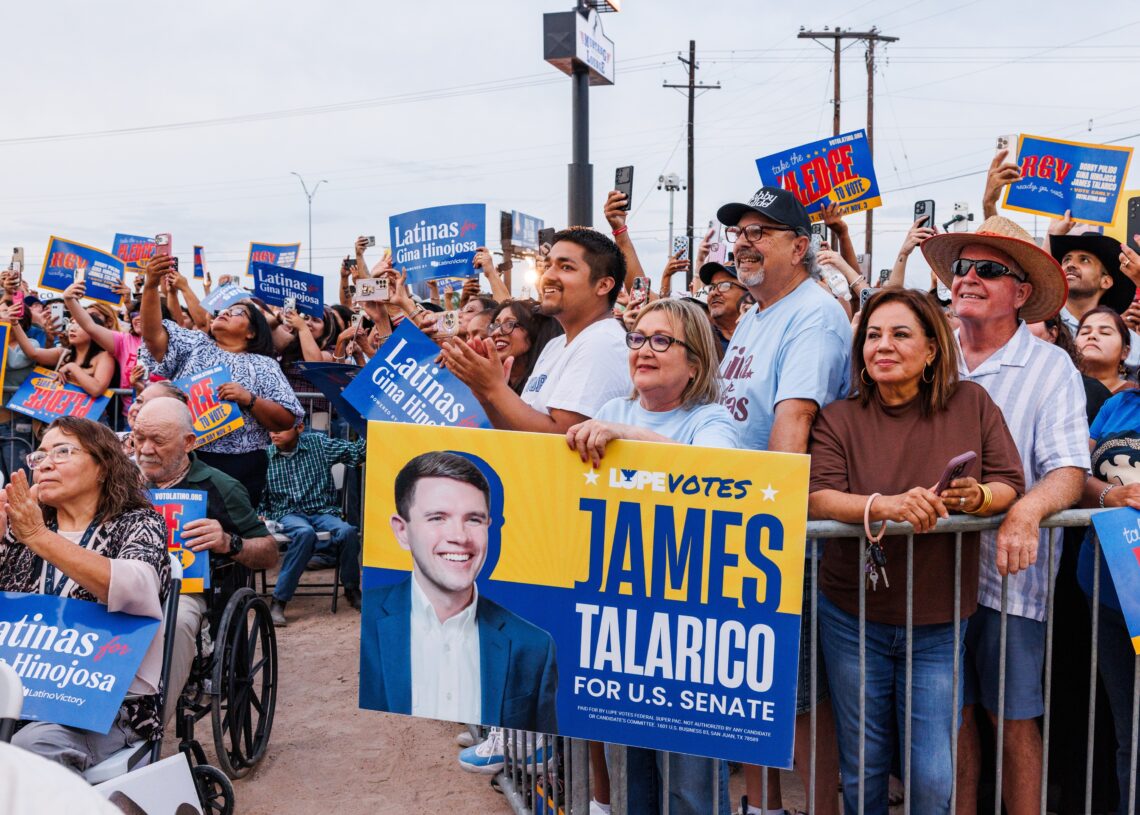
The infatuation went about as far as a $20 bill at a Rio Grande Valley diesel pump these days. Only two years after Republicans raised margarita toasts in triumph, the four border counties swung drastically back to the Dems. In the U.S. Senate race, James Talarico (D) defeated scandal-plagued Ken Paxton (R) in Starr County, 77 percent to 21 percent. In 2024, Trump carried the county over Kamala Harris, 58 percent to 42 percent. That represents a 72-point swing in the two-party margin toward Democrats.
In the governor’s race, Democrat Gina Hinojosa, born and raised in the Valley, defeated Abbott, 53 percent to 46 percent. She won 74 percent of the vote in Starr. Hinojosa and Talarico helped propel a clean sweep for Texas Democrats running in statewide races. For a party trudging through the political wilderness for more than three decades in Texas, it was a triumph of near-miraculous proportions.
“I think Starr County and South Texas have proven that Latinos are asserting themselves as perhaps the largest bloc of independents in the country,” said Carlos Sanchez, a former Texas Monthly senior editor and retired director of public affairs for Hidalgo County.
What happened in the Valley this time around? Why the switch? I put my questions to Noel Benavides, whose wife’s family owns J.C. Ramirez & Co., a western apparel store just off the plaza in downtown Roma. The store has been in business for nearly two centuries. Benavides, good-naturedly cantankerous at 84, has been active in local politics and civic affairs for decades.
“We thought [Republicans] could do something to help us,” he said, standing beside a display of snap-button western shirts. “They didn’t.”
In Rio Grande City, Rose Benavidez, who just became the first woman elected county judge of Starr County, saw Immigration and Customs Enforcement in action. Driving to work one morning, she watched a half-dozen black SUVs cut off a work truck carrying equipment and a ladder. Masked, armed agents swarmed the driver, a middle-aged Hispanic man jabbing frantically at his cellphone as he was hauled out of his truck.
Robert Vale has experienced a less obvious but more pervasive effect of the immigration crackdown on the Valley economy. His family owns the Starr-Camargo Bridge Co., a bridge port of entry connecting Rio Grande City and Camargo, Mexico. His grandfather constructed the bridge in 1966 with assistance from his friend Lyndon Baines Johnson, replacing a small ferry that operated for a century. It’s one of several privately owned bridges spanning the Rio Grande.
The modern crossing caters to commercial traffic, with spacious parking areas for 18-wheelers and a joint-inspection regimen called Unified Cargo Processing that keeps truckers from having to unload their cargo more than once at the border. Trucks ferry drywall, sand, lumber and other construction materials in both directions. Mexican trucks bring in onions, watermelons and avocados for U.S. supermarkets, while American trucks ferry corn and wheat from the Midwest to Mexican breweries.
Since the Trump administration’s immigration crackdown, Vale has seen fewer Mexican trucks hauling building materials into the United States. Bridge toll revenue is down.
He checked with about a dozen contractors who rely on his bridge and found that construction throughout the Valley is stalled. Builders can’t find labor because of the ICE threat. New homes, apartment complexes and office buildings along busy U.S. Highway 83 aren’t being completed. The effects are rippling through the local economy, with restaurant workers, home health care aides, teachers and hotel employees fearful about leaving their homes and driving to work.
Valley residents, Vale said, “didn’t like what they were seeing in places like Minnesota. Going after mom-and-pop businesses, young mariachi players, it just swung in the extreme opposite direction. It energized everyone.”
“It left Republican officeholders in an impossible situation,” said political scientist Richard Murray, who’s affiliated with the Hobby School of Public Affairs at the University of Houston. “They couldn’t break with Trump, and it killed them.”
Delfino Garza Jr. — a retired architect and Vietnam War veteran — and his wife, Nora, a retired educator, own Dos Rios Winery, a few miles west of Rio Grande City. A 30-foot-high border wall blocks their view of the Rio San Juan as it flows into the Rio Grande (thus “Dos Rios”). One night a few years ago, they saw marijuana smugglers running through their vineyard toward the highway; otherwise, they’ve never had a problem with border crossers.
“Trump and all those guys he’s got up there with him, Elon Musk, the governor, the attorney general, they’re all like pigs at a trough, just looking out for themselves,” Garza said. “I voted for Trump the first time, and I’ve never ever voted straight Democratic, but this year that’s what I did.”
Benavidez, the county judge-elect, agrees that Trump excesses contributed to the Democratic sweep, but she concedes that her party, particularly the Biden administration, was partially responsible for allowing Trump an opening to pursue his immigration crackdown. “People started to see a lot of people coming through and no plan to do it in a coordinated and a lawful way,” she said. “That was a big concern.”
Benavidez, the daughter and granddaughter of migrant farmworkers, points out that kitchen-table economics also contributed to Trump’s victory in 2024 and his party’s losses on Nov. 3. “People vote with their wallet,” she said. “And that happened with Trump and then again to Trump.”
Will the newly invigorated rapprochement between Rio Grande Valley voters and exultant Democrats last? Benavidez warns her party there are no guarantees. “The Latino vote has to be earned,” she said.
In Roma, Brando’s Zapata assures his future mother-in-law that “a whipped dog is the wiser dog.” Texas Democrats since the era of Gov. Ann Richards in the early ’90s have been whipped, often. With Democrats back in control of the governor’s office and the Texas House, Rio Grande Valley voters will be watching to see whether they’re any wiser.
The post At the border, Texans don’t hide why they turned on Trump appeared first on Washington Post.