Spain is in the middle of a growth spurt. Immigrants are driving the population to a record high of nearly 50 million. Tourism has skyrocketed and is set to attract nearly 100 million people, 25 million more than in 2016. With one of Europe’s fastest-growing economies, Spain has invested tens of billions of euros in digitalization and renewable energy.
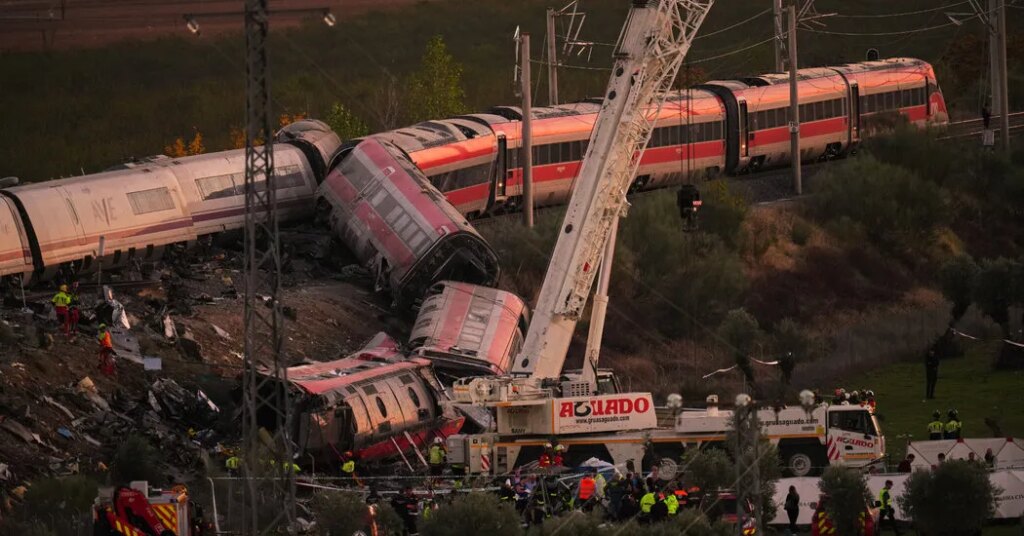
But a horrific train crash that killed 69 people last month, only nine months after a collision on the same high-speed line killed scores more, has raised concerns about the state of Spanish civil infrastructure. It has also left Spaniards asking if their country has grown too fast for its own good.
With national elections set for this month, infrastructure has moved from esoteric policy papers to the campaign trail.
Opposition politicians say the left-wing government of Prime Minister Pedro Sánchez has let the country go to seed. Some experts argue that his government was overly focused on new investments instead of maintaining old ones like roads, water systems and the high-speed rail network, the world’s second-largest, behind China’s. One think tank found that spending per high-speed rail passenger fell by more than a quarter in the decade leading to 2024.
“The system is under strain,” said Pere Navarro, the Spanish civil servant responsible for highway traffic. Spain’s infrastructure and public services, he said, were designed for “when there were 40 million of us” but now “we have a population of 50 million and welcome 100 million tourists every year.”
Mr. Sánchez’ government said that, though Spain needed to increase investment in its railways, it was the center-right former government that led the country until eight years ago that had eroded infrastructure, and especially railway infrastructure, with years of austerity policies.
Mr. Sánchez, pressed on the lack of maintenance in a television interview on Wednesday, argued that his government had worked to “reverse the cuts to the railway system” by his conservative predecessor. He also promised the equivalent of an additional $21 billion on maintenance and safety spending through 2030.
Much of Spain’s infrastructure dates to a previous boom era, soon after the country joined a precursor to the European Union in 1986. Suddenly awash in the bloc’s funds, it spent the 1990s revamping its industrial capitals, like Barcelona and Bilbao, and building a sprawling high-speed rail system and broader highways.
By the early 2000s, as Spain kept spending billions on transit infrastructure, it gained global renown for its high-capacity rails and roads. But a series of setbacks hit the country hard. Investment in infrastructure fell off after the financial crisis in 2008 and the popping of Spain’s housing bubble.
As Spain became wealthier and E.U. priorities shifted east, European funds dried up. Then, after the 2008 financial crash, Europe’s sovereign debt crisis nearly halved public investment in Spain, once higher than the European average. The spending didn’t recover under either right- or left-leaning governments. Now, Spain is spending, in real terms, about 25 percent less on infrastructure than it did in 2000, according to the Valencian Institute of Economic Research.
In 2018, Mr. Sánchez, of the Socialist Party, took office. After managing Spain through the coronavirus pandemic, he used a round of enormous E.U. recovery funds to focus on growth.
“Spain is in fashion,” Mr. Sanchez said at a tourism fair last year.
In a sign of his confidence in Spanish rail infrastructure, his government proposed banning short flights to cut carbon emissions. He used increased tax revenues from an influx of immigrant workers to fill the government coffers and offer popular subsidies and social benefits.
As the country’s gross domestic product soared, its investment in infrastructure didn’t keep pace. Last year, a national blackout exposed the weaknesses of the country’s saturated energy grid. It depends increasingly on the renewable sources that Mr. Sánchez’ government has prioritized, a factor that experts have said may have made it less stable. Analysts and energy companies also say the grid’s limitations make it harder to supply electricity to new construction projects, slowing building projects and contributing to a housing shortage. Protests over housing and high rents this year prompted Mr. Sánchez to call for early elections.
The blackout inspired a book by the economic think tank Funcas that argued that “political considerations influencing decisions” contributed to obsolescence and breakdowns of Spain’s transport infrastructure, water networks and energy assets. The authors said that the government should instead “prioritize maintaining existing infrastructure over new investment.”
They weren’t alone.
“In Spain, many things that once worked well now work poorly,” Ramón González Férriz, a political analyst, wrote in a much-discussed article in El Confidencial, a center-right news outlet, after the recent train crash. He blamed the government for prioritizing benefits and subsidies over maintaining public works that, he wrote, “take a long time to bear fruit and may go unnoticed by voters.”
The government’s initial response to the crash was not to focus on maintenance flaws but to blame the human error — revealed in leaked audio from a train traffic control center — in which a controller directed one high-speed train into a stalled train on the same track. But the second deadly crash in a year prompted inevitable questions about railway infrastructure and safety.
The transportation minister, Óscar Puente, who subsequently resigned, lamented that because the government did not control a majority of lawmakers in Parliament, it could not pass a budget that invested more in railway maintenance. Since then, Mr. Sánchez has responded to criticism with a mix of blame for conservative predecessors, defense of his government’s spending level and promises to increase it.
Conservative opponents, including from the Popular Party, which leads election polls, say Mr. Sánchez has full responsibility for any infrastructure shortcomings after eight years in power.
Spain is suffering from “continued negligence” under Mr. Sánchez that has put Spaniards at risk, Alberto Núñez Feijóo, the Popular Party leader, said this month.
Train usage in Spain has risen drastically since 2021, when Mr. Sánchez’ government opened the country’s market for high-speed passenger trains to competitors. Ticket prices fell by more than 40 percent, and hundreds of miles of new high-speed rail routes were opened. Last year, 44.5 million passengers used high-speed rail, twice as many as in 2019.
But according to the Institute of Economic Studies, a Madrid think tank associated with Spain’s largest association of employers, maintenance spending per high-speed passenger dropped 27.5 percent between 2015 and 2024. At the time of the accident, Spain was among the European countries that spent the least on maintaining its rail network.
Spain’s passengers had begun to notice delays, with on-time arrivals dropping nearly 10 points to roughly 86 percent in 2024, according to Spain’s competition regulator.
Train drivers warned last year of track deterioration on the high-speed route to Seville, the line where the crashes occurred.
Beyond the issue of high-speed rail maintenance, transportation experts have said that Spain’s entire strategy of prioritizing high-speed rail makes little sense because over 80 percent of Spain’s passenger rail trips last year were on shorter-distance commuter lines that have suffered from years of neglect.
Spain’s Independent Authority for Fiscal Responsibility, an autonomous state-appointed body, reported that between 1990 and 2018, Spain invested 15 times more on high-speed rail than on commuter rail, a trend that continued under Mr. Sánchez.
But Mr. Sánchez’ focus on high-speed rail was not just a government priority. Mr. Puente, the former transportation minister, pointed out at the time that regional politicians all over the country had demanded high-speed rail, regardless of their political affiliation.
“Look at this country’s history over the past 20 or 30 years,” he said. “If you don’t have high-speed rail, you’re nobody.”
The post After Train Crash, Spain Asks if High-Speed Rail Grew Too Fast appeared first on New York Times.