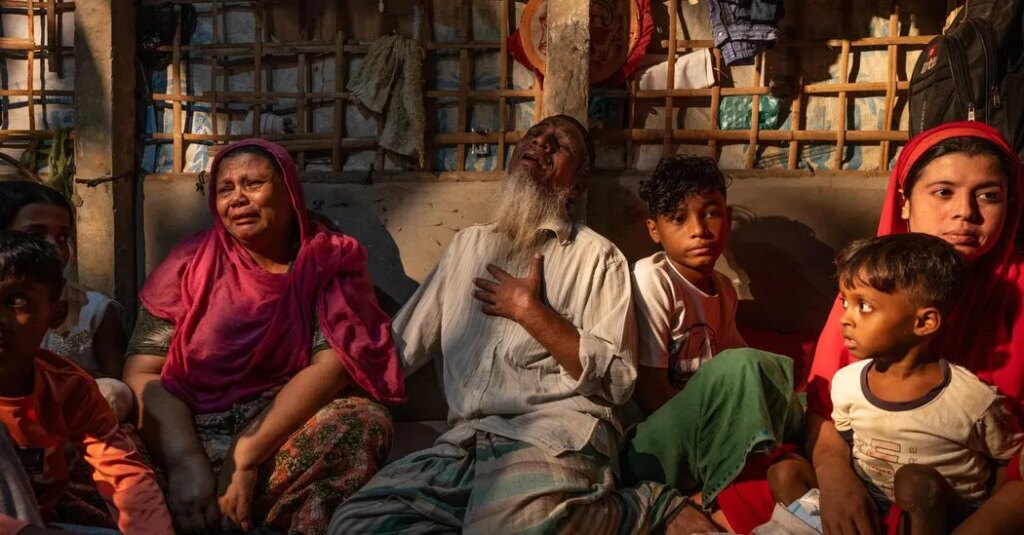
As his village burned, Mustafa Kamal somehow kept his family safe.
Husband and wife, three sons, three daughters, a granddaughter, they ran until their breath ran out. They stumbled past bodies of people they knew, shot by Myanmar’s security forces. They slogged through mud that claimed some of their clothes and trekked over jungle passes thick with leeches. Days later, when they finally crossed a river into Bangladesh, they rowed past swollen bodies of other Rohingya Muslims who never made it to the other side alive.
On Thursday, the International Court of Justice in The Hague ruled that the atrocities against the Rohingya ethnic minority constitute a genocide waged by the Myanmar state. The killing, gang rape and mass arson reached a furious zenith in 2017, building on years of systematic persecution. Three quarters of a million Rohingya flooded into Bangladesh in a matter of weeks, the most rapid refugee exodus in recent history. And more kept coming.
A judgment in a country half a world away would matter, Mr. Kamal told me. It would acknowledge the fate of his home, Zammona, one of 400 Rohingya villages that were obliterated by Myanmar security forces nine years ago.
But sitting in the dark, cramped shelter that is now his home in Bangladesh, part of what is now the world’s largest refugee settlement, Mr. Kamal said that the trauma did not end nine years ago. For the Rohingya, he said, misery never ends.
International aid to the camps has plummeted. Hunger and disease are rampant. In May, Mr. Kamal’s 18-year-old son was killed by Rohingya militants who have unleashed a reign of terror in the refugee camps. Human traffickers roam the narrow spaces between tarpaulin shelters, grabbing men, women and children. One of Mr. Kamal’s daughters was kidnapped by a militant, who forced himself on her. She had no choice but to marry him, and they now have a baby boy.
“Oh, Allah, why is there no justice for the Rohingya anywhere on earth?” Mr. Kamal said, weeping as he clutched a photo of his dead son.
The Gathering Storm
Mr. Kamal, now 66, grew up in Zammona, a fertile collection of hamlets in Myanmar’s far west, dotted with fish ponds, well-stocked groceries and mosques with graceful arches. His father was a teacher at a government school. Mr. Kamal learned Burmese, the language of Myanmar’s Buddhist Bamar majority, and took a job as a trader, ferrying goods from one town to another. His wife, Toyuba Khatun, was educated, too.
The Rohingya had long faced repression from the military, which ruled Myanmar for decades and preserved power for the Bamar. In the 1980s, the Rohingya lost their legal status in Myanmar, their citizenship essentially stripped from them. Babies rarely were issued birth certificates. There was also occasional tension with the Rakhine ethnic group, with whom the Rohingya shared Rakhine State.
Still, Mr. Kamal said he had easy relations with Rakhine villagers who lived nearby. After all, he had gone to school with them; his father had been their teacher.
A store owner in Zammona, Mohammed Yunus said he welcomed Buddhist customers, bantering with them as they haggled over the latest clothes or electronics. (Zammona is called Zin Paing Nyar in the Burmese language.)
In 2012, violence flared between the Rohingya and the Rakhine, inflamed by state media coverage. Gatherings of more than five Rohingya were banned. Mosques were shuttered. Many Rohingya children no longer felt welcome at government schools. Mr. Kamal’s father secretly taught his grandchildren at home, desperate for the next generation to be educated.
When Mr. Kamal’s daughter Rehana Bibi got married, a Myanmar official forbade her from having more than two children. A false narrative took hold across Myanmar that the high birthrate of Rohingya was part of a global Muslim plot to swamp Buddhist lands. Military propaganda inaccurately portrayed the Rohingya as illegal immigrants from Bangladesh. Never mind that Rohingya had been elected to Parliament, studied at the nation’s finest universities, and once enjoyed government radio broadcasts in their own language, just like any other of the nation’s many ethnic groups. In the 2015 elections, which elevated the party of Daw Aung San Suu Kyi, the Nobel Peace laureate, the Rohingya lost their right to vote.
On Oct. 9, 2016, a militant group led by a Rohingya refugee who was born in Pakistan and schooled in Saudi Arabia launched attacks on Myanmar security outposts, killing nine police officers, according to the Myanmar authorities.
The security forces’ response to the attacks punished an entire ethnicity.
In Zammona, Mr. Kamal locked the door to his spacious wooden house and prayed with his family that the soldiers would not attack.
Over the next few months, soldiers rounded up men in Zammona, accusing them of participating in the militant raids, charges they denied. Their only crime, they said, was being young, able-bodied Rohingya men. One was given a 54-year prison sentence. Soyadul Amin and Abdul Rohim were sentenced to 16 years each. Mr. Amin described how the Myanmar soldiers tied his arms behind his back, threw him on the ground and laughed as they ordered him to lap up his food like an animal. When he and others cried out for water, the soldiers offered urine.
The United Nations said at the time that hundreds of Rohingya were killed and that the crackdown “very likely” constituted crimes against humanity.
“We could not imagine what would happen next,” Mr. Kamal said. “Our people, our Rohingya were finished.”
The Fury
On Aug. 25, 2017, the Rohingya militants carried out another series of attacks, killing more than a dozen security forces. This time, the military was prepared. Within hours, the scorched-earth retribution began.
Mr. Kamal heard the rocket launchers crescendo from the east. He gathered his family, but there was no time to grab anything, apart from a few precious papers that proved their existence in Myanmar.
Mr. Yunus, the store owner, marshaled his kin. As he left his two-story home, with its spacious garden and surrounding fields, he made sure to lock the door. He would surely be back, he thought.
“I was a rich man in Myanmar,” he said. “I had everything I needed for my family.”
As the soldiers descended on Zammona, Fatema Khatun, the wife of Mr. Amin, one of the men sent to prison, searched frantically for her seven children and thanked Allah that they were all there. She was seven months pregnant with her eighth child. Along their long escape to Bangladesh, a Myanmar soldier grabbed one of her daughters, Sukura Begum, in the forest and raped her, just one horror in what U.N. investigators say was systematized sexual violence. She was 11 years old.
Elsewhere in the village, Morijan, a young mother who goes by one name, searched for her 9-year-old son, Mohammed Omair, who had raced to the west when the artillery began. Two days later, he was found in a rice paddy with a bullet wound through his heart.
At least 10,000 Rohingya were killed by security forces and Rakhine mobs in the immediate aftermath of the 2017 attacks, the U.N. estimated. In Zammona, 10 unarmed men were trussed and killed, then tossed in a mass grave north of the village, said a Myanmar soldier whose testimony, after he ended up in the hands of an enemy militia, marked the first time perpetrators confessed to their crimes. The soldier also said seven Rohingya were shot dead there.
Zammona was wiped from the map, its ruins smoldering for days, visible from a hill in Bangladesh. When he was released from a Myanmar prison four years later, his 16-year sentence commuted, Mr. Rohim returned home before he, too, fled across the border.
“Everything was gone,” he said of Zammona. “I couldn’t recognize anything.”
The Myanmar government soon covered up evidence of the village, building rows of prefab housing on burned earth.
All that was left of Zammona was a large Bodhi tree, sacred to Buddhists because it was the kind under which a prince meditated and gained enlightenment as the Buddha.
‘I Don’t Feel Alive’
In Bangladesh, Mr. Kamal and his family were allotted a tiny shelter with a tarpaulin cover. They could not leave the refugee camps without permission. International assistance allotted each person $12 a month for food, decreased now to $10.
Fatema Khatun’s daughter, who was raped, suffers from debilitating seizures. Three years ago, another daughter, then 18, disappeared for months, then called tearfully from Malaysia, where she said she had been trafficked. She was forced to marry an older man, she said, 50 or 60 years old, she wasn’t sure.
Five years ago, Ms. Khatun’s husband, Mr. Amin, was released from prison a broken man. His kidneys barely work from the beatings. He lies on the floor of their shelter, groaning from an ache that never dissipates. There is no money for painkillers. Occasionally, he repeats the Burmese words he learned in detention: a string of numbers that was his prisoner ID.
“I was supposed to die,” he whispered. “I don’t feel alive.”
On Monday, children crammed into Mr. Kamal’s shelter. His 10-year-old grandson recounted how the boy had been held by the militants, his hands reaching wide to show the size of the blades they brandished. One granddaughter was quiet, but over the hours she leaned against me. Later, she offered a tentative “hello” in English. We practiced sentences.
What is your name? Sadeka Bibi.
How old are you? 13.
Where are you from? Her English faltered. The answer came translated as the block number of her refugee camp. Her mother intervened. Sadeka tried again.
“I am Rohingya,” she said. “I am from Myanmar.”
Mohammed Faisal Arakani contributed reporting.
The post A Village Burned, Its People Killed or Exiled. A Court Ruled It Was Genocide. appeared first on New York Times.