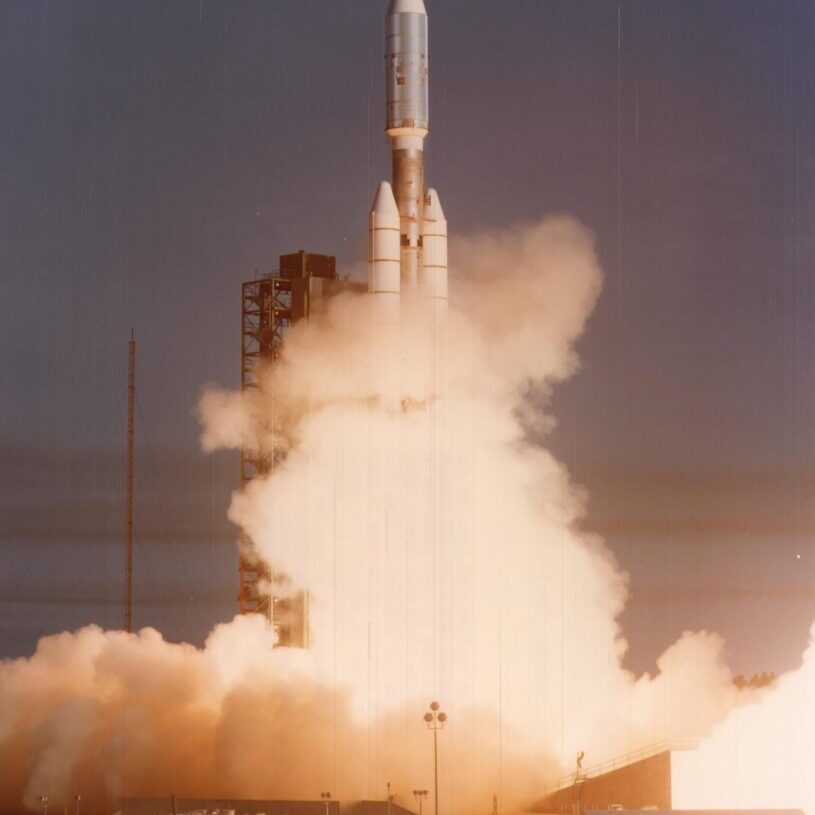
In the summer of 1977, Alan Cummings stood on a platform near the top of a rocket in Cape Canaveral and peered at the spacecraft tucked inside the nose cone. Cummings, an astrophysicist at Caltech, was nervous that technicians might unintentionally damage a science instrument during launch preparations, so he had been sent up to give the delicate components a final check.
“I twisted each one to see if they were tight,” he said.
Cummings was the last person to touch the Voyager 1 spacecraft before it left Earth. Nearly half a century later, the iconic probe is still chugging along, no longer within the bounds of the sun’s protective bubble, but in the space between stars, some 16 billion miles away.
Its trajectory hasn’t changed, but today Voyager 1 marked a tremendous milestone, a first for any human-made object. The spacecraft is now so far that its signal, traveling at the speed of light, takes 24 hours to reach our planet. The probe is, in the parlance of cosmic distances, one light-day away from Earth.
NASA dispatched a pair of identical spacecraft to capture the solar system’s outer worlds and their moons in tantalizing detail. Together, Voyagers 1 and 2 explored Jupiter’s burbling storms, Saturn’s glossy rings, Europa’s skating-rink surface and Titan’s hazy atmosphere. Voyager 2 went on to capture the wondrous blue hues of Uranus and Neptune.
Decades later, Voyager 1 is still collecting data and sending it back to Earth, exploring the depths of our universe humans could only imagine of reaching.
And when the robot calls home, it whispers. The signal is “very weak,” said Suzy Dodd, the project manager for the Voyager mission at NASA’s Jet Propulsion Laboratory. The mission’s longevity is even more impressive when you consider that the machine is cruising with less computer memory than the plainest cellphone.
“It’s more like your fancy car key fob,” Dodd said.
In addition to science instruments, each Voyager carries a gold-plated phonograph record encoded with a variety of information, including greetings in 55 languages, music from around the world and diagrams of the structure of DNA — a kind of informational pamphlet for Earth, should any extraterrestrial beings someday intercept the probes. The records’ covers display a series of wordless symbols, instructions for how to play the discs.
“Hopefully they know what a phonograph is,” Dodd said.
The Voyagers’ journey has been extensive. In 1990, with the planets in their rearview mirror, the explorers began the long coast toward the edges of our celestial neighborhood. In 2012, Voyager 1’s instruments sensed an uptick in galactic cosmic rays and significantly denser plasma — signs that the probe had slipped into the interstellar medium. Its robotic sibling crossed the boundary in 2018.
The Voyager spacecraft still collect scientific data, and the realm between stars has turned out to be stranger than expected. The magnetic field out there hasn’t taken on the distinctly interstellar alignment that scientists predicted, said Linda Spilker, the Voyager mission’s project scientist at NASA’s Jet Propulsion Laboratory. They also thought the sun would be a distant memory out there, but the Voyagers’ surroundings still bristle at waves of particles unleashed by solar eruptions.
“We’re still seeing effects from the sun,” Spilker said. “Will the Voyagers last long enough to reach what we call the pristine interstellar medium?”
Over the years, as the Voyagers’ radioactive energy source naturally dwindles, engineers have tinkered with the probes to save power and make them last longer. They’ve retired science instruments for good: On Voyager 1, just two of the original 11 instruments are running. They powered down the cameras decades ago, once there wasn’t much to see in the inky darkness. This year, the team turned off some engineering systems in favor of booting up a less power-intensive set, a switchover that added two years to each probe’s lifespan, Dodd said.
From Earth’s point of view, Voyager 1 has traversed an unfathomable distance. From the perspective of the rest of the Milky Way galaxy, of course, it’s hardly any movement at all. The nearest star system to the sun, with potentially habitable planets, is 4.3 light-years away. To venture one light-year from home, Cummings said, Voyager 1 must drift for another 17,000 years. In this way, humankind is still a young space-faring civilization: While telescopes have spotted thousands of other planets around other stars, astronauts have yet to set foot on the Red Planet just next door.
The Voyagers will eventually become alien space junk. Dodd estimates that Voyager 1 will run out of power for its transmitters in 2029. The team expects Voyager 2 to go silent in 2031, four years before it hits its own light-day milestone. They’ll still be gliding through the galaxy when the sun eventually dies and engulfs the inner planets, Cummings said.
“Billions of years from now, the Voyagers will still be out there carrying the Golden Record with the sights and sounds of the Earth that once was,” he said. “That really boggles my mind — that the Voyagers could outlive the planet that we are on.”
The post Voyager 1 is the first human-made object to reach one light-day from Earth appeared first on Washington Post.