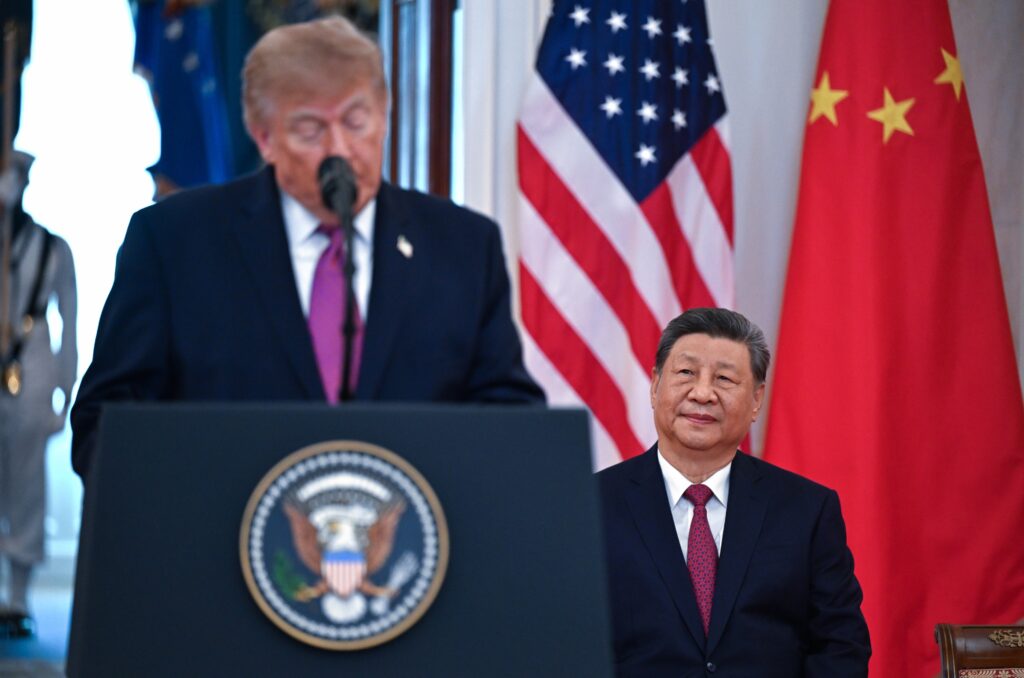
The Nvidia scandal broke at an inopportune time for President Donald Trump. Questions about his policy on sales of advanced chips to Chinese companies — why his administration had loosened restrictions and tightened them only after the controversy — will now accompany his trip to China this week for the Asia-Pacific Economic Cooperation summit. Worse: As Trump prepares to meet with Chinese dictator Xi Jinping and Russian dictator Vladimir Putin, the scandal may bring attention to how accommodating he has been in general toward the former’s autocratic leadership. The Democrats about to take over Congress are likely to have questions about that, too.
For them to hit the president for not being hawkish enough, as they are already starting to do, is a turnaround. Before Trump first took office, he accused politicians in both parties of being “totally controlled by people that love China.” In December 2017, his administration produced a National Security Strategy that claimed that Beijing wants “to shape a world antithetical to U.S. values and interests” and to “displace the United States in the Indo-Pacific region.” Trump expanded arms sales to Taiwan and levied tariffs on Chinese exports. He signed a law placing sanctions on officials who violated rights in Hong Kong.
The president has acted very differently in his second term. The early signals were mixed: Though he refused to enforce a law requiring the Chinese company ByteDance to sell TikTok as a condition of operating in the U.S., he also escalated the trade war. Since Chinese retaliation forced a partial Trump climbdown, however, the president has made one conciliatory move after another. It’s not just the chips. He has frozen arms sales to Taiwan and reportedly blocked some of its president’s U.S. travel plans. He has also weakened the Hong Kong sanctions.
The rhetoric has changed, too. The 2025 National Security Strategy didn’t echo the earlier warnings. When Xi visited Washington in September, Trump was effusive about their “truly great friendship … built on mutual respect.”
Democrats had so much ammunition to use against the Trump administration during this year’s midterm elections that they talked little about China. The ouster of Nvidia CEO Jensen Huang after he admitted to having an affair with a woman suspected of being a Chinese spy will surely, however, lead to investigations by the next Congress. Democrats, and perhaps some Republicans, will want to know why Commerce Secretary Howard Lutnick let Nvidia sell so many chips.
Does it have anything to do with the company’s donations to the new White House ballroom or the president’s holdings of Nvidia stock? And has Trump’s broader policy toward China been influenced by such considerations or simply distorted by a fantasy about his personal rapport with Xi?
Polling suggests Democrats have a political opportunity. Though the U.S. public has grown a bit less hostile to China in recent years, it is still cooler than it was a decade ago. Confidence in Trump’s handling of the relationship has also fallen nine points, from 48 percent to 39 percent, since 2024.
After the September summit, Senate Democrats on the Foreign Relations Committee hit the administration over issues including the chips sales, the hold-up of arms to Taiwan and the failure to make China change abusive trade practices such as intellectual property theft. They also lamented how Trump’s belligerence has weakened U.S. alliances. In many countries, China has been gaining popularity as a result.
What the Democrats still lack is someone with a history of toughness toward Beijing and a willingness to lead the party on related issues. Former senator Sherrod Brown of Ohio is returning to Congress, but two other Democrats with such track records, Reps. Nancy Pelosi of California and Raja Krishnamoorthi of Illinois, are leaving.
Three tests of whether Congress will contest Trump’s China policy during the next two years will come fast. Watch what Democrats, and to a lesser extent Republicans, say about the APEC summit when Trump meets with Xi. Keep an eye on whether the lame-duck Congress passes a bipartisan defense-authorization bill with new export controls for chips. And see if Hakeem Jeffries, the House speaker-in-waiting, leaves the select committee on China intact.
Cooperation with Beijing had bipartisan support for decades following the opening of diplomatic relations between the U.S. and China during Richard Nixon’s administration, with only a brief pause after the Tiananmen Square massacre. That support started to wane in the 2010s, and Trump effectively indicted both parties’ leadership for it during his rise to the presidency. Now it’s the Democrats’ turn to prosecute.
Beijing should note: Trump may have grown friendlier, but he isn’t the only one with a say in U.S. policy.
The post Trump, Nvidia and the emergence of the Democratic China hawk appeared first on Washington Post.