SHENZHEN, China — Nearly half a century ago, a high-ranking Chinese official, Xi Zhongxun, pushed for a bold experiment: to convert a small town just north of Hong Kong into a special economic zone where socialist China could dabble in market capitalism.
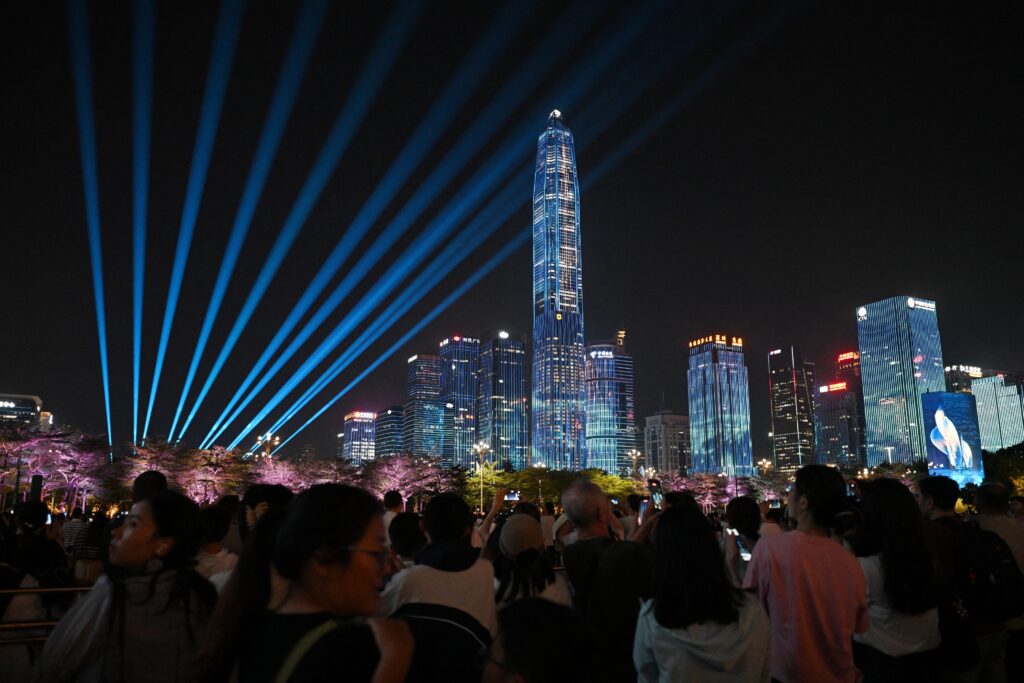
In a spectacular transformation, this onetime backwater, now called Shenzhen, became a high-tech hub with a population of some 18 million in just a few decades.
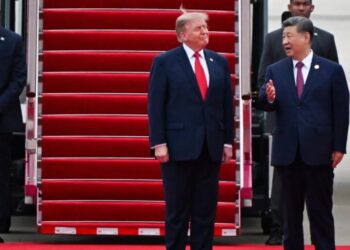
And in a remarkable moment of family history, it is Xi Zhongxun’s son, Xi Jinping, who is showcasing Shenzhen this week as the triumph of a technologically advanced world power. As President Donald Trump landed here Wednesday, Xi was on the tarmac to welcome him to the city his father helped build.
Xi, a born-and-bred Beijinger, rules China from its capital in the northeast, but Shenzhen, about 1,200 miles to the south, is a singular monument to his family’s legacy.
Dignitaries arriving in the city Wednesday for the Asia-Pacific Economic Cooperation (APEC) leaders’ meeting — where Trump is set to meet Xi and Russian President Vladimir Putin on the sidelines — were greeted by highways clustered with electric cars, high-tech gadgetry on display and for sale, and a sprawl of skyscrapers, many under construction.
Food deliveries by drone, another local hallmark, were suspended temporarily for summit security.
“Shenzhen is this economic superpower,” said Joseph Torigian, a professor of Chinese politics at American University and biographer of Xi Zhongxun. “You can only imagine what kind of emotional resonance that would have for the Xi family.”
The metropolis is a testament to the twisting path China has taken under two generations of the Xi family — from the country’s experiment with liberalizing economic reforms in the time of the father to retrenchment toward top-heavy control under the son.
“Shenzhen is the product of a variety of different approaches,” said Scott Kennedy, who studies the Chinese economy at the Center for Strategic and International Studies, a Washington think tank. “It reflects China’s effort to liberalize and be open to the world, but also an immense amount of industrial policy.”
When Xi Zhongxun was tapped to run China’s southern Guangdong province by the ruling Chinese Communist Party in 1978, Shenzhen — then known as Bao’an County — was little more than a stopover for migrants fleeing the turmoil and poverty of China for neighboring Hong Kong, then a British colony.
The economic changes Xi Zhongxun enacted — part of the Reform and Opening Up movement that began after Chairman Mao Zedong’s death — encouraged foreign companies to set up factories, creating a boomtown virtually overnight. He also gave it a new-old name, Shenzhen, dating back to the Ming Dynasty in 1410.
The city became a laboratory for liberal policies that Communist Party leaders were hesitant to apply more broadly, and which could draw on the international manufacturing needs and capital influx of Hong Kong.
It was an approach the junior Xi initially sought to emulate. Shortly after assuming China’s top office in 2012, Xi Jinping symbolically planted a banyan tree in Shenzhen to mark his commitment to economic reform — just as his father had 12 years earlier.
“After Xi Jinping came to power, a lot of [party elders] thought that he was going to be a reformer because that was their understanding of his father,” Torigian said.
But Xi Jinping’s flirtation with reform did not last. Xi “was at best a good-weather reformer,” Kennedy said. “As soon as things got tough … Xi decided, actually, what China needed do is the exact opposite.”
During Xi’s 14-year-long tenure, China has reined in free-market capitalism and instead ramped up its support for handpicked industrial and technological champions.
Today, the factories producing goods for the rest of the world have been relocated to the peripheries of Shenzhen. In their place are the glass-and-steel headquarters of Chinese companies like electric-car manufacturer BYD, WeChat maker Tencent and tech juggernaut Huawei — all built with state subsidies from Beijing.
“Reform used to mean economic liberalization and reduction in the state’s intervention in the economy, and of course, that’s not the case any longer,” Kennedy said.
The choice of Shenzhen to host this year’s APEC summit is to open an “important window” on the Reform and Opening Up movement that Xi Zhongxun championed, according to the Chinese Foreign Ministry. Signs across the city exhort APEC visitors to “witness the wonder.”
But as the country moves ever closer to the economic vision of the junior Xi, rather than the elder Xi, cracks are emerging. Amid a broad economic slowdown, China’s manufacturing labor market is shrinking, and many young people are trapped in dead-end jobs.
Shenzhen may instead turn out to be a reminder of where China still excels — technology remains a “world-beater” in Shenzhen, said Kennedy — even as China falls short elsewhere.
“There was perhaps a moment in time where that path [to further reform] might have been an option,” Kennedy said. But the Shenzhen of 2026 tells the story of a city, and a country, that followed a different path.
The post Trump arrives in Shenzhen, China, where Xi Jinping’s family history runs deep appeared first on Washington Post.