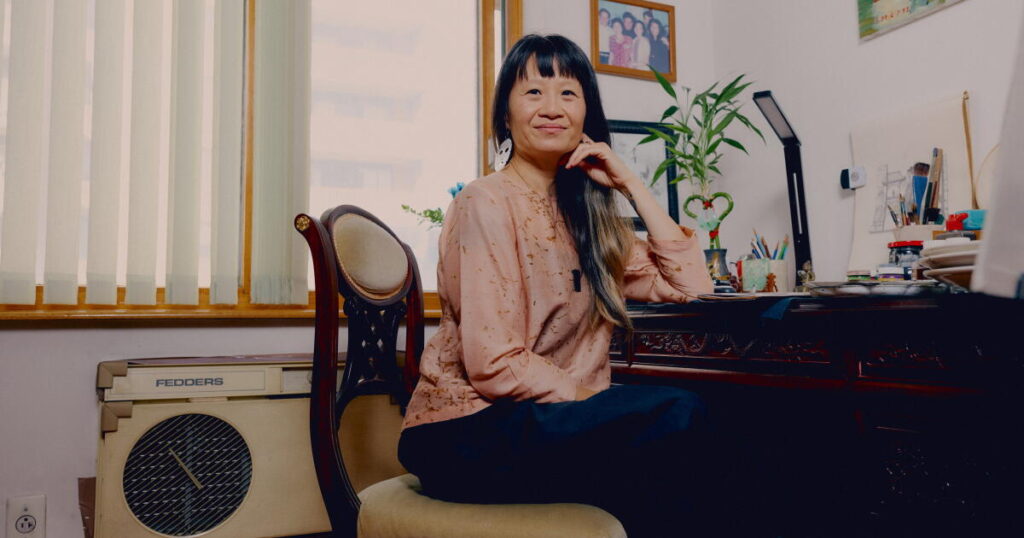
How do you process an aging parent? How do you ask them the questions you never asked? How do you say goodbye? “Hand, Held,” a hybrid memoir and artist book by Wah-Ming Chang, movingly finds the language to begin to address these urges and obstacles that, however universal, are not spoken about often enough. You might turn to “Hand, Held” as an unconventional guide, which is also how I think Wah-Ming intends it.
“I just want to know why we’re here,” Chang tells me, simply and sincerely. I have known the Brooklyn, N.Y.-based writer and bookmaker for about a decade, and she is one of the few people I know who can ask such a grand question and mean it. This existential search was behind her “low-key reading parties,” where participants gathered over Zoom during the COVID-19 pandemic to read excerpts from books they were reading, writing and loving. It’s also in her 28-year career producing and managing books (including at Farrar, Straus and Giroux, Melville and Catapult). It’s what has propelled her to devote herself to roller-skating, capoeira and New Style Hustle over the years. And it’s what led her to spend nights recording her parents’ stories for her new book.
The origins of “Hand, Held” go back more than 15 years, when Chang began taking photographs of her father’s studio whenever she visited her parents in Flushing, N.Y. She snapped images of his Chinese-to-English dictionaries, his ornate magnifying glass, his clusters of paintbrushes and his hundreds of drawings of hands and faces, prisms and mountains, apples and teapots. “I would creep into the studio with my camera and aim at what his hands had touched, at what was waiting for him to pick up again,” Chang writes. Just as she began to look at her father in a way she hadn’t quite before, she began to ask him why he left China, what he dreamed about during his naps, and if he remembered his sisters.
It is trite to say that we don’t look at our parents closely enough, don’t see them for who they are, but “Hand, Held” is an example of what happens when that effort is made — and how it’s less about gathering the answers than following our questions.
This interview has been edited and condensed for clarity
We’re not supposed to know that much about our parents — they shield us, and in the shielding, a lot goes unsaid. This really comes into relief as they age, as we realize there’s so much we don’t know. Your book beautifully captures this urgency to know more. When and why did this project of recording your father’s stories come about?
I’ve always been curious about my parents’ stories, but never had the language or even the courage to ask directly. Even when I did ask directly when I was younger, I would be met with a very short answer. And [I was] like, “OK, that’s them saying no.” I didn’t quite pursue further. At this stage, it was in January 2023, I spent a month at my parents’ apartment in Flushing because my mother was going through a hip surgery, and I wanted to be there to help out with everything. And it gave me this chance to, when we sat down to dinner, ask a bunch of nosy questions. Because I wasn’t going anywhere, I just felt like, “Oh, I can keep pressing,” and something about the pressing, asking them to keep going, helped them open up a little bit more. Part of it had to do with me feeling more confident at this age, where I am right now in my s— Chinese, to ask in the most kindergarten Mandarin that I have … I think it felt very natural because it was dinner. It didn’t work all the time; it also was me figuring out what kinds of questions had to be asked that would open them up. And as soon as I found the right key to unlock them, I slid over to my phone and pressed record.
So, they didn’t know?
[Laughs]
They didn’t know. It’s something that I know we all talk about, consent, and I know that’s something very serious. For me, it was just a matter of: I need to make sure that I’m in the conversation and not trying to remember everything [my father] said. No. 2, he is an open book. So I did tell him later: “You know, I’ve recorded all sorts of conversations between us.” He was like, “Oh, OK.” And that was it.
That’s interesting because it does have this feel of an organic conversation. It doesn’t have that mood of, “OK, interviewing my parents.”
For those of us who are curious to interview our parents but it just feels too difficult, what advice would you give?
Oh boy, you have to talk to them on their terms. That’s all it is. Even when they say triggering things — which they will [laughs], because they’re your parents — take a moment, and then just continue. This sounds so cliche, but it has to be completely from a place of curiosity about them as people who used to be the age that you are now, and to picture what that is. Like me, for example, when I turned 50, I asked my mom, “Do you remember when you turned 50? What was that like for you?” And her answer was very simple: “I don’t remember any of it. There was menopause, but that was a long time ago.” I thought it was going to open her up in some way, and it just was not the right question, or she was not having it. But what was great about that interaction, as short as it was, in terms of her answer, it just made me laugh.
If you’re really coming at it from a place of curiosity about them as people, not just as your parents, something in that familiar response of theirs is also a surprise, and that’s where I locate this sense of, “Oh you are a different person from what I know.”
My parents are the type who think that they have no story, and that’s partly why it’s hard to get stories out of them. What I’ve learned to do, and my sister does this as well — a lot of it is really just drawing them out. Again, on their terms, but also making the question as specific as possible.
You play a lot with words in this book, and you mix English and Chinese, words with images. How would you describe your relationship to language in the book and the process of finding the form for it?
Elisa, how do we write? How do we get anything done? This thing was so hard, and it was hard because I had it in my head for the longest time that I was just a fiction writer, and then when this project came along, Stefan [Lorenzutti], my publisher [of Bored Wolves], suggested, “Let’s showcase your father’s art, and you can write some kind of introduction or write some text around it.” And as soon as I heard the word introduction, everything froze.
Introduction? Boring!
[Laughs]
I had this locked-in idea of what an introduction should be. So, because I hated that process so much, I procrastinated and did all this other stuff, and all this other stuff meant it was at the time when I was at [the] Saltonstall[residency], and I was there to work on fiction, but I brought all my father’s artwork with me to act as inspiration. I put up all his artwork, and I started to take the words that I had already put down and separate them out — because I work with InDesign, I make book interiors for a living — I took those paragraphs and put them into an InDesign document. I isolated the sentences and gave them their own space. I started to separate out the sentences even more because the sentences were so formal, and I needed to feel it more in my bones. I needed to really break it down. That’s partly when I started pairing these fragments of text with the images of my dad’s art, and with the photographs that I had of his studio, and that started becoming really interesting to me.
Drawing, to me, is like an essay, it’s the working through a subject; you see the mind at work, the hand on the page. I felt like the pairing of your father’s drawings with your words was very harmonious, and it brought me to John Berger — whom I know we both love, and who loved drawing as a medium. In an essay about drawing his father in his coffin, Berger described drawing as the summary of moments of looking, of being with your subject. Berger is a big reference for your book, specifically “The Red Tenda of Bologna,” which you’ve described as the bible that encapsulates everything about “Hand, Held.” Why is this book and Berger important to you?
Everything that you just said about him, like this attention to somebody, and even just picturing him drawing his father in his coffin — it’s an act of love to do that. It’s an act of seeking some kind of answer about your parent, knowing that you can’t get an answer from them verbally anymore, but to look at them so carefully after maybe all their life they didn’t let you look at them. Whenever I read [Berger’s] work and come across a scene like that, I feel like I’ve experienced it in a dream already. I feel like I’ve had a conversation with him about it already, meaning it just feels familiar, and the fact that I’m reading it, it opens up all kinds of permission to follow suit.
“The Red Tenda of Bologna” is a teeny-tiny book, and on each page it’s just a few sentences. The way it’s typeset, the few sentences are almost in the middle of the page, rather than starting at the top, and already that brings an intimacy to the reading experience for me. I feel like that’s Berger’s middle name, intimacy. Because he writes as though he’s writing only to you. This book is about his uncle Edgar, a beloved uncle. That first sentence: “I should begin with how I loved him, in what manner, to what degree, with what kind of incomprehension.” Why does that move me so much? Why does it move you? For me, several things are happening with just that one sentence. One, the way that he starts a story: “I should begin with …” Oh, OK, that’s how I start my introduction.
Suddenly, I have an entry to how I want to talk about somebody who means so much to me.
The post The art of talking to an aging parent before it’s too late appeared first on Los Angeles Times.