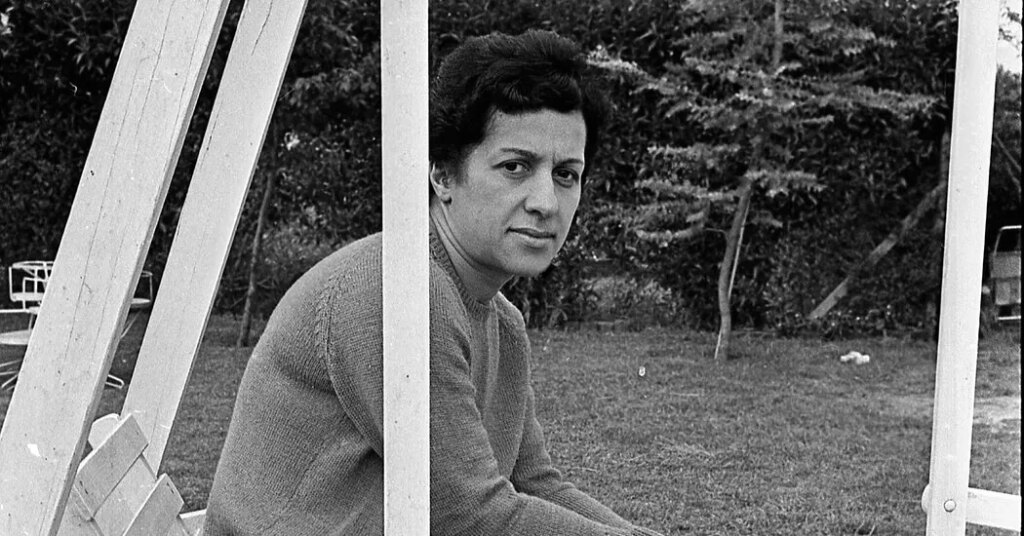
Griselda Gambaro, an Argentine writer whose internationally acclaimed plays and novels grappled with state-sponsored repression and, in particular, the 1976-83 junta that killed and disappeared thousands of Argentines, died on Sept. 15 in Buenos Aires. She was 98.
Argentina’s secretariat of culture confirmed the death but did not provide further details.
Ms. Gambaro’s abiding concern was the psychological damage that institutionalized terror inflicts on a population. Inherent in her work is the idea that an abusive government gains strength when a society neglects the defenseless. Citizens become complicit.
Her output over six decades — dozens of plays, novels, short stories and children’s books translated into multiple languages — placed her among Argentina’s leading authors.
Ms. Gambaro emerged as a writer in the 1960s, when explicit criticism of her country’s military government could lead to arrest. Beginning with plays like “The Walls” (1963) and “The Camp” (1967), she deployed allegory, irony, dark humor and buffoonery to avoid directly offending the authorities while still conveying the disorientation of victims indiscriminately swept up in government brutality.
Many of Ms. Gambaro’s characters, facing the prospect of violent death, search for reason where none exists. In “The Walls,” a young man is abducted and held in what appears to be a comfortable bedroom. He doesn’t know why he is there. Distant screams are heard. His captors say he came willingly. He is told the walls will close in on him. He doesn’t believe it.
The questions the play raises — what is real and whom to believe? — lay bare the anxieties and paranoias of Argentina in the late 1960s.
In “The Camp,” a man who arrives at a corporate headquarters to begin a job finds his future boss wearing a Nazi uniform and the company’s offices to be a concentration camp. Like many of Ms. Gambaro’s figures, he clings to the belief that he controls his own life.
Ms. Gambaro’s early plays foreshadowed the kidnappings and murders that characterized the 1976-83 military dictatorship. Her work called attention to the “desaparecidos” — the thousands who disappeared and left behind traumatized families.
Her novel “To Earn One’s Death” (1976) tracked a woman from orphanhood to marriage, against the backdrop of authoritarian control. The book, with its vivid portrait of state violence, was banned by the junta and led to Ms. Gambaro’s three years of self-imposed exile in Barcelona.
“Information For Foreigners,” a play she wrote in the early 1970s and smuggled out of Argentina during her exile, was considered so subversive that she refused to allow it to be produced for fear it could endanger members of her family still in Argentina.
The play, which Ms. Gambaro called “a guided tour through the places of repression and indignity,” challenged theatergoers to imagine themselves not as spectators but as unwitting collaborators in acts of cruelty. The audience is led through a series of rooms to observe sights — people in confinement, urban crowd scenes — that are as baffling as they are haunting.
While in Spain, Ms. Gambaro also wrote the novel “God Doesn’t Want Us Happy.” The story, which she considered her best work of long fiction, was about an aspiring singer who attains a form of spiritual liberation through his perseverance in his art.
“She was utterly original,” Marguerite Feitlowitz, a professor emerita of literature at Bennington College who is an authority on Argentine literature and is among Ms. Gambaro’s major translators, said in an interview. “Her plays dealt with the theatricality of political violence in technically groundbreaking and virtuosic ways.”
Professor Feitlowitz noted that Ms. Gambaro paid homage in her plays to writers as varied as Sophocles, Shakespeare, Ibsen and Chekhov by reframing their work in ways that commented on Argentina’s state-sponsored terror.
Her mid-1980s play “Antígona Furiosa” begins with the title character — who is wearing a dress and a crown of withered flowers — hanging by a rope. Antígona then removes the rope and performs the mournful ballad that Ophelia sings in “Hamlet” after she has sunk into madness.
“He is dead and gone, lady / He is dead and gone,” Antigona sings, echoing the chants of mothers and grandmothers who gathered weekly at Plaza de Mayo in Buenos Aires during the dirty war, carrying photographs of the disappeared and demanding their return.
Griselda Gambaro was born on July 28, 1928, in a working-class area of Buenos Aires, the youngest of five children of immigrant parents from Genoa, Italy. Her father held menial jobs, and her mother was illiterate.
Ms. Gambaro spent much of her time at the public library because her family had no books at home. “Sometimes I finished reading so quickly that I was embarrassed to borrow another book so soon,” she said in a 2015 interview with the performing arts institution Fundación Teatro a Mil.
In public school, Ms. Gambaro learned to read in multiple languages and knew early that she wanted to write. After graduation, she worked as a secretary and produced her first literary efforts, some of which began to win national prizes.
The Torcuato di Tella Institute in Buenos Aires, an incubator for emerging artists, helped develop Ms. Gambaro’s early work. Amid political turmoil, she felt compelled to dramatize how institutional cruelty subdues its victims, leading many to rationalize their own downfall.
Years later, after she had returned from exile in Spain, Ms. Gambaro became associated with Teatro Abierto, a movement of creative and performing artists who confronted the diminished but still dangerous Argentine junta.
Under the auspices of Teatro Abierto, she revisited a common theme — blind obedience to authority — in one of her most notable plays, “To Say Yes,” in which a customer’s visit to a hair salon takes a murderous turn.
In her final decades, Ms. Gambaro reworked classics like Shakespeare’s “Macbeth” and Ibsen’s “A Doll’s House” to assess power dynamics from new angles. In Ms. Gambaro’s 2003 “La Señora Macbeth,” Macbeth remains offstage, while Lady Macbeth is shown to be so blindly devoted to her husband that she struggles to recognize his evil ambition.
Her plays continued to be mounted around the world. In 2007, the GALA Hispanic Theater in Washington, D.C., produced a Spanish-language production of “The Walls.” Its striking visuals, the theater critic Celia Wren wrote in The Washington Post, illustrated “totalitarianism’s potential for grinding down the human spirit.”
Ms. Gambaro was married for 71 years to the sculptor Juan Carlos Distéfano, who died in July at 92. Survivors include two children, Lucas Distéfano and Andrea Distéfano; and several grandchildren.
In a 2005 interview with the Argentine newspaper La Nación, Ms. Gambaro was asked whether the reasons an author chooses to write evolve over time.
“Not in my case,” she said. “The reason I write is that it gives me pleasure, that I enjoy it. I’ve dedicated many hours of my life to this work. I don’t separate them: I am what I write, and I write what I am.”
The post Griselda Gambaro, Whose Writing Confronted State-Sponsored Terror, Has Died appeared first on New York Times.