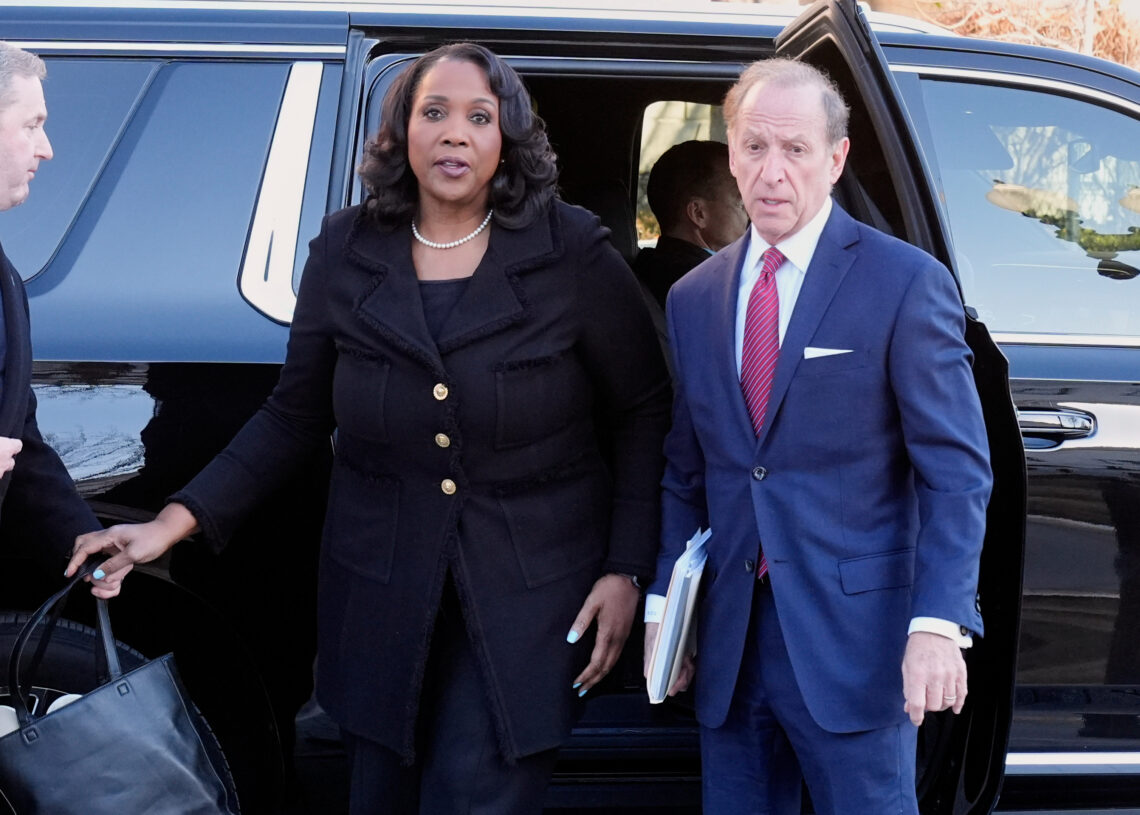
Federal Reserve governor Lisa Cook won’t take part in a White House hearing next month on whether to fire her unless the panel and its rules change, her lawyer told President Donald Trump’s aides Monday.
In a letter to White House counsel Will Scharf, attorney Abbe Lowell said the committee process “appears to be a facade designed to obscure a predetermined decision to fire Governor Cook.”
The letter came on the day of the White House committee’s deadline for Cook to turn over her financial records. Lowell said she has no obligation to provide them while the panel withholds its own evidence.
The White House did not immediately respond to a request for comment.
The letter, along with more than a dozen others exchanged since September and provided by Cook’s legal team, shows how far apart the two sides remain in Trump’s second attempt to oust Cook. He is the first president in the Fed’s history to try to fire one of its board members.
The president has alleged that Cook claimed two homes as primary residences to get a better mortgage rate, characterizing her alleged behavior as “deceitful and potentially criminal conduct,” or, at a minimum, “gross negligence.” She has said that a reference to her Atlanta condo as her “primary” residence was “inadvertent oversight.”
The Supreme Court ruled in June that Trump couldn’t remove Cook without first giving her notice and a chance to respond. On Sept. 30, the White House invited her to a hearing, and Deputy Chief of Staff Dan Scavino questioned her explanation.
Trump then set up a committee of inquiry made up of Kevin Hassett, his top economic adviser; Equal Employment Opportunity Commission Chair Andrea Lucas; and Keith Sonderling, acting director of the Office of Government Ethics. It will recommend whether there is “cause” to fire Cook, and Trump will decide whether to remove her.
Scheduling quickly became a fight. Lowell said Cook was in Bangkok for meetings of the International Monetary Fund and World Bank on the first proposed date, and would be in Stockholm for a central bankers’ meeting on the second, Nov. 5.
Scharf questioned her “candor” and wrote that Trump’s “directive” to attend “far outweighs whatever peripheral relevance” the Stockholm meeting had to her Fed job. If she didn’t agree to Nov. 5 or offer a date close to it within 24 hours, he warned, “you will be considered to have forfeited your right to appear or participate.”
Last month, the White House agreed to move the hearing to Dec. 14, a date Lowell offered. Cook was willing to take part “if it is the ‘fair and substantive’ one you have represented it will be,” Lowell replied the next day.
But after Lowell again asked that Hassett be replaced, Scharf wrote that Cook was “not entitled to veto any of the President’s selected Committee members” and would get the committee’s evidence only seven days before the hearing. He accused her side of continuing “to delay and haggle at every turn.”
The next day, the committee set Monday as the deadline for her documents. “There will be no further extensions,” the three members wrote, warning that if she didn’t participate, they could “draw adverse inferences” against Cook.
Lowell’s letter Monday said Hassett “has prejudged the issue,” pointing to his comment last year that Cook’s refusal to step aside was “a partisan stance contrary to the independence of the Fed.” Scharf has said Hassett “presumably believed a leave of absence was in the best interests of the Federal Reserve and the Nation,” and that his remarks don’t show he prejudged the case.
Cook’s lawsuit over Trump’s first attempt to fire her is on hold in the meantime. In a joint filing Nov. 6, her lawyers and the Justice Department told U.S. District Judge Jia M. Cobb that “the White House and Governor Cook are discussing a process” for the committee and asked her to pause the case. Cobb ordered another update by Jan. 12.
The post Fed official Lisa Cook refuses to attend White House firing hearing, citing bias appeared first on Washington Post.