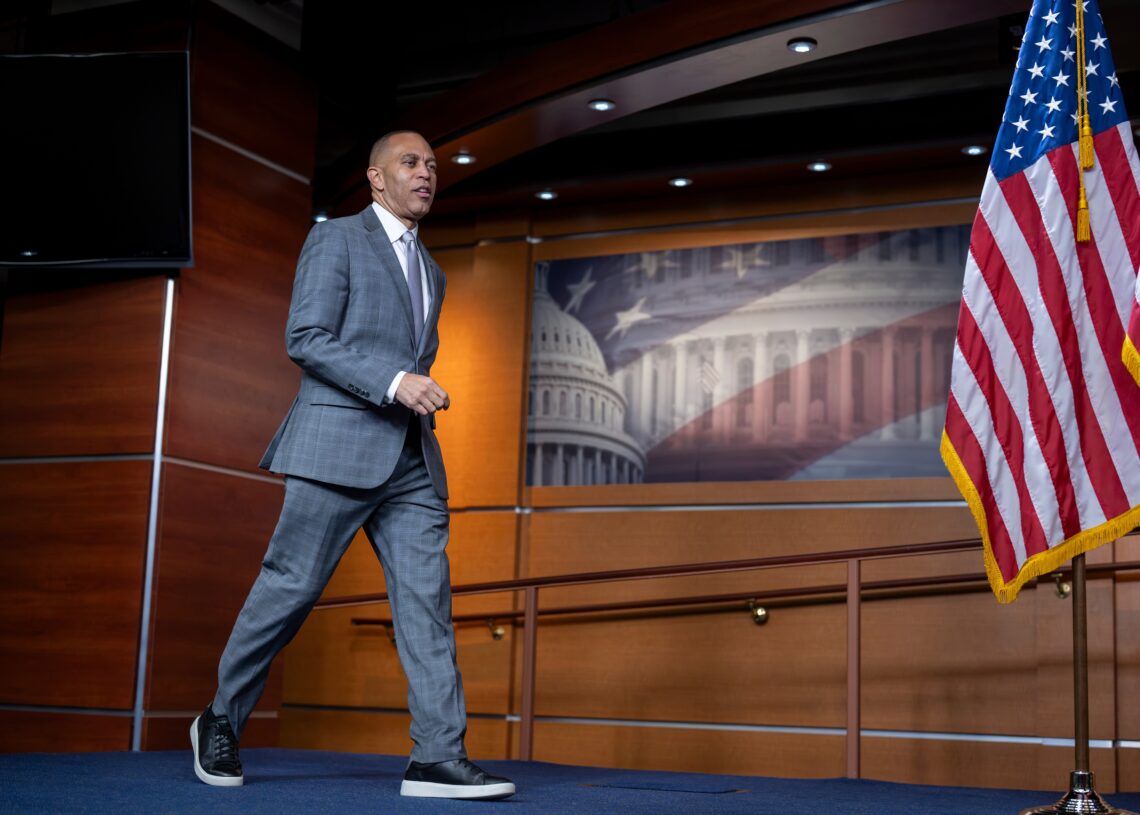
House Democrats voted overwhelmingly Wednesday to nominate Rep. Hakeem Jeffries (D-New York) as speaker of the House next year, putting him on the precipice of history as the first Black American to assume the post.
Jeffries, the chamber’s minority leader, prevailed 251-11, according to two people in the room who spoke on the condition of anonymity to share the results of a closed-door, secret-ballot vote.
Jeffries, 56, needed to secure only a simple majority of Democrats elected to the House in this month’s midterms to win the nomination.
The full House is scheduled to vote Jan. 3 on a speaker. Democrats will hold a commanding majority upon lawmakers’ return, all but ensuring Jeffries’s ascension.
Despite pushback from some pockets of the Democratic base who have criticized their party’s congressional leaders as too corporate, too pro-Israel and insufficiently progressive, a Democratic challenger to Jeffries did not emerge. His path to leadership next year has been far smoother than that of Sen. Chuck Schumer (D-New York), who is seeking to fend off a challenge from Sen. Chris Van Hollen (D-Maryland) as majority leader.
Ahead of the House vote, Rep. James E. Clyburn (D-South Carolina), a mentor to Jeffries, reflected on the significance of his likely elevation to speaker.
“It’s very historic. John Lewis’s sacrifices are finally paying off in this body,” Clyburn said. Lewis, a civil rights leader, served in Congress for more than three decades as a representative from Georgia.
After the vote, seven Democrats who said they voted against Jeffries, all members of the incoming freshman class, said in a joint statement that they were continuing to have “good-faith” conversations with Jeffries about a handful of issues. Among them: moving to a Medicare-for-all health insurance system, reforming immigration enforcement, reining in money in politics and ending Israel’s war in Gaza.
“While we have seen meaningful progress, there is still work to be done to ensure that the direction our party takes this coming Congress reflects what our constituents are demanding of leadership,” the statement said.
Rep. Henry Cuellar (D-Texas), one of the caucus’s most conservative members, was dismissive of the group that voted against Jeffries.
“The Democratic Party is not going to let that little small group dictate where we’re going to stand at,” he said. “It is a small group that have marginalized themselves.”
“They really want to push their particular issues, but each of us are pushing our issues,” said Rep. Greg Landsman (D-Ohio), a member of the bipartisan Problem Solvers Caucus. “I don’t think voting against [Jeffries] was a path forward in terms of getting those things done.”
In the days leading up to Wednesday’s vote, Jeffries did not take the outcome for granted. He sought to meet with every new Democratic member, and he met with leadership of the Progressive, New Democrat and Blue Dog caucuses, which span the ideological spectrum of the broader Democratic caucus. Close Jeffries allies worked the phones to gauge members’ priorities and concerns — and limit defections.
House Democrats are also elevating others in their current leadership trio, promoting Rep. Katherine Clark (D-Massachusetts) to majority leader and Rep. Pete Aguilar (D-California) to whip.
Jeffries, Clark and Aguilar were first elected to lead the Democratic caucus in 2022. The next Congress would mark their first time leading in the majority.
House Republicans held their leadership elections last week, picking Rep. Jim Jordan (R-Ohio) to serve as minority leader next year.
As the current minority leader, Jeffries has exhibited a consensus-building style that even some allies have suggested will need to be more muscular as the chamber’s leader. He will preside over a Democratic caucus with a large progressive faction, as well as many Democrats unexpectedly elected in more conservative districts carried by President Donald Trump just two years ago.
Jeffries’s top deputies, whose positions do not require approval by the full chamber, are also poised to make history.
Clark will be the first woman to serve as majority leader, and Aguilar will be the first Latino whip.
Rep. Ted Lieu (D-California), who was elected as Democratic caucus chair, becomes the first Asian American to hold that position and the highest-ranking Asian American to serve in Congress.
Caucus elections are expected to continue Thursday for lower leadership posts.
Mariana Alfaro contributed to this report.
The post Democrat Hakeem Jeffries nominated to be first Black speaker of House next year appeared first on Washington Post.