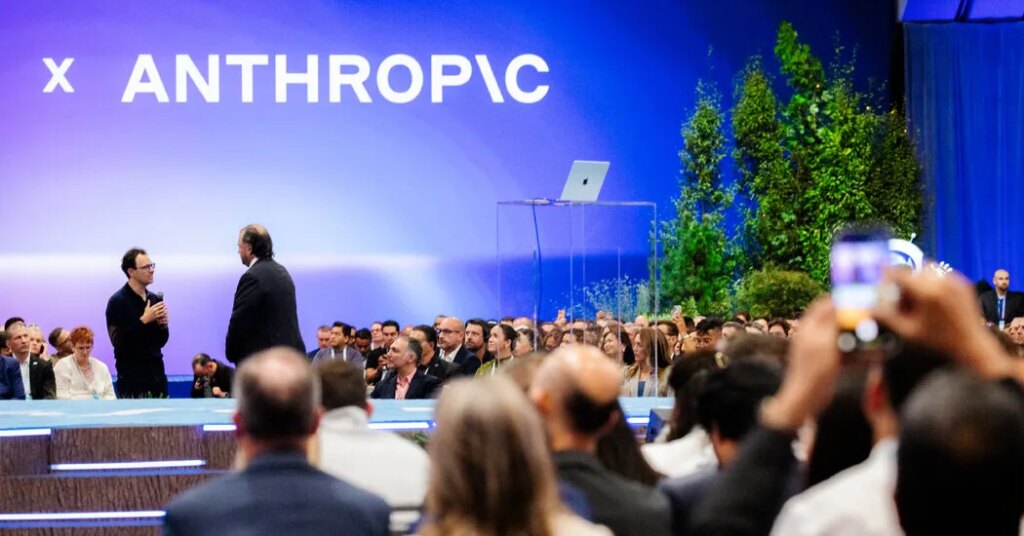
Todd Underwood, a former Anthropic engineering leader, fielded a stream of calls in recent months from investment managers eager to gain his insider view on the artificial intelligence giant’s business strategy ahead of this week’s initial public offering.
But few of the questions focused on an aspect of the company Mr. Underwood viewed as a crucial asset: Anthropic’s unusual governance structure.
The company is set to become by far the most valuable company on the stock market with the legal designation of a public benefit corporation, or P.B.C. That status requires Anthropic to prioritize its corporate mission — to develop safe A.I. systems “for the long-term benefit of humanity” — in addition to the customary sole focus on value for stockholders.
The company’s public benefit mandate is guarded partly by a five-member “long-term benefit trust,” which includes Ben Bernanke, the former Federal Reserve chair.
The company “will choose to do things in favor of safety rather than in favor of making money,” said Mr. Underwood, who has been sought out by investors as a former employee for insights into the company. He added that he agreed with that focus but thought it might turn off some investors.
The company’s public offering sets up an important test as Anthropic goes from one of the most closely watched private companies in the world to one of the most scrutinized.
Anthropic is expected to spend its first two years as a publicly traded company asking investors for patience as it burns hundreds of billions of dollars of cash to invest in new chips and data centers. It is also facing increasing calls from A.I. safety advocates, as well as some of its own employees, to slow down its pace of training new models.
On Wednesday, the company is expected to sell roughly $65 billion in shares, making it the second-largest I.P.O. after SpaceX’s earlier this year. It also has $26 billion of investments lined up from tech giants like Nvidia and Microsoft.
Anthropic’s expected market capitalization, more than $1.4 trillion, would make it 30 times as valuable as the next public benefit corporation that trades on the stock market, the software maker Veeva Systems.
Anthropic was founded as a public benefit corporation in 2021, and formed its long-term benefit trust in 2023 as a way to give the structure teeth, ensuring the company balances goals for shareholders and its broader mission. The structure is taxed the same as any corporation.
The trust is made up of a group of “financially disinterested” experts in economics, science and global health who don’t own Anthropic stock, the company said in its offering prospectus. The group has the power to appoint and remove several of the company’s board members, authority that is typically given only to shareholders.
Adding to the unusual leadership structure, the company also spent the months leading up to its public offering locking in new authority for the executives who started the company nearly six years ago, according to securities filings.
The company created a new class of shares this fall for its unusually large co-founding team — seven executives, including the chief executive, Dario Amodei — that give them 50.1 percent of voting control over the company, collectively. The founders have the ability to appoint other board members.
A founder-controlled board committee can also help overrule one of the trust’s four board appointments, reducing the trust’s power, said Jesse M. Fried, a Harvard law professor who has studied Anthropic’s corporate structure.
The trust’s authority was “watered down” as a result of the changes, but they don’t “fundamentally change the governance of the company,” he added.
Anthropic’s structure is unique when compared with other publicly traded companies, corporate governance experts said.
“I don’t know if I can really compare it to anything else,” said Douglas Chia, a senior fellow at Rutgers Law School who advises companies on corporate governance. “It’s going to be an interesting experiment.”
The Council of Institutional Investors, an advocacy group that represents public, union and corporate pension funds, has long been critical of arrangements that give founders voting control disproportionate to their financial stakes. The group wrote a letter this year expressing concerns that when SpaceX went public, it gave its founder, Elon Musk, dominant voting control.
The group will “wait and see” how Anthropic’s structure plays out, said Glenn Davis, the council’s executive director. The founders’ immense voting power means that “ultimately the founders are accountable to themselves,” rather than shareholders, he added.
The layered structure could still challenge investors’ understanding of the company and the group of people who govern it, said Paul Abrahimzadeh, a senior partner at the tech investment firm 1979 Capital.
Still, investor enthusiasm was inevitable despite the uncertainties, he added. “You have to own it. The question is at what price?”
The post Anthropic’s Public Debut Sets Up ‘Experiment’ in Corporate Power appeared first on New York Times.