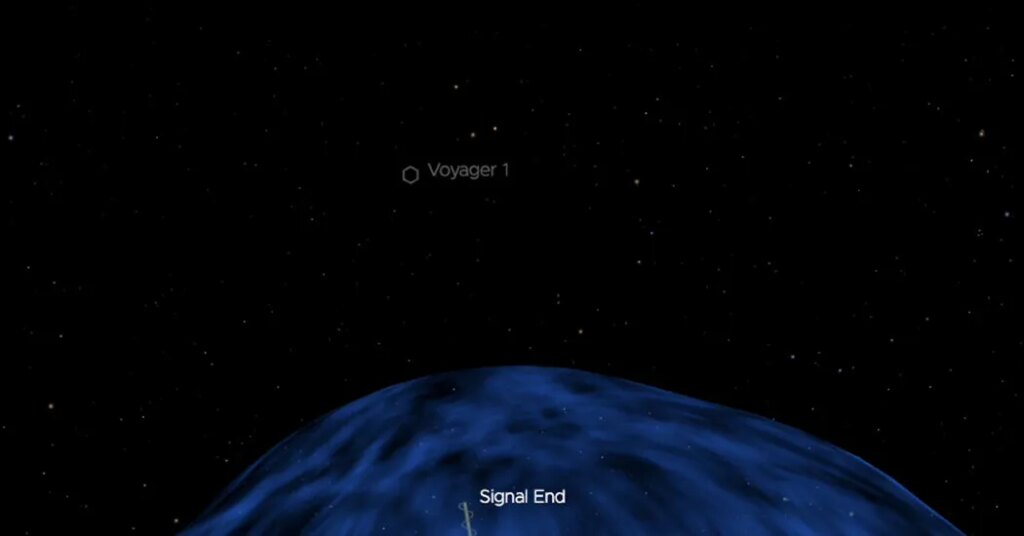
After nearly half a century in flight, NASA’s Voyager 1 spacecraft has crossed an invisible threshold — a boundary measured by time rather than distance. Today, our farthest-flung creation is one light-day from Earth, beaming messages home across an expanse that takes photons a full 24 hours to traverse.
“It is truly a staggering feeling, to know that Voyager 1 is one light-day from Earth,” said Nicky Fox, NASA’s associate administrator for the science mission directorate. “That makes us pause and think about just how vast our universe is.”
In a sense, today’s boundary crossing represents a change toward a more interstellar mind-set, said Jordan Bimm, a space historian at the University of Chicago. “It’s a rhetorical shift we are making to signal our hope and ambition for future space missions that go faster and further,” Dr. Bimm said.
It’s also a reminder of the lonely undercurrents of exploration. Launched in the summer of 1977, Voyager 1 and its twin, Voyager 2 set off on a journey to surveil the outer solar system’s giant planets. They ended up becoming humankind’s most enduring pair of spacecraft, and now, 49 years later, both of them are relaying information about their travels through interstellar space.
Neither spacecraft was ever meant to come home, and the farther they go, the harder it gets for them to trade messages with their builders.
The radio transmissions we use to communicate with spacecraft travel at light-speed — about 186,000 miles per second. That’s fast, but space is big, and there’s no way to get around light’s limit. Each conversation we have with our space-faring explorers is laggy, and the delays grow with distance.
Depending on the relative positions of the planets, messages to Mars can take as few as three minutes or as long as 22 minutes to arrive. That’s why it’s impossible for people on Earth to drive a Mars rover in real time; engineers instead send packages of preprogrammed commands. It can take nearly an hour for transmissions to reach NASA’s Juno spacecraft, which orbits Jupiter.
And Voyager 1? At its light-day distance, even a simple check-in takes 48 hours.
“You wake up on a Monday morning and say hello to the spacecraft, and on Wednesday morning it says hello to you,” said Suzanne Dodd, the Voyager mission project manager at NASA’s Jet Propulsion Laboratory in California.
The Voyagers’ dispatches from the cosmos are a big part of the reason they are so beloved and celebrated today. As they looped through the solar system on a sort of 20th-century odyssey, they revealed a lively array of worlds big and small.
Some of them seemed almost too fantastic to be true — like Jupiter’s icy moon Europa, which improbably appeared to harbor a vast, alien ocean. And Io, tucked in next to the giant planet, turned out to be so intensely volcanic that some scientists initially suspected well-organized mischief.
“My first thought was, No, the Caltech students have pulled a prank and they’ve gotten into the feed,” recalled Alan Cummings, at senior research scientist at the California Institute of Technology in Pasadena, Calif. “It just didn’t look real. It looked like a poorly rendered pizza.”
After coloring in our solar neighborhood, the Voyagers set their sights on the uncharted waters of interstellar space. Their new goal: to emerge from the heliosphere, a protective cocoon created by the sun’s magnetic field and solar wind, and explore the galactic wilds.
In the 1970s, no one knew exactly where the bubble’s edge lay, or how long it might take to reach. Turns out, it would take 36 years of hurtling through space at some 38,000 miles per hour before the Voyager 1 team reported a telltale shift in cosmic radiation that signaled its passage beyond the solar bubble. Voyager 2 crossed over in 2018.
“When we crossed that border, we were all humbled by the experience,” said Stamatios Krimigis, a space scientist at the Johns Hopkins University Applied Physics Laboratory who is the oldest active principal investigator on the Voyager team. “We realized that we were essentially a delegation from humanity, going away from our home planet and our own solar system, and we ventured on into the unknown. I can’t get over it, all these years later.”
But while the speed of light is an immutable constant, the Voyager mission is not. Eventually, both spacecraft will run out of power and fall silent. Yet they will press on into a cosmos only they can know. And in five billion years or so, when the sun swells into a red giant and obliterates Earth as we know it, the Voyagers will still be there.
“The Voyagers were the first to do a lot of things, but they will also be one of the last pieces of evidence that humans on Earth have ever existed,” Dr. Cummings said. “That boggles my mind.”
Each spacecraft carries a Golden Record etched with the sights and sounds of planet Earth, along with instructions for how to play that record, should it ever be found. For the rest of their existence, the twin spacecraft will carry these relics of their creators, bearing our hopes and dreams into the stars.
“Voyager is humanity’s gift to the universe,” Dodd said. “Go boldly, Voyager. Godspeed.”
The post After 49 Years, Voyager 1 Is a Mind-Blowing One Light-Day From Earth appeared first on New York Times.