Gorette Mbusi stood on her doorstep and wrestled with a question. Should she let her grandson be taken to the hospital?
Health workers had come to her village, in the eastern part of the Democratic Republic of Congo, to implore her to let them take the young man to a specialized Ebola facility in the nearby town of Nizi. But she was wary. She had already lost two family members, including her daughter, who had been transported to the hospital and then died.
Now, her grandson was sick.
“I don’t know where this sickness is coming from that is killing my family,” she said. “I feel abandoned.”
Ms. Mbusi’s dilemma reflects a central challenge for health workers as they struggle to contain the fastest-growing Ebola outbreak on record — how to stop people from passing the disease to loved ones at home.
Community transmission happens when family members care for Ebola patients at home and then become ill themselves, spreading the disease and making it more difficult for medical teams to identify and isolate people who have been in contact with those infected. Tracking and tracing the contacts of Ebola patients and educating people about the virus are crucial to ending community transmission.
Health workers must first get more people to seek medical treatment in hospitals sooner and overcome deep suspicions about Ebola in villages like this one, known as Nizi 4.
There are those who doubt Ebola is real or say it’s a curse. Others think they will be imprisoned if they enter a hospital. Medical facilities also carry their own risks. If a hospital does not have ample testing or strict safety protocols, a patient with an illness that might be mistaken for Ebola, such as malaria, could end up being exposed to Ebola itself, a far more fatal disease.
For many Congolese, home and family are sanctuaries in a region tormented by decades of insurgent violence and broken government institutions.
While Ms. Mbusi’s grandson, Dieumerci Koli, 17, languished on a mattress, she held her ground. Throughout her ordeal, she referred to her grandchildren as her children. Fearing another loss, she refused to take Dieumerci to the hospital.
The deadlock was broken only when the village’s acting chief, Dieudonne Musingu, entered the home and appealed to her to listen to the Congolese health workers.
When she relented, the young man stumbled into the light, blood dripping from his mouth and nose. I watched, along with some neighbors, as he staggered to a waiting ambulance. We kept our distance. Halfway up the hill, he sat down on a patch of bare earth and looked up at the nearby trees. It was close to his house but he appeared disoriented.
Because Congo’s Ebola response struggles with limited resources, the ambulance sent to transport Dieumerci was an aging four-wheel drive staffed by a Congolese man who wore little protective gear.
“Of course I’m afraid,” said the ambulance driver, wearing only a mask and one glove to protect himself from infection.
Ms. Mbusi, 62, climbed aboard with her grandson and his 5-year-old brother, Fabrice Koli. The young man spent the ride clinging to his grandmother, she said.
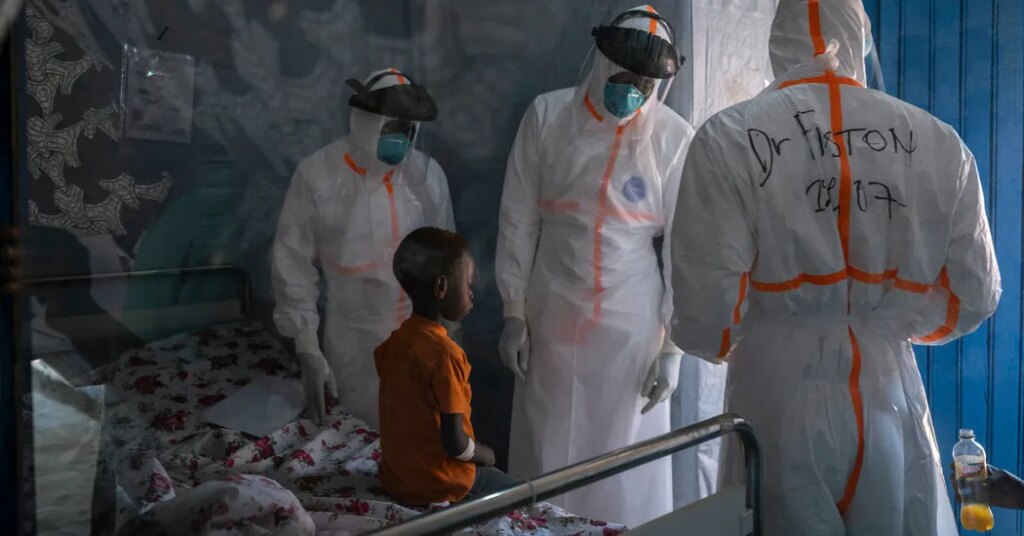
When the family arrived at the Ebola clinic, the staff said there were no beds available in the isolation unit. Ms. Mbusi and her two grandsons were forced to wait in the hot sun for an hour.
Dieumerci was eventually given a bed in an isolation room, where nurses gave him an IV. He was barely conscious, but within 30 minutes he sat up and could say his name.
Dr. Patient Wenga, the clinic’s lead doctor, said the young man had a chance to recover, even though he had been brought to the hospital so late.
But Dieumerci died that night.
As of November, more than 5,300 people have died in this Ebola outbreak. More than 11,000 people have been infected, according to the Africa Centers for Disease Control and Prevention.
Even when families seek help in hospitals, they do not always survive. The death rate for Bundibugyo, the virus responsible for this Ebola outbreak, is nearly 50 percent. Scientists have yet to find a cure, and by the time many patients see a doctor in a hospital, they are often near death.
The Africa C.D.C. reported on Thursday that 64 percent of Ebola deaths in the last week of October took place outside a hospital.
Dr. Wenga said critically ill Ebola patients that arrived to his hospital often died overnight, when staffing was thin. Dieumerci died just before dawn, the doctor said.
That morning, Ms. Mbusi wept as health workers zipped her grandson into a body bag. Friends later said he was a quiet young man who, like most people in the village, worked at a small-scale gold mine on a nearby hillside.
“We worked together, drank beer together, smoked together and went to church together,” said David Dhalonga Boju, a fellow miner.
Two days later, Dieumerci was buried by Congolese health workers, who carried his body in a simple coffin down the hillside and placed it in a fresh grave next to his aunt and sister, who also died from the disease. His friends sang mourning songs in Swahili.
Ms. Mbusi was not able to attend the funeral. She and Fabrice had come down with headaches and fever, early signs of the virus. Fabrice later tested positive.
Amid the heartbreak, health workers said that they had made progress in the village. When the outreach team first arrived in September, residents shut their doors. Several villagers had shown Ebola symptoms, but refused to accept outside medical help, said Mr. Musingu, the acting chief.
Half of those who died of Ebola in Nizi in September died at home, according to the Africa C.D.C.
Yet, since then, a shift has happened. The day after Dieumerci’s funeral, Congolese workers held a public meeting on the main street of the village. The mayor and church leaders came to speak, along with a local woman named Micheline Mbidha, 41.
Ms. Mbidha had been treated for Ebola at the hospital in Nizi. She said that when she first showed symptoms in July, she immediately sent her six children out of the home and took herself to the hospital. None of her children were infected with Ebola, she said at the meeting.
She added that she had warned her neighbor, Ms. Mbusi, not to treat family members at home. “People in the village have a serious problem accepting that Ebola is real,” Ms. Mbidha said.
After the meeting, Dr. Leon Malengala, who leads the World Health Organization’s outreach team in Nizi, said villagers had started reporting to health workers when they felt sick.
“At the beginning, there was strong resistance to our operation in the village, but now that’s starting to change,” he said.
At the Ebola clinic, Ms. Mbusi endured another harrowing week. A close female relative was brought in and placed in a room two doors down from where she and Fabrice were isolated. The relative died two days later.
Ms. Mbusi’s health, however, remained stable, and she did not require intensive care. Fabrice was given an IV for rehydration and was closely monitored by medical staff.
Each day in isolation, Ms. Mbusi and her grandson would sit in the sun on plastic chairs outside their room and talk to other patients who were isolated in the ward with Ebola symptoms.
After a week in the hospital, Dr. Wenga said that both Ms. Mbusi and Fabrice had received negative Ebola tests. A second test would be performed soon, he said. If that, too, was negative, he would be able to give his patients some good news: They could go home.
The post Why Ebola Patients Avoid Hospitals, Spreading the Disease at Home appeared first on New York Times.