This story appeared in Today, Explained, a daily newsletter that helps you understand the most compelling news and stories of the day. Subscribe here.
Shortly after 5 am ET tomorrow morning, while much of the East Coast is still in bed, Voyager 1 will cross a threshold that’s kind of hard to comprehend.
The 49-year-old spacecraft will reach a point about 16 billion miles from Earth — the distance that light travels in 24 hours.
Scientists call that unit a light-day. And while it’s not a particularly meaningful scientific measurement, it’s a pretty good opportunity to marvel at how far Voyager has voyaged.
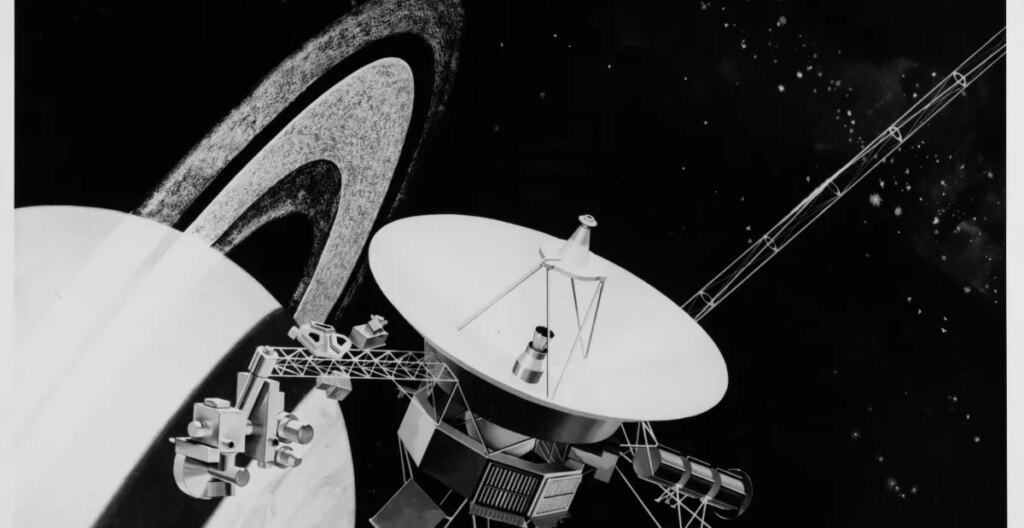
The craft first set out in 1977 to explore our solar system’s outer planets, including Jupiter and Saturn. It flew past both planets, snapping photos of their surfaces and making several big discoveries, before reaching interstellar space in 2012.
Today, both Voyager and its sister, Voyager 2, remain part of an active NASA mission measuring the gases and magnetic field outside the Sun’s protective magnetic bubble. Both spacecraft also famously carry identical copies of the so-called Golden Record, which contains images and recordings meant to introduce humanity to passing aliens. That means Voyager isn’t just interesting as a live experiment or a souvenir of America’s 1970s space ambitions — but as an attempted self-portrait of human civilization.
Go a little deeper
Voyager will surely lose touch with Earth long before it makes contact with aliens, though. The mission only has a few years left: Its nuclear generators are gradually producing less electricity, which means Voyager is expected to lose the power to fuel its transmitter by 2030.
But the spacecraft will keep coasting on its momentum, potentially surviving for billions of years with very little around it to wear it down. Which is why, as NASA readied the Voyager missions, it tapped the astronomer Carl Sagan to curate a message for spacefaring aliens.
Sagan and his team spent six weeks on the project, which was stored on a gold-plated copper phonograph LP. (In case you’re wondering how aliens will actually play the record, the team provided hieroglyphic instructions that explain where to place the needle and how fast to spin it.)
Sagan’s team decided to leave out images that depicted war, poverty, disease, crime, and religion. The record also reportedly excluded the Beatles’ song “Here Comes the Sun” over a rights-holding dispute, and a photograph of a naked man and pregnant woman because the suits at NASA objected to full-frontal nudes.
But even with those omissions, the team managed to compile an extraordinary collection of images that convey scientific concepts like continental drift and the structure of DNA; depict human anatomy, industry, daily life, and culture; and illustrate the diversity of Earth’s landscapes and animals.
The record also includes letters from former President Jimmy Carter and UN Secretary General Kurt Waldheim, a compilation of sounds from Earth, spoken greetings in more than 50 languages, and 90 minutes of music from around the world.
Readers of Liu Cixin’s The Three-Body Problem might distrust this approach. (In it, aliens plan to invade Earth after getting a message from a disgruntled scientist who reveals where the Earth is.)
But don’t lose sleep over that possibility. We’ll be long dead before such an invasion could take place: Even the nearest potentially habitable planet is more than four light-years from Earth. And Voyager, as you know, has only traveled one light-day.
One link for later
➨ Try a “bird sit.” It’s basically a nature hike for indoor cats: Find a nice spot outdoors, get comfy, and work on observing the birds that fly past. It’s a great way to appreciate (and get the health and wellness benefits of appreciating) nature without getting your hands dirty. If birds aren’t doing it for you, try plants or insects.
Before you go…
- Did you know…that TV kind of does “rot” your brain? (Sorry, and also: Mom, you were right!) Research has found that heavy TV viewers had less gray matter in midlife.
- Today’s trivia: Which renowned 13th-century explorer dictated his biography to a prison cellmate? (You can find this and other brain puzzles in Vox’s daily crossword. Look for the answer in tomorrow’s edition.)
- Yesterday’s trivia: Yesterday we asked you for the European capital that has 343 lakes within its limits. That would be Oslo, which also boasts the highest tree coverage of any capital in Europe.
The post Voyager 1 is about to reach a mind-bending milestone appeared first on Vox.