“Are you going to tell the truth?”
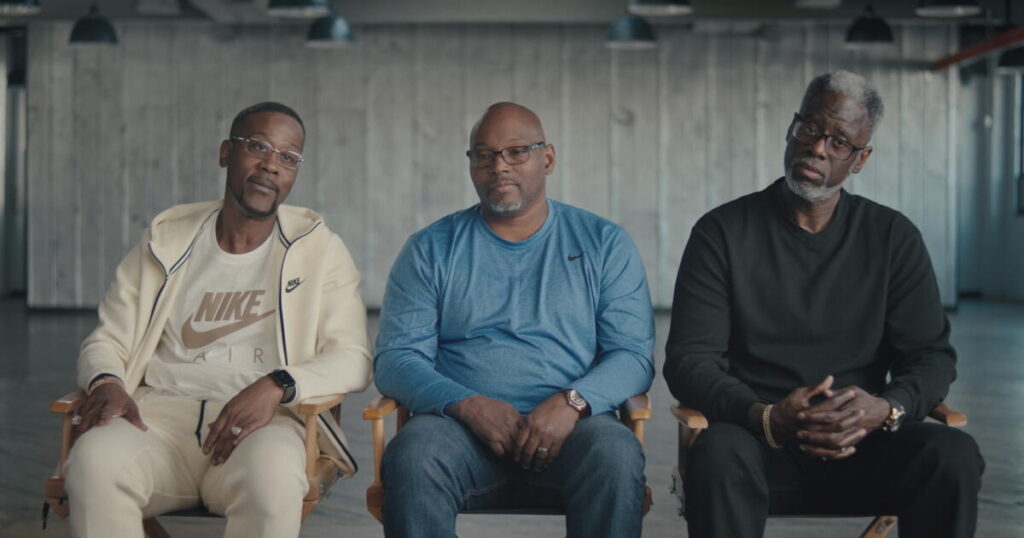
Director Dawn Porter and executive producer Ta-Nehisi Coates were hoping to adapt a 2021 New Yorker article, “When a Witness Recants,” about one of the worst wrongful convictions in American history. The article centered the witness who had lied on the stand and lived with guilt, but Porter’s anguish and anger-inducing HBO documentary of the same name premiering Tuesday shifts the spotlight to the three Baltimore men who lost 36 years of freedom to a justice system that utterly failed them.
At a preliminary meeting, those men — Alfred Chestnut, Andrew Stewart and Ransom Watkins — who had suffered so much because of lies upon lies had just one question for the filmmakers: “Are you going tell the truth?”
“I still get a chill, feeling the weight of that question,” said Porter.
Watkins said that upon regaining their freedom, the trio, who were known as the Harlem Park Three, were barraged with interview requests, but he told the other two, “First we need to take some time and get some therapy because we’re going through a lot and we don’t want to rush in.”
By the time they met with Porter and Coates, they were ready to tell their story in full as long as it would be done honestly. Watkins said that most of the people on the production team were women. “They had a different approach,” he said, noting that after being imprisoned for much of their adult lives, the three men were still, to some extent, teenagers emotionally. “They understood what they were dealing with, and they approached us with motherly love. While we were filming, if they saw we were getting emotional, Dawn would say ‘cut’ and tell us to take a break.”
Porter, who previously worked as a lawyer and whose filmmaking career features several documentaries about justice and the law, including “Gideon’s Army” and “The Sing Sing Chronicles,” wanted to make sure the men felt safe, but she also wanted to deliver a message to audiences.
“As Americans, we have a somewhat romantic idea that there are so many safeguards that this kind of wrongful conviction is exceedingly rare, and I think we need to stop being romantic about that,” Porter said. “One reason I make these movies is to say we can choose to do better.”
Porter said her legal background helps her to stay focused on the narrative essentials. “The real issue in this story is that you can see so many of the places where the criminal legal structure failed: from the police to the prosecutor who shouldn’t have indicted and shouldn’t have suppressed evidence,” she said. “The judge shouldn’t have allowed some of the evidence or over-sentenced all of them. Their appeal shouldn’t have been denied.”
It all started in 1983 as Ron Bishop and Eddie Capers were walking to lunch at their junior high school with their friend DeWitt Duckett, when someone suddenly appeared, robbing Duckett and then shooting him as Bishop and Capers fled. The community was shocked by a murder inside a public school and police were eager to quickly solve the case.
The two witnesses said the killer acted alone, but Baltimore Det. Donald Kincaid, who was at best lazy and incompetent, relied on the testimony of someone who could not have seen the shooting and decided that the crime was committed by three older teens who had visited the school that day. Using threats of arrest, Kincaid coerced Bishop and Capers to change their story, leading to the arrest of Chestnut, Stewart and Watkins. (The police inexplicably ignored testimony and evidence about the likely killer, Michael Willis.)
Prosecutorial misconduct and dubious decisions by the judge led to the boys being convicted and, despite their juvenile status, sentenced and imprisoned as adults. Watkins, Chestnut and Stewart languished in prison for decades until digging by Chestnut, his high school sweetheart and a lawyer led to the unsealing of suppressed evidence that could reverse their convictions. Chestnut wrote to Baltimore State Attorney Marilyn Mosby and her staff reopened the investigation. Eventually, Bishop and the other witnesses confessed that they had lied under pressure from Kincaid. Soon after, the three men were set free.
Coates, who was a boy in West Baltimore in 1983, appears on camera discussing the impact of the murder on the community. “Folks were completely outraged,” he recalled in an interview, adding, “this crime has been with me all my life.”
So when the three men were finally exonerated, overturning the community’s understanding of its own history was tough to absorb. “The police just did not take the crime seriously, which undermines our basic trust in the state,” he said. “It was horrifying enough that a boy had been killed in school, but the police’s level of disregard for the truth completely compounded everything.”
At that initial meeting with the three men, Coates apologized. “I was just a kid but I knew they had to carry the rage of the community they called home, and I felt it was important that someone who grew up there express some contrition about how they were treated.”
In Jennifer Gonnerman’s New Yorker article, she brought an emailed message from Bishop to the men. It read in part, “I’m sorry for all the pain I’ve caused them and their families,” and “One day I hope to sit down with you guys, apologize in person.”
Spoiler alert: Near the end of the documentary, that meeting actually happens. (Capers, whose life spiraled after being pressured into lying on the stand, is currently in prison.) “I suspect one reason Ron Bishop participated in the movie was because he wanted to meet with them,” Porter said. Still, she was reluctant to bring the men together, uncertain of what it would yield and what it might do to Chestnut, Stewart and Watkins emotionally.
After interviewing Bishop, she realized he’d “constructed” his own version of history: “He was the victim because he was forced to lie, but he is the hero, because he eventually does come forward — ‘This was so bad for me. And then I finally did come through.’”
So she kept asking the men if they were sure. But this time the men insisted they didn’t need to be coddled, and she realized she shouldn’t be paternalistic with such an important matter. “We were adamant,” Watkins said. “We wanted to be face-to-face with him. We’ve been waiting our lives to talk to the people who did this to us.”
Although the three men understood why Bishop and the others had lied out of fear as teenagers, they say in the film there was no excuse for him not coming forward 20 or 25 years later. “He could have walked in and apologized and it would have been very different,” Watkins said.
But he did not. Bishop talked about himself. And talked about himself some more. And some more still, a painful stream of self-justification that completely missed the moment. Porter was getting desperate to stop it when the three men, who had listened with growing anger but improbable patience, said they needed a break. Watkins said that calm came both from therapy and from prison, “‘which teaches you how to deal with situations where you need to stay level or things will get out of control.”
While they were gone, Porter broke her own rules of engagement and reminded Bishop that he was there to apologize. But when the men returned, they said it was their turn to speak. It is a mesmerizing and powerful scene; they are eloquent and passionate but restrained in explaining why they are angry with what he has done and said. And then they walk out.
The director, thinking that perhaps Bishop was too nervous that day, later gave him another chance to apologize via the camera. “He said he completed his ‘mission’ and he’s at peace,” Porter said. “I realized, there’s nothing else I can say or do.” (She added that Bishop told her he liked the film.)
That last section of the film is the most emotional of this heart-wrenching documentary, but Coates and Porter hope it doesn’t obscure the larger message. “This is part of a long campaign to democratize American policing, which does not serve the communities that need and want protection because they, the police, do not take human life seriously,” Coates said.
Porter hopes the film provokes a visceral reaction from viewers. “First you get mad and then you want to do something to change things,” she said. “What each person wants to do may be different, but it’s really important we have that first stage to motivate people to be part of making the change.”
The post In ‘When a Witness Recants,’ exonerees confront a witness who gave false testimony appeared first on Los Angeles Times.